
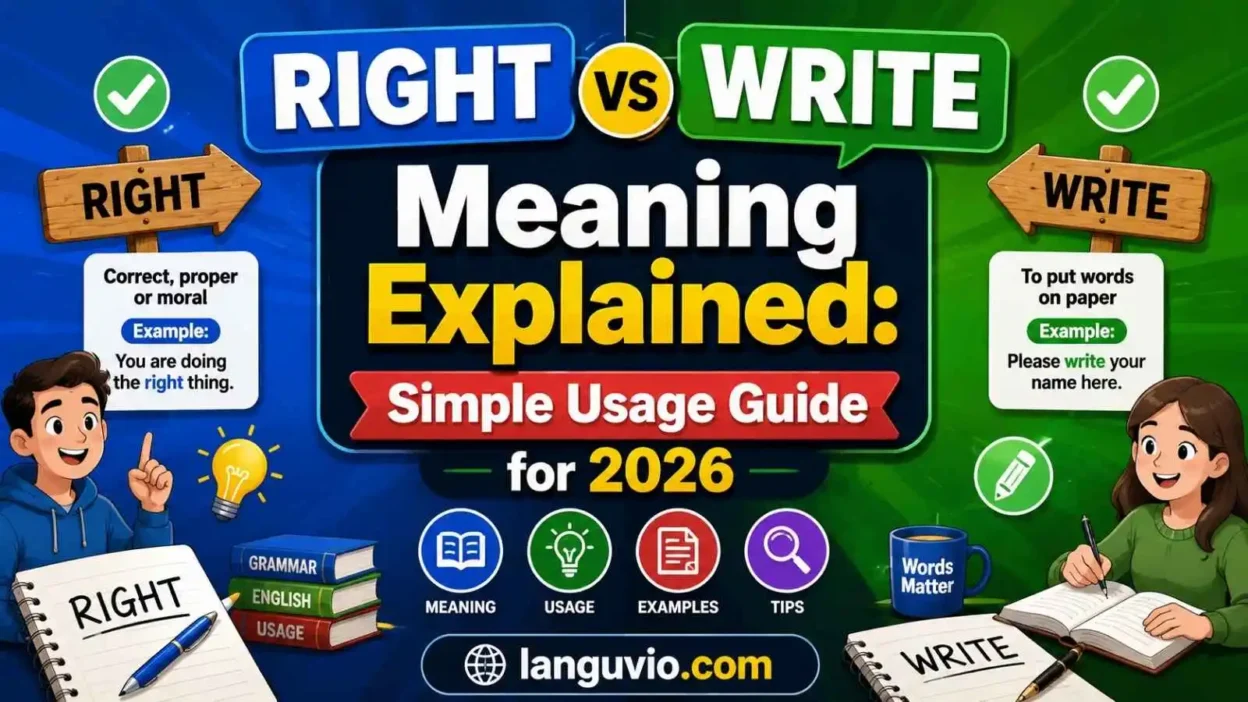
“right vs write” is a classic English confusion because both words sound the same but mean very different things. One relates to correctness, direction, or entitlement, while the other is about putting words on paper or screen.
This mix-up happens often in texting, school writing, and even professional emails. The problem is not pronunciation—it is meaning. Once you see how each word works in real sentences, the confusion becomes easy to fix.
Quick Answer
“Right” means correct, a direction, or something morally or legally allowed. “Write” means to create text using letters, words, or symbols.
If you are talking about accuracy, direction, or fairness, use right. If you are talking about writing words, use write.
Why People Confuse Them
These words are homophones, meaning they sound exactly the same in speech. That makes them easy to mix up when typing quickly or learning English.
Another reason is that both words appear in common everyday situations. You might “turn right” in traffic and also “write a note” in the same day, which keeps both meanings active in your mind at once.
Key Differences At A Glance
| Feature | Right | Write |
| Core idea | Correctness, direction, or entitlement | Producing written text |
| Main use | Describing truth, direction, or permission | Describing writing activity |
| Part of speech | Adjective, noun, adverb, verb | Verb |
Meaning and Usage Difference
“Right” has several meanings depending on context. It can describe something correct (“you are right”), a direction (“turn right”), or a legal or moral claim (“human rights”).
“Write” is more focused. It always refers to creating written language, whether by hand, typing, or texting. You write emails, write essays, or write messages.
The key difference is scope: right is broad and contextual, while write is specific and action-based.
Tone, Context, and Formality
“Right” is flexible and used in both formal and informal speech. It appears in conversation, law, directions, and general agreement.
“Write” is neutral and task-focused. It fits school, work, and casual communication without changing tone.
Neither word is more “formal,” but their roles in sentences are completely different.
Which One Should You Use?
| Context | Best Choice | Why |
| Giving directions | Right | Refers to direction |
| Checking correctness | Right | Means correct or accurate |
| Talking about letters or text | Write | Means producing written language |
| School or work assignment | Write | Involves writing tasks |
| Legal or moral claims | Right | Refers to entitlement or fairness |
When One Choice Sounds Wrong
If you try to replace “write” with “right” in a sentence about text, it will not make sense. For example, “I will right a letter” sounds incorrect in modern usage because it confuses correctness with writing.
On the other hand, using “write” in place of “right” also breaks meaning. “Turn write at the corner” is not understandable because direction is being described, not writing.
Common Mistakes (and Quick Fixes)
A common mistake is typing “right an email” instead of “write an email.” The fix is simple: if you are creating text, always choose write.
Another mistake is confusing “you are write” instead of “you are right.” If you mean agreement or correctness, use right.
Quick check:
- If you can replace the word with “correct,” use right
- If you can replace it with “compose,” use write
Everyday Examples
- You are right about the meeting time.
- Turn right at the next traffic light.
- She has the right to speak freely.
- I will write a short message to her.
- He writes emails every morning for work.
- That answer is right, not wrong.
Dictionary-Style Word Details
Verb
- Right: Used to correct or fix something (e.g., right a wrong)
- Write: To create text using letters or symbols
Noun
- Right: A moral, legal, or directional concept (e.g., human rights)
- Write: Not commonly used as a noun in standard English
Synonyms
- Right: correct, proper, accurate, true (closest plain alternatives)
- Write: compose, draft, type, record
Example Sentences
- Right: You are right about the answer.
- Write: Please write your name on the paper.
Word History
- Right: Comes from old forms meaning “straight” or “correct” in early English usage.
- Write: Comes from early English meaning “to mark or scratch symbols.”
Phrases Containing
- Right: turn right, you’re right, human rights, right away
- Write: write down, write up, write off, write back
FAQs
1. What is the main difference between right and write?
“Right” means correct, a direction, or a moral/legal entitlement. “Write” means to create text using letters or words.
2. Why do right and write sound the same?
They are homophones. That means they share the same pronunciation but have completely different meanings and spellings.
3. How can I remember when to use right or write?
A simple trick:
- If it involves text, letters, or typing → write
- If it involves correctness, direction, or fairness → right
4. Is “right” ever used for writing?
No. “Right” is not used to mean creating text. The correct word in that context is always “write.”
5. Can “write” ever mean correct?
No. “Write” only refers to producing written language, not correctness or direction.
6. What are common mistakes with right vs write?
People often write:
- “You are write” ❌ instead of “You are right” ✔
- “I will right an email” ❌ instead of “I will write an email” ✔
7. Are right and write interchangeable in any situation?
No. They are not interchangeable because they have completely different meanings and uses.
8. Why is this confusion so common in English?
Because both words sound identical when spoken, especially in fast conversation, so learners often rely on sound instead of meaning.
9. What part of speech are right and write?
- Right: adjective, noun, adverb, and sometimes verb
- Write: mainly a verb
10. What is a quick way to choose the correct word?
Think of context:
- If you can replace it with “correct,” use right
- If you can replace it with “compose,” use write
Conclusion
The difference between right vs write is simple once you connect each word to its meaning. “Right” is about correctness, direction, or entitlement, while “write” is about creating written language.
If you focus on context instead of sound, you will rarely confuse them again.

[…] the meaning is that she then went on to explain […]