
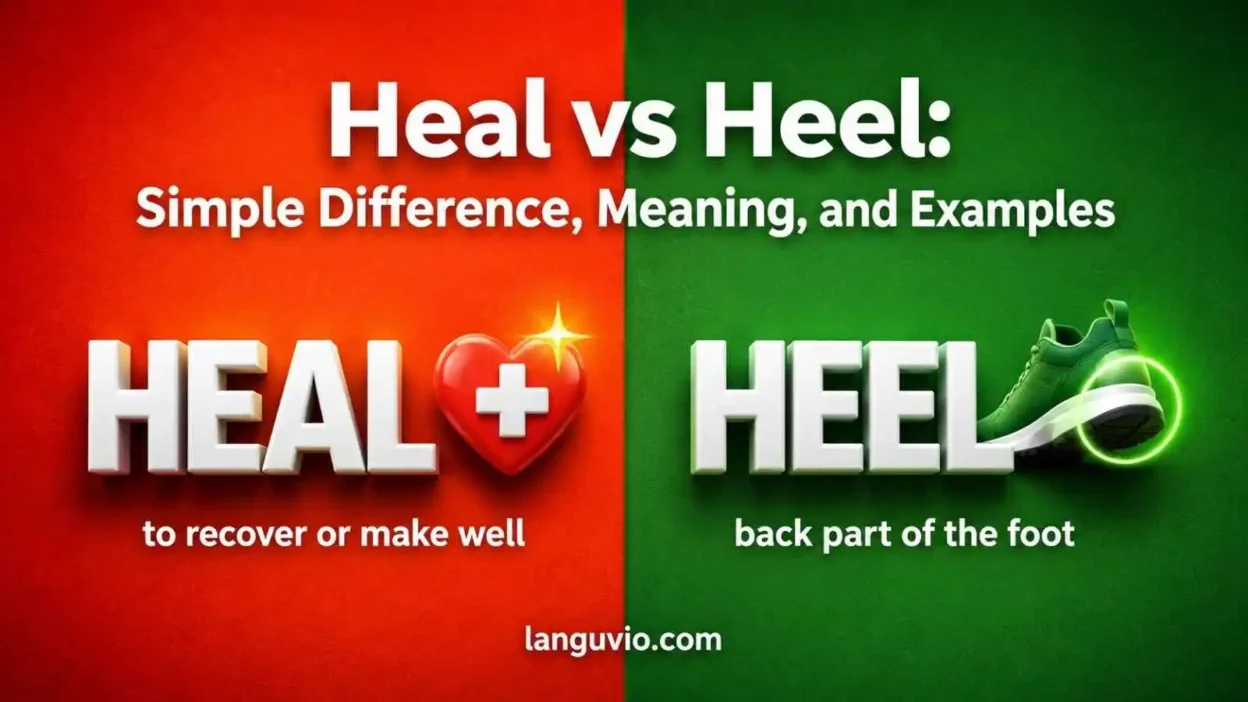
Heal vs heel is a common word-choice problem because the two words sound exactly the same. The spelling changes the meaning completely.
Use heal when you mean to recover, repair, or become healthy again. Use heel when you mean the back part of a foot, the raised back part of a shoe, or a few special verb uses such as a dog walking close beside someone.
The difference is not about formality. It is about meaning. One word belongs mostly to recovery. The other belongs mostly to feet, shoes, movement, or position.
Quick Answer
Heal means to get better or make something better after injury, illness, pain, or damage. Heel usually means the back part of the foot or the raised back part of a shoe. They are pronounced the same, so the correct choice depends on meaning, not sound.
Why People Confuse Them
People confuse heal and heel because they are homophones. That means they sound alike but have different spellings and meanings.
Both words rhyme with feel, seal, and wheel. In speech, you cannot hear the spelling difference. In writing, the difference matters.
The confusion often appears in sentences about foot injuries:
“My heel needs time to heal.”
That sentence uses both words correctly. Heel names the body part. Heal describes recovery.
Autocorrect may not always catch this mistake because both words are real English words. A sentence can be spelled correctly but still use the wrong word.
Key Differences At A Glance
Use this compact comparison to remember the difference:
- Heal = recover, cure, mend, become healthy again
- Heel = back of the foot, shoe part, dog command, or tilt to one side
- Heal is mainly a verb
- Heel is mainly a noun, but it can also be a verb in specific contexts
- Heal fits medical, emotional, and relationship recovery
- Heel fits anatomy, footwear, pet training, boats, and some fixed phrases
The shortest rule is simple: health takes heal; foot takes heel.
Meaning and Usage Difference
Heal is the word for recovery. A cut can heal. A broken bone can heal. A person can heal after surgery. Feelings, trust, and relationships can also heal when the meaning is emotional or figurative.
Examples:
“She needs time to heal after the accident.”
“The apology helped heal the friendship.”
Heel usually names the back part of the foot. It can also mean the raised back part of a shoe.
Examples:
“My heel hurts after the long walk.”
“She wore black heels to the wedding.”
Heel also has verb uses, but they are more specific. A dog can heel, meaning it walks close beside its handler. A boat can heel, meaning it leans to one side.
Tone, Context, and Formality
Both words are standard in American English. Neither one is more formal by itself.
Heal often appears in health, emotional, spiritual, and repair contexts. It can sound practical, medical, or emotional depending on the sentence.
Examples:
“The wound should heal in a week.”
“The family needed time to heal.”
Heel sounds physical when it refers to the body or shoes. It can sound instructional when used as a dog command.
Examples:
“The blister formed on my heel.”
“Ranger, heel.”
The pronunciation does not help you choose because both words sound the same: heel. The spelling must match the meaning.
Which One Should You Use?
| Context | Best Choice | Why |
| A wound, cut, burn, or injury gets better | heal | It describes recovery. |
| Someone recovers emotionally | heal | It can describe emotional recovery. |
| The back part of the foot | heel | It names a body part. |
| The raised back part of a shoe | heel | It names part of footwear. |
| A dog walks close beside a person | heel | It is a specific command or action. |
| A boat leans to one side | heel | It describes tilting in that context. |
| A weakness in a person or plan | heel | It appears in “Achilles’ heel.” |
Choose heal when the idea is getting better. Choose heel when the idea is a foot, shoe, command, tilt, or fixed phrase.
When One Choice Sounds Wrong
Some mistakes are easy to spot because the wrong word creates a strange image.
Wrong: “My heal hurts after running.”
Correct: “My heel hurts after running.”
A body part cannot be a heal in normal writing. The correct word is heel.
Wrong: “The cut should heel soon.”
Correct: “The cut should heal soon.”
A cut does not heel. It heals because it gets better.
Wrong: “The puppy learned to heal on walks.”
Correct: “The puppy learned to heel on walks.”
In dog training, heel is the correct word because it means to walk close beside the handler.
Common Mistakes (and Quick Fixes)
One common mistake is using heal for the foot.
Incorrect: “I have a blister on my heal.”
Correct: “I have a blister on my heel.”
Another mistake is using heel for recovery.
Incorrect: “Rest will help your ankle heel.”
Correct: “Rest will help your ankle heal.”
Writers also confuse phrases.
Incorrect: “That mistake was his Achilles’ heal.”
Correct: “That mistake was his Achilles’ heel.”
Incorrect: “Time heels all wounds.”
Correct: “Time heals all wounds.”
A quick fix is to replace the word with recover. If recover fits, use heal. If recover does not fit, you probably need heel.
Everyday Examples
“Heal” in everyday sentences:
“My shoulder is starting to heal.”
“She took a few days off to heal after the procedure.”
“Honest conversations can help heal old tension.”
“The doctor said the scrape should heal quickly.”
“Heel” in everyday sentences:
“These shoes rub against my heel.”
“He bought inserts for his sore heels.”
“She wore low heels because the event lasted all night.”
“The trainer told the dog to heel.”
“The sailboat began to heel when the wind picked up.”
Mixed examples:
“My heel needs time to heal.”
“The blister on his heel healed faster than expected.”
“She switched shoes so her heel could heal.”
These mixed sentences show why the spelling matters. One word names the place. The other word describes the recovery.
Dictionary-Style Word Details
Verb
Heal: Commonly used as a verb. It means to become well again or to make someone or something well again.
Example: “The wound will heal with proper care.”
Heel: Used as a verb in specific meanings. It can mean to follow closely, especially in dog training, or to lean to one side, especially for a boat. It can also mean to put a heel on a shoe.
Example: “The dog heeled beside her.”
Example: “The boat heeled in the wind.”
Noun
Heal: Not commonly used as a noun in standard everyday American English. In normal writing, use healing, cure, or recovery instead, depending on the sentence.
Heel: Commonly used as a noun. It can mean the back part of the foot, the raised back part of a shoe, or a person viewed as badly behaved.
Example: “My heel is sore.”
Example: “Those heels match the dress.”
Synonyms
Heal: Closest plain alternatives include recover, mend, cure, repair, and restore. Use the one that fits the sentence. A person recovers, a wound heals, and a relationship may mend.
Heel: For the foot meaning, there is no strong everyday synonym. You can say back of the foot for clarity. For the shoe meaning, you can say shoe heel. For the boat meaning, closest alternatives include tilt or lean.
Clear opposites depend on context. For heal, possible opposites include worsen, injure, or damage. For heel as a body part, there is no true opposite.
Example Sentences
Heal:
“The burn should heal if you keep it clean.”
“He needed time to heal after losing his job.”
“The new policy helped heal tension between the teams.”
“Sleep can help the body heal.”
Heel:
“She had a pebble stuck under her heel.”
“The heel of his boot was worn down.”
“The dog learned to heel during training class.”
“The boat began to heel toward the left.”
Word History
Heal: The word has old roots connected with making whole, sound, or healthy. That history fits its modern use for recovery and repair.
Heel: The foot meaning also goes back to old English roots for the back part of the foot. The boat-tilt meaning has a separate history connected with leaning to one side.
For a practical word-choice guide, the important point is the current meaning: heal is about recovery, while heel is mostly about the foot, footwear, or a few special actions.
Phrases Containing
Heal:
- heal a wound
- heal from surgery
- heal emotionally
- heal a relationship
- time heals all wounds
Heel:
- high heels
- Achilles’ heel
- head over heels
- bring to heel
- at someone’s heels
- down at heel
- to heel
Do not switch the spellings in fixed phrases. Write Achilles’ heel, not Achilles’ heal. Write time heals all wounds, not time heels all wounds.
FAQs
What Is The Difference Between Heal And Heel?
Heal means to recover, repair, or become healthy again. It is used for wounds, injuries, illness, emotions, trust, and relationships. Heel usually means the back part of the foot or the raised back part of a shoe. For example, “My heel hurts” uses heel, but “My cut will heal” uses heal.
Which Is Correct: Heal Or Heel?
Both words are correct, but they are used in different situations. Use heal when something gets better. Use heel when you are talking about a foot, shoe, dog command, or certain fixed phrases. The correct word depends on the meaning of the sentence.
Are Heal And Heel Pronounced The Same?
Yes. Heal and heel are pronounced the same in standard American English. They rhyme with feel, meal, and wheel. Because they sound alike, the mistake usually happens in writing, not speaking.
Is It “My Heal Hurts” Or “My Heel Hurts”?
The correct sentence is “My heel hurts.” In this sentence, you are talking about the back part of your foot, so heel is the right word. Heal would be wrong because it means to recover or become well again.
What Does Heel Mean As A Verb?
As a verb, heel can mean that a dog walks close beside its owner or trainer. For example, “The dog learned to heel.” It can also describe a boat leaning to one side, as in “The boat heeled in the wind.”
How Can I Remember Heal Vs Heel?
Use this simple trick: heal is about health, and heel is part of the foot.
Conclusion
The difference between heal and heel is clear once you connect each word to its meaning.
Use heal for recovery, repair, and becoming well again. Use heel for the back of the foot, the raised part of a shoe, dog-training commands, boat tilting, and fixed phrases such as Achilles’ heel. A simple memory trick can help: heal has health in its meaning, while heel belongs to the foot.
Heal means to recover, repair, or become healthy again. It is used for wounds, injuries, illness, emotions, trust, and relationships. Heel usually means the back part of the foot or the raised back part of a shoe. For example, “My heel hurts” uses heel, but “My cut will heal” uses heal.
Both words are correct, but they are used in different situations. Use heal when something gets better. Use heel when you are talking about a foot, shoe, dog command, or certain fixed phrases. The correct word depends on the meaning of the sentence.
Yes. Heal and heel are pronounced the same in standard American English. They rhyme with feel, meal, and wheel. Because they sound alike, the mistake usually happens in writing, not speaking.
The correct sentence is “My heel hurts.” In this sentence, you are talking about the back part of your foot, so heel is the right word. Heal would be wrong because it means to recover or become well again.
As a verb, heel can mean that a dog walks close beside its owner or trainer. For example, “The dog learned to heel.” It can also describe a boat leaning to one side, as in “The boat heeled in the wind.”
Use this simple trick: heal is about health, and heel is part of the foot.