
Married and marry are both correct, but they serve different grammatical purposes. Marry is the base form of the verb. Married works as the past-tense form, the past participle, or an adjective that describes someone’s relationship status.
The sentence around the word determines the correct choice. You can say, “I want to marry Jordan,” “I married Jordan last year,” or “Jordan and I remain married.” Switching the forms can change the meaning or make the sentence incorrect.
This guide explains how each word works and shows which one fits common questions, plans, and everyday conversations.
Quick Answer
Use marry when a sentence needs the base verb:
- “They plan to marry.”
- “Will you marry me?”
- “She may marry Alex.”
Choose married for a completed past action, a perfect construction, or relationship status:
- “They married in June.”
- “She has married her longtime partner.”
- “The couple remains happily married.”
In simple terms, marry names the action in its base form. Married refers to a completed form of that action or describes someone who has a spouse.
Why People Confuse Them
Both words belong to the same verb family and relate to marriage. That shared meaning makes them look interchangeable, even though their grammar differs.
Another source of confusion comes from the many jobs married can perform. “They married last spring” uses it as a past-tense verb. The sentence “They have married” uses it as a past participle. Meanwhile, “They remain married” describes their relationship status.
Marry has a narrower role. Writers use it as the base verb after words such as to, will, can, may, should, did, and does.
Key Differences At A Glance
- Marry: Base verb for plans, possibilities, commands, and questions with did.
- Married: Past-tense form, past participle, or adjective.
- Direct-object pattern: Say “marry someone.”
- Relationship pattern: Say “married to someone.”
- Common event phrase: Say “get married,” not “get marry.”
Meaning and Usage Difference
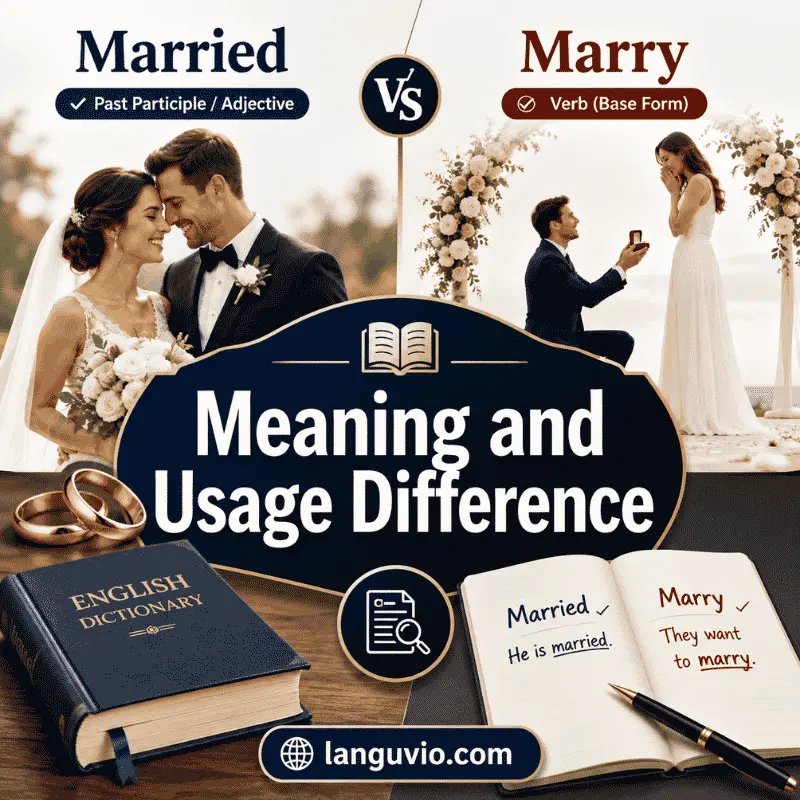
Marry means to enter a marriage with someone. It can also mean to conduct a marriage ceremony or combine two things closely.
When the verb names the other person directly, it takes a direct object:
“She wants to marry Chris.”
“The actor married his longtime partner.”
Sometimes the sentence leaves out the person because the context already makes the meaning clear:
“They decided to marry in the fall.”
“Many people marry later in life.”
Married shows a completed past action:
“They married after college.”
It also follows have, has, or had:
“She has married her longtime partner.”
As an adjective, married describes someone who has a spouse:
“My sister remains married.”
“He describes himself as happily married.”
The word does not reveal when the wedding occurred unless the sentence includes a time reference.
In everyday English, speakers often use get married instead of marry when they do not directly name the person they are marrying.
Tone, Context, and Formality
Both forms sound standard and neutral in American English. Grammar, rather than politeness or formality, controls the choice.
Marry often puts attention on an action, decision, or ceremony:
“The couple will marry next May.”
“Would you marry someone with different goals?”
In everyday conversation, speakers often prefer get married when they do not name the other person:
“We plan to get married next May.”
Married works naturally when the sentence focuses on status, duration, or a completed event:
“Do you have a spouse?”
“They have remained married for ten years.”
“She married her college classmate in 2022.”
Neither choice sounds more respectful by itself. Select the form that fits the sentence pattern and intended meaning.
Which One Should You Use?
| Context | Best Choice | Why |
| After to | marry | An infinitive requires the base verb: “to marry.” |
| After will, can, may, or should | marry | Modal verbs take the base form. |
| After did or did not | marry | Did already marks past time. |
| For a completed past action | married | Married is the simple past form. |
| After have, has, or had | married | These helping verbs require a past participle. |
| For relationship status | married | Married can describe someone who has a spouse. |
| After get in the common expression | married | The correct phrase is “get married.” |
| Before a person as the direct object | marry | Say “marry someone.” |
Use marry in “I hope to marry Sam.” Choose married in “I married Sam,” “I have married Sam,” and “Sam and I remain married.”
When One Choice Sounds Wrong

One form sounds wrong when the surrounding words require another verb form.
- “I want to married her” should become “I want to marry her.”
- Change “Did they married last year?” to “Did they marry last year?”
- Replace “I am marry” with “I am married.”
- Write “She married Ben,” not “She married to Ben.”
- Use “She remains married to Ben” when describing the relationship.
- Correct “We are getting marry in December” to “We plan to get married in December.”
The helping word often reveals the answer. To, will, can, may, should, did, and does usually require marry. Have, has, had, and get commonly require married in the patterns covered here.
Common Mistakes (and Quick Fixes)
Using married after did
Did already carries the past tense, so the main verb returns to its base form.
“Who did she married?” → “Who did she marry?”
Adding to after the active verb marry
Marry takes the person directly as its object.
“He married to Rosa.” → “He married Rosa.”
Leaving out to in the relationship pattern
Use to when married describes a person’s relationship to a spouse.
“He is married Rosa.” → “He remains married to Rosa.”
Using marry after get
The standard expression uses married.
“They will get marry soon.” → “They will get married soon.”
Using the simple present to describe status
“I marry Taylor” does not normally mean that Taylor is your spouse.
Better: “Taylor and I remain married.”
Everyday Examples
Talking about a future plan
A: “Are you two planning a wedding?”
B: “Yes, we hope to marry next summer.”
Naming the person
“Lena wants to marry someone who shares her values.”
Describing a past event
“My parents married in a small courthouse ceremony.”
Describing current status
“Our new manager has a spouse.”
Asking about a spouse
“Who did Maya marry?”
Relationship pattern
“Maya remains married to Noah.”
Modal verb example
“They may marry after graduate school.”
Present perfect example
“By the final chapter, the two characters have married.”
These examples show why sentence structure matters more than the general topic. Although the terms share a meaning, they do not fit the same grammatical positions.
Dictionary-Style Word Details
Verb
Married: The simple past and past participle of marry. It describes a completed action in “They married quietly” and follows helping verbs in “She has married her longtime partner.”
Marry: A base-form verb meaning to enter marriage with someone, conduct a marriage ceremony, arrange a marriage in certain contexts, or unite things closely. Example: “The judge will marry the couple.”
Noun
Married: Speakers sometimes use married as a noun for a married person, usually in plural expressions such as “young marrieds.” This use appears less often than the adjective.
Marry: Standard American English does not commonly use marry as a noun.
Synonyms
Married: Closest plain alternatives include wedded and joined in marriage. Unmarried serves as a clear opposite when married describes relationship status.
Marry: Close alternatives include wed and take as a spouse. Get married often expresses the same event when the sentence does not name a direct object. No single opposite fits every meaning.
Example Sentences
Married: “Nora married her best friend in April.” “Nora remains married to Elise.” “They have married after years together.”
Marry: “Nora plans to marry Elise.” “Will you marry me?” “The officiant can marry them on Saturday.”
Word History
Married: This form comes from marry. English spelling changes the final y to i before adding -ed.
Marry: English received the verb through French from a Latin source connected with marriage. Both compared forms belong to the same word family.
Phrases Containing
Married: get married, happily married, married couple, married life, newly married, remain married.
Marry: marry someone, marry into a family, marry for love, marry for money, marry off, marry young.
FAQs
Yes. Married is the simple past and past participle of marry. Use it for a completed action, as in “They married last year,” or after have, has, or had, as in “They have married.” It can also describe relationship status.
Say “I am married to him” when you describe your current relationship. “I marry him” uses the simple present and rarely fits that meaning. It may work only in a special context, such as narrating a repeated scene in a play.
After did, the main verb must return to its base form. Therefore, “Did you marry?” is correct. The helping verb did already places the question in the past, so adding married creates an unnecessary second past marker.
No. Standard English uses “getting married” for the event of entering marriage. For example, write “We plan to get married in October.” Without get, use the base verb: “We plan to marry in October.”
Yes. Married can describe someone who currently has a spouse. For example, “She remains married” focuses on present status. To focus on the wedding event, add a time reference, such as “She married in 2024.”
Both sound standard and neutral. Marry usually highlights an action, choice, or ceremony, while married often points to a completed action or relationship status. Neither word automatically sounds more formal, polite, or respectful than the other.
Conclusion
Marry and married share a meaning, but they do not perform the same grammatical job. Marry is the base verb in sentences such as “I want to marry Alex” and “Did she marry Alex?” Married appears in “She married Alex,” “She has married Alex,” and “She remains married to Alex.”
Look at the words around the blank before choosing. Use marry after to, modal verbs, and did. Choose married for past actions, perfect constructions, relationship status, and the phrase get married.


