
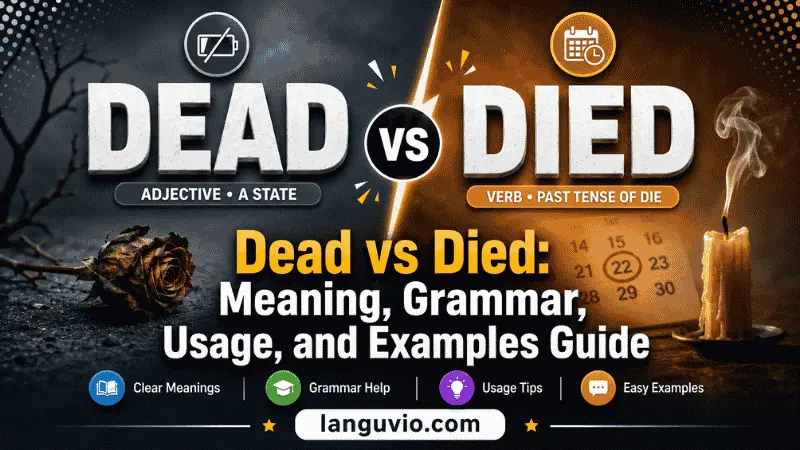
Dead and died both relate to the end of life, but they do different jobs in a sentence. Dead usually describes the condition of a person, animal, plant, machine, or other thing. Died reports the event of stopping life or stopping operation.
Understanding this state-versus-event difference prevents common errors such as “He is died” and “The battery is died.”
Quick Answer
Both words are correct. Use dead mainly as an adjective meaning “not alive” or “not working”: “The bird is dead.”
Use died as the past tense or past participle of the verb die: “The bird died yesterday.”
Dead describes a state; died tells what happened.
Why People Confuse Them
The words point to closely connected ideas, so learners may treat them as interchangeable. In addition, some languages use the same form or a different sentence pattern for both ideas.
English separates them grammatically. Dead normally follows a linking verb or comes before a noun, while died acts as the main verb or follows a helping verb.
Key Differences At A Glance
- Dead: Mainly an adjective that describes a state: “The flowers are dead.”
- Died: A verb form that reports a completed event: “The flowers died.”
- Dead with duration: “The tree has been dead for months.”
- Died with past time: “The tree died last winter.”
A useful memory cue is simple: dead describes; died happened.
Meaning and Usage Difference
Dead means no longer alive. It can appear after forms of be, seem, look, or another linking verb:
- “The animal was dead.”
- “The plant looks dead.”
It can also come before a noun:
- “We removed the dead branch.”
Died is the simple past and past participle of die. It usually names a completed change:
- “The animal died overnight.”
- “The plant has died.”
The pronunciation also differs clearly. Dead rhymes with bed, while died rhymes with side.
Both words extend beyond living things. A dead battery has no usable power. A phone died when it stopped operating. The same distinction remains: dead names the condition, and died reports the change.
To understand another commonly confused verb form, read our guide to die vs dying.
Tone, Context, and Formality
Both words are standard in American English. Died often sounds direct and neutral when reporting an event:
“Her uncle died last year.”
Dead can sound more blunt when it describes a person directly:
“Her uncle is dead.”
That difference involves tone, not correctness. In medical, historical, and factual contexts, direct wording often works well. During a sensitive personal conversation, speakers may choose gentler wording, but dead and died remain grammatically correct when their sentence roles fit.
Which One Should You Use?
Choose the word according to what the sentence needs: a condition or an event.
| Context | Best Choice | Why |
| Describing a current condition | dead | It works as an adjective: “The plant is dead.” |
| Reporting a past event | died | It works as a past-tense verb: “The plant died.” |
| Naming when something happened | died | It fits completed time expressions: “He died in 2019.” |
| Giving the length of a condition | dead | Use “has been dead for”: “It has been dead for hours.” |
| Describing something before a noun | dead | It can modify a noun: “a dead battery.” |
| Using a perfect construction | died | Use “has/had died”: “The engine had died.” |
When One Choice Sounds Wrong
Use dead after a linking verb when you describe a state. “The bird is dead” sounds natural, but “The bird is died” does not.
Use died when the sentence needs an action verb. “The bird died yesterday” is correct. “The bird dead yesterday” lacks a verb.
Time structure also matters. Say “She died five years ago” for the event. Say “She has been dead for five years” for the continuing state.
“She died for five years” incorrectly treats a completed event as a duration.
Common Mistakes (and Quick Fixes)
Incorrect: He is died.
Correct: He is dead.
Also correct: He died.
Incorrect: My phone is died.
Correct: My phone is dead.
Also correct: My phone died.
Incorrect: She has dead.
Correct: She has died.
Also correct: She has been dead for several hours.
Incorrect: The dog dead last night.
Correct: The dog died last night.
The quick fix is to identify the sentence role. Use dead for a description and died for a completed action or change.
Everyday Examples
- The fish is dead, but it was moving this morning.
- The fish died while we were away.
- My laptop is dead, so I need to charge it.
- My laptop died during the video call.
- That tree has been dead since the storm.
- The tree died after several weeks without rain.
- The character is dead at the end of the movie.
- The character died during the final scene.
These pairs show how the same subject can take either word when the sentence changes its focus.
Dictionary-Style Word Details
Verb
- Dead: Not commonly used as a verb in ordinary standard American English. Its main role in this comparison is adjective.
- Died: The simple past and past participle of die. Examples include “The motor died” and “The motor has died.”
Noun
- Dead: Can appear in the collective expression the dead, meaning people who are no longer living.
- Died: Not used as a noun in standard American English.
Dead can also work as an adverb in established expressions such as dead center, dead tired, and dead serious. That role is separate from the central dead-versus-died distinction.
Synonyms
- Dead: Depending on context, close alternatives include deceased, lifeless, inactive, and nonfunctioning. Alive is the clearest opposite for the literal sense.
- Died: Close alternatives include passed away, perished, expired, or ceased, but their tone and context differ. Lived or survived may serve as opposites in suitable sentences.
Example Sentences
- Dead: “The battery is dead.” “They found a dead plant near the window.”
- Died: “The battery died overnight.” “The plant died because its roots stayed wet.”
Word History
- Dead: An Old English word with Germanic roots.
- Died: The past form of die, a verb that entered Middle English from a Germanic source related to Old Norse.
The two terms have long been related in meaning, although they developed different grammatical roles.
Phrases Containing
- Dead: dead end, dead battery, dead silence, dead tired, the dead.
- Died: died of, died from, died in, died at, nearly died, has died.
FAQs
Both are correct, but they serve different grammatical jobs. Use dead to describe a state: “The plant is dead.” Use died to report what happened: “The plant died last week.” The sentence structure determines which word fits.
No. “He is died” is incorrect in standard American English because died is not an adjective. Say “He is dead” to describe his condition, or “He died” to state that the event happened at a past time.
“He died” focuses on the event, usually at a past time. “He is dead” focuses on the present state. Both may describe the same reality, but the speaker chooses a different grammatical viewpoint and sentence pattern.
Use died with a completed past time: “She died in 2020.” Use dead with a duration after be: “She has been dead for six years.” Avoid “She is dead in 2020” when reporting the event.
Yes. Dead can describe something that no longer works, such as a dead battery. Died can describe something that stopped working: “My phone died during the call.” These uses follow the same state-versus-event distinction in everyday speech.
Neither word is automatically disrespectful. Died often sounds direct and neutral when reporting an event. Dead can sound blunt in personal conversation, especially in “He is dead.” Choose clear wording while considering the listener and situation.
Conclusion
Use dead to describe a state and died to report an event. “The bird is dead” tells its condition, while “The bird died” tells what happened.
Check the sentence pattern, the time expression, and the focus. That simple method will help you choose correctly in most everyday situations.