
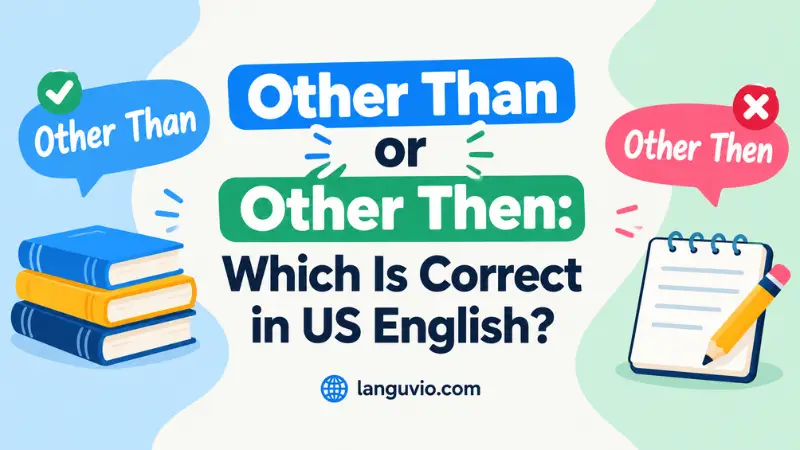
If you are unsure whether to write other than or other then, choose other than when you mean “except,” “apart from,” or “different from.”
The confusion comes from the similar spelling and pronunciation of than and then. They are different words with different jobs.
In standard US English, other than is the established phrase for expressing an exception or difference. Other then is not the standard phrase for that meaning.
For example:
- Correct: I have no plans other than studying tonight.
- Incorrect: I have no plans other then studying tonight.
Understanding what the sentence means makes the choice much easier.
Quick Answer
Other than is correct when you mean except for, apart from, besides, or different from.
Other then is not a standard fixed phrase with those meanings. It usually results from confusing than with then.
Compare:
- Other than Friday, I am available every day.
- We will meet on Friday, then go to dinner.
In the first sentence, other than identifies an exception. In the second, then shows what happens next.
A useful check is to ask whether except or apart from fits. If it does, other than is usually the right choice.
Why People Confuse Them
The main reason is that than and then look and sound very similar.
Than commonly appears in comparisons and expressions of difference or exclusion. For example, “older than,” “more useful than,” and “other than” all use than.
Then usually relates to time, sequence, or a result. For example, “We ate, then we left” uses then to show the next event.
Because both words are extremely common, writers can select the wrong one quickly, especially when typing.
The phrase other than is especially easy to remember incorrectly because the word then is familiar and often appears in sentences about actions. However, then does not replace than in this phrase.
Key Differences At A Glance
| Feature | other than | other then |
|---|---|---|
| Standard phrase | Yes | No |
| Main use | Exception, exclusion, difference | No standard fixed use |
| Typical meaning | Except for, apart from, different from | Usually a mistaken form |
| Formal writing | Appropriate | Avoid |
| Everyday writing | Appropriate | Usually incorrect |
The key difference is not simply spelling. The two forms perform different grammatical jobs because than and then have different functions.
Meaning and Usage Difference
Other than has several closely related uses.
Exception or exclusion
It can identify someone or something left outside a general statement.
- Everyone other than Marcus attended the meeting.
- I eat almost everything other than seafood.
- No one other than the manager can approve the request.
Here, the phrase means roughly “except for.”
Apart from or besides
It can also introduce another possibility or something outside the main item being discussed.
- Do you have any plans other than work this weekend?
- She speaks several languages other than English.
- Is there anything other than coffee available?
The exact interpretation depends on context. It can suggest exclusion, an additional possibility, or something different from the item already mentioned.
Different from
Other than can also describe something that differs from what was expected or stated.
- The result was other than we expected.
- His response was other than what I had anticipated.
In many everyday sentences, different from may sound more direct, but other than is still established English.
What about “other then”?
When someone writes other then in a sentence such as “I have no choice other then to leave,” the intended meaning is normally “except to leave.” The correct form is therefore:
I have no choice other than to leave.
Tone, Context, and Formality
Other than is neutral in US English. You can use it in casual conversation, workplace communication, school writing, and more formal prose.
For example:
- Casual: Other than that, I’m doing fine.
- Workplace: Other than the final section, the report is ready.
- Academic: The results identified no factor other than age that affected the outcome.
You do not need to avoid other than because it sounds too casual or too formal. It fits a wide range of situations.
The alternatives except for, apart from, and besides can also work in many sentences, but their exact meaning and sentence structure can vary.
Which One Should You Use?
Use other than when your sentence means:
- except for
- apart from
- besides
- different from
Use then only when the sentence needs its normal meaning of time, sequence, or consequence.
| Context | Best Choice | Why |
|---|---|---|
| Everyone came except Maria. | other than | Maria is the exception. |
| I have no plans except studying. | other than | The phrase excludes other plans. |
| We finished dinner and went home next. | then | It shows sequence. |
| Things were different at that time. | then | It refers to a past time. |
A simple test works well: if you can replace other than with except for without changing the basic meaning, keep than.
When One Choice Sounds Wrong
Other then sounds wrong when it is being used to introduce an exception.
For example:
- Wrong: Nobody other then Sarah knew.
- Correct: Nobody other than Sarah knew.
The first sentence needs an expression meaning “except Sarah.” Then does not provide that meaning.
Another common mistake is:
- Wrong: We have no option other then to wait.
- Correct: We have no option other than to wait.
Here, the phrase introduces the only available option.
There is an important qualification: the separate words other and then can occasionally appear near each other when they perform separate jobs. That does not make other then a standard phrase. In ordinary word-choice questions, when the intended meaning is “except” or “apart from,” use other than.
Common Mistakes (and Quick Fixes)
Mistake 1: Using “then” for an exception
Wrong: I don’t need anything other then water.
Fix: I don’t need anything other than water.
Mistake 2: Confusing the phrase with sequence
Wrong: Other then the meeting, everything was ready.
Fix: Other than the meeting, everything was ready.
If you actually mean that one event happens after another, use then in a different structure:
We finished the meeting, then we went home.
Mistake 3: Writing “other then” before a verb
Wrong: She had no choice other then to apologize.
Fix: She had no choice other than to apologize.
Mistake 4: Assuming “than” is only for comparisons
Than is strongly associated with comparisons, but it also appears in established expressions such as other than. The phrase can introduce an exception or difference rather than a simple comparison.
Everyday Examples
Here are natural US-English examples:
- Other than Monday, I can meet any day this week.
- Nobody other than Elena knew about the surprise.
- I don’t drink anything other than water during workouts.
- Is there another option other than canceling the event?
- Other than a small delay, the flight went smoothly.
- We need something other than the original proposal.
- He has no interests other than photography.
- Other than that, everything went according to plan.
- The final result was other than we expected.
- What can we do other than wait for an answer?
In each example, other than introduces an exception, alternative, additional possibility, or difference.
Dictionary-Style Word Details
Verb
- other than: Not commonly used as a verb. The phrase itself does not function as a standard verb.
- other then: Not a standard verb phrase.
The individual word other can have verb uses in specialized contexts, but that does not make other then a verb expression.
Noun
- other than: Not normally a noun. It is a phrase used to express exclusion, difference, or an alternative.
- other then: Not a noun phrase in standard US English.
Synonyms
For other than, the closest plain alternatives depend on context:
- except for
- apart from
- besides
- excluding
- different from, when expressing difference
These are not exact replacements in every sentence. For example, besides can sometimes suggest addition, while except for more directly emphasizes exclusion.
Other then has no standard synonyms because it is not an established phrase with its own meaning.
Example Sentences
Other than: Other than the weather, we enjoyed the trip.
Other than: No one other than Jordan had the access code.
Other than: She wanted something other than the original design.
Other then: Do not use this form when you mean “except for” or “apart from.”
Word History
The phrase other than has a long-established history in English, and modern dictionaries recognize it as a standard expression.
The confusion in this comparison comes from the separate words than and then, not from an established historical phrase called other then.
There is no need to assign a special history to other then as a phrase because it is not a standard fixed expression in this sense.
Phrases Containing
Common expressions containing other than include:
- other than that
- nothing other than
- anything other than
- no one other than
- none other than
- anything other than
- no choice other than
- someone other than
These patterns commonly express an exception, exclusion, difference, or alternative.
FAQs
Is “other than” always the correct choice?
Other than is correct when you mean “except,” “apart from,” or “different from.” It is the standard choice in sentences such as “No one other than Maya knew.” However, then can still appear elsewhere when the sentence needs a word for time or sequence.
Can “other then” ever be used correctly?
Other then is not a standard fixed phrase for expressing an exception or difference. The words may occasionally occur separately in unusual sentence structures, but that is not the normal comparison. If you mean “except for,” write other than.
What does “other than” mean in a sentence?
Other than usually means “except for,” “apart from,” or “besides,” depending on context. It can also express difference, as in “The outcome was other than expected.” The surrounding sentence determines which closely related meaning applies.
Can “other than” start a sentence?
Other than can start a sentence naturally. For example, “Other than the traffic, the drive was easy.” When the phrase introduces an opening exception, a comma commonly follows the introductory phrase.
Is “other than” appropriate in formal writing?
Other than is appropriate in formal writing as well as everyday US English. It is a neutral expression, so you do not need to replace it simply because you are writing a professional email, report, application, or academic paper.
Is “other than that” correct?
Other than that is correct when you mean “apart from that” or “except for that.” For example, “The presentation went well. Other than that small issue, everything was ready.” Writing other then that for this meaning is a mistake.
Conclusion
When choosing between other than and other then, use other than when you mean “except,” “apart from,” “besides,” or “different from.”
Other then is not the standard phrase for those meanings. The confusion happens because than and then are similar in appearance and sound, but they serve different purposes.
Remember the simple test: if the sentence needs an exception or something different, other than is the correct choice. If the sentence needs a word about time or sequence, then may be correct elsewhere in the sentence


