
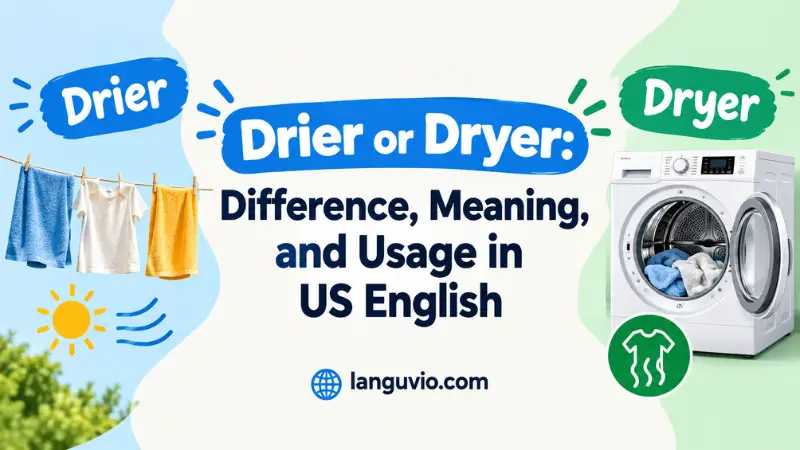
Drier and dryer are both correct English words, but they usually perform different jobs. The spelling you need depends on what you mean in the sentence.
When you are describing something as more dry, use drier. When you are naming a machine or device that dries something, dryer is usually the clearest choice in American English.
For example, “The air is drier today” describes a condition, while “The dryer is running” names an appliance.
There is one useful nuance: dictionaries also record drier as a noun for a drying device. So the distinction is practical rather than an absolute rule that one spelling can never have the other function.
Quick Answer
Use drier when you mean more dry or less wet:
- The air is drier today.
- This towel is drier than the other one.
- My skin feels drier in winter.
Use dryer when you mean a machine or device that dries something:
- Put the clothes in the dryer.
- My hair dryer stopped working.
- The store installed a new hand dryer.
The easiest memory rule is:
Drier describes dryness. Dryer usually names something that dries.
Why People Confuse Them
The confusion comes from their nearly identical spelling and pronunciation. Both forms are closely connected to the word dry, and both can relate to the process of becoming dry.
There is also a grammatical reason for the confusion. The comparative adjective is formed as dry → drier, while dryer can be formed with -er to identify something that performs the action of drying.
That creates two different patterns:
dry → drier = more dry
dry → dryer = something that dries
Because the words sound alike in ordinary American speech, listening does not always tell you which spelling to write.
Key Differences At A Glance
| Feature | Drier | Dryer |
|---|---|---|
| Main role | Comparative adjective | Noun |
| Basic meaning | More dry; less wet | A machine or device that dries |
| Common context | Weather, air, skin, food, soil, clothing | Clothes, hair, hands, crops, materials |
| Example | The air is drier today. | The dryer is running. |
The distinction is not completely absolute. Drier is also documented as a noun for a drying device, so context still matters.
Meaning and Usage Difference
Drier is normally the comparative form of dry. It tells readers that something has a greater degree of dryness than something else or than it had before.
You can use it for physical conditions:
- The towels are drier now.
- The soil is drier after several sunny days.
- The indoor air feels drier in winter.
It can also describe other meanings of dry. For example, someone can have a drier sense of humor, meaning the humor is more understated or deadpan.
Dryer is most commonly a noun for something that dries. In American English, this includes a clothes dryer, hair dryer, hand dryer, or similar device.
The two words can therefore appear close together:
The clothes are drier because I used the dryer.
Here, drier describes the clothes, while dryer identifies the appliance.
Tone, Context, and Formality
Neither spelling is inherently more formal than the other. The important issue is grammatical function and context.
In edited American English, drier is the straightforward choice when you mean “more dry.” Writing “The climate is drier this year” clearly expresses a comparison.
For an appliance, dryer is the familiar choice in everyday US writing:
- clothes dryer
- hair dryer
- hand dryer
- grain dryer
You may encounter drier as a noun in dictionaries and technical contexts. That does not make dryer incorrect. For general American readers, dryer is often the clearest noun form when referring to an appliance.
Pronunciation does not provide much help. The two forms are pronounced alike or very similarly in ordinary US speech, so the meaning and grammatical role should guide your spelling.
Which One Should You Use?
Choose drier when you can replace it with more dry without changing the intended meaning.
For example:
The desert air is more dry.
That wording sounds less natural, but it reveals why drier fits:
The desert air is drier.
Choose dryer when you are naming an object that performs drying:
The dryer needs to be repaired.
A quick test is to ask: Am I describing something, or am I naming something?
If you are describing a greater degree of dryness, choose drier.
If you are naming a drying machine or device, choose dryer.
When One Choice Sounds Wrong
Some sentences become unclear or unnatural when the spelling does not match the intended meaning.
If you write:
The weather is dryer today.
Readers may understand what you mean, but drier is the clearer standard comparative form:
The weather is drier today.
Likewise, when referring to an appliance, dryer is normally the clearest choice:
Put the clothes in the dryer.
The alternative noun spelling drier is documented, so it is not accurate to say that every occurrence of “drier” for a machine is automatically wrong. Still, dryer is the practical choice for ordinary US writing.
Common Mistakes (and Quick Fixes)
Mistake 1: Using dryer as the comparative
Incorrect for the intended standard comparison:
The air is dryer today.
Better:
The air is drier today.
Mistake 2: Treating drier as the only noun spelling
It is too strong to say that drier can never be a noun. Dictionaries record noun use for a drying device.
For everyday US writing, however, this is clearer:
I put the clothes in the dryer.
Mistake 3: Writing “more drier”
Avoid a double comparative:
The room is more drier today.
Use:
The room is drier today.
Mistake 4: Choosing by sound
Because the words sound the same or nearly the same, pronunciation may not settle the question. Look at the meaning instead.
Everyday Examples
Here are natural examples showing the difference:
- The towels are drier after sitting outside.
- The desert climate is drier than the coastal climate.
- My hands feel drier after washing dishes.
- This bread is drier than yesterday’s.
- The office air seems drier than it was last week.
- Please put the wet clothes in the dryer.
- Our old dryer makes a loud noise.
- She bought a new hair dryer.
- The gym installed a wall-mounted hand dryer.
- The laundry room has two dryers.
Notice how drier describes a condition, while dryer usually identifies equipment.
Dictionary-Style Word Details
Verb
Drier: Not commonly used as a verb in standard US English. The related verb is dry.
Dryer: Not commonly used as a verb in standard US English. It is primarily a noun for a device or thing that dries.
Noun
Drier: A noun meaning a person or thing that dries is documented, including a machine or device used for drying. It can also have specialized technical meanings.
Dryer: A common noun for a machine, appliance, or device that dries something. In American English, it is especially familiar in phrases such as clothes dryer and hair dryer.
Synonyms
Drier: There is no single exact synonym for every use. Closest plain alternatives include more dry and less wet, depending on the sentence.
Dryer: Closest plain alternatives include drying machine or drying device when referring to equipment. These are descriptive alternatives rather than exact replacements in every phrase.
Example Sentences
Drier:
- The air feels drier this morning.
- The paint is drier than it was earlier.
- The northern part of the state has a drier climate.
Dryer:
- The dryer finished the load.
- I need to clean the dryer vent.
- Her hair dryer is in the bathroom.
Word History
Both words are connected to dry. The comparative drier follows the spelling pattern used when an adjective ending in y takes -er.
The noun dryer comes from dry plus -er, with the ending identifying something that performs the action. Dictionaries also record drier as a noun variant, so the historical relationship does not create a strict modern divide between the spellings.
Phrases Containing
Drier:
- drier weather
- drier climate
- drier air
- drier soil
- drier conditions
- drier skin
Dryer:
- clothes dryer
- hair dryer
- hand dryer
- grain dryer
- industrial dryer
- dryer vent
FAQs
Is drier or dryer correct?
Both are correct, but they usually serve different purposes. Use drier when you mean “more dry” or “less wet.” Use dryer when naming a machine or device that dries something. Context determines the appropriate spelling.
Can drier and dryer mean the same thing?
They can overlap when drier is used as a noun for a drying device, because dictionaries recognize that usage. However, for clear everyday US writing, drier is best for comparisons, while dryer is the familiar appliance spelling.
Is drier the comparative form of dry?
Yes. Drier is the standard comparative form of dry. It expresses a greater degree of dryness, such as “The air is drier today.” The spelling follows the familiar pattern in which final y changes to i before -er.
Should I write clothes dryer or clothes drier?
Clothes dryer is the clearest choice in ordinary American English. Although drier can function as a noun in documented usage, dryer is the familiar spelling for the household appliance used to dry clothing.
Can drier be used as a noun?
Yes. Drier can be a noun meaning a person or thing that dries, and dictionaries record it as a variant of dryer. In ordinary US writing, however, dryer usually makes the appliance meaning immediately clear.
Are drier and dryer pronounced the same?
They are pronounced the same or very similarly in standard American speech. Because sound usually does not distinguish them, listeners cannot always tell which spelling is intended. Writers should choose based on meaning and grammatical function rather than pronunciation.
Conclusion
Drier and dryer are both correct, but they are not normally interchangeable in everyday US writing.
Use drier when you mean more dry or less wet: “The air is drier today.”
Use dryer when you mean a machine or device that dries something: “The clothes are in the dryer.”
Remember the practical distinction: drier describes greater dryness, while dryer usually names the thing doing the drying. Although dictionaries also recognize drier as a noun, dryer is the clearest choice for ordinary American references to appliances and devices.


