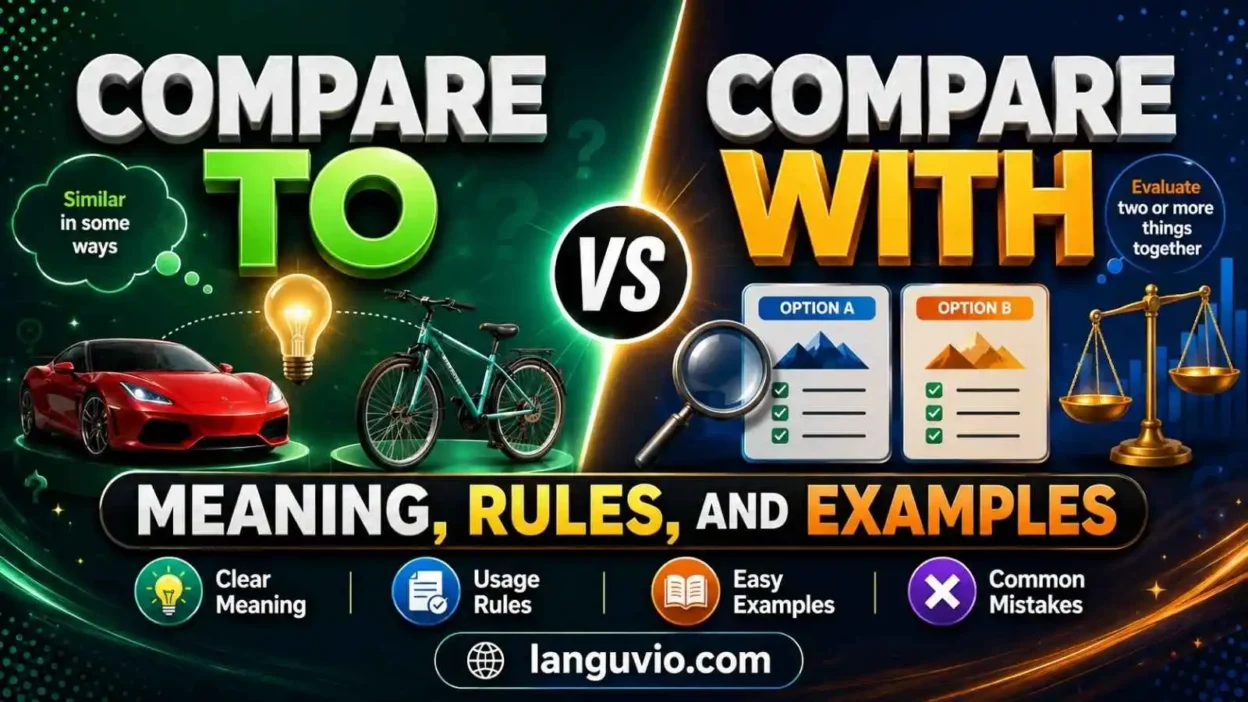
Both compare to and compare with are correct in American English. However, they do not always express exactly the same idea.
Use compare to when you are mainly showing that one person, object, or idea is like another. Use compare with when you are examining two things side by side to find similarities, differences, strengths, or weaknesses.
Real usage is flexible, especially in sentences beginning with compared to or compared with. Therefore, the difference is best treated as a useful writing distinction rather than an unbreakable grammar law.
Quick Answer
Use compare to when you are making an analogy or emphasizing a likeness: “She compared the crowded highway to a parking lot.”
Use compare with for a direct examination of two subjects: “We compared this year’s insurance rates with last year’s rates.”
In general relative statements, either form may work: “Sales increased compared to last year” and “Sales increased compared with last year.”
Why People Confuse Them
The phrases begin with the same verb and perform closely related jobs. Both connect one subject with another so the reader can understand a relationship between them.
The traditional distinction is also less strict in everyday American English than many simple grammar lessons suggest. Writers commonly use compared to in places where a more formal editor might prefer compared with.
Passive constructions create even more overlap. In a sentence such as “This apartment is inexpensive compared to ours,” the speaker is not necessarily making an analogy. The phrase simply establishes a point of reference.
Because both choices may sound natural, the writer’s intended emphasis matters more than memorizing an absolute rule.
Key Differences At A Glance
| Feature | compare to | compare with |
| Main purpose | Shows likeness or makes an analogy | Examines subjects side by side |
| Usual focus | A shared quality or impression | Similarities, differences, or relative performance |
| Common context | Figurative, descriptive, or personal statements | Reports, reviews, studies, and careful evaluations |
| Basic pattern | Compare A to B | Compare A with B |
| Flexibility | Often overlaps with “compare with” in relative statements | Often overlaps with “compare to” in relative statements |
The strongest distinction appears when compare is active and clearly describes what someone is doing. The overlap becomes greater when compared to or compared with introduces a general contrast.
Meaning and Usage Difference
Compare to often means “liken to.” It presents one subject as similar to another, sometimes in an imaginative or figurative way.
“The teacher compared the human heart to a pump.”
The sentence highlights a shared function. It does not promise a complete review of every similarity and difference between a heart and a pump.
Compare with usually means “place beside and examine.”
“The researcher compared the new treatment with the standard treatment.”
Here, the comparison suggests a structured review. The researcher may examine cost, results, risks, or other measurable features.
The difference is less firm in passive relative statements:
“This winter has been mild compared to last winter.”
“This winter has been mild compared with last winter.”
Both sentences are standard and easy to understand. Compared with places slightly more attention on the side-by-side evaluation, while compared to sounds natural in ordinary conversation and general reporting.
The phrases are verb-preposition constructions. Compare is the verb, while to and with are prepositions that connect the subjects being considered.
Tone, Context, and Formality
Compare to often sounds more natural in analogies, descriptions, compliments, and personal observations.
A sportswriter might compare a talented rookie to a former champion. A novelist might compare a quiet town to a sleeping animal. In both cases, the writer wants readers to notice a particular likeness.
Compare with often sounds more measured and analytical. It is especially useful when a writer examines prices, results, policies, products, statistics, or performance.
However, neither phrase is automatically formal or informal. You can use both in conversation, academic work, business communication, and news writing.
The context creates the difference in tone. Compare with may suggest a deliberate evaluation, while compare to may suggest a quick relationship, image, or point of reference.
Which One Should You Use?
| Context | Best Choice | Why |
| Making an analogy | compare to | It highlights a shared quality or image |
| Examining two products or results | compare with | It signals a side-by-side evaluation |
| Writing a study or detailed report | compare with | It makes the analytical purpose clearer |
| Giving a simple point of reference | Either | Both forms are common in this structure |
| Saying that nothing is equal to something | compare to | This is the familiar idiomatic pattern |
| Saying one option performs poorly beside another | compare with | It naturally suggests measured performance |
When both choices seem possible, ask one question: Am I likening the subjects, or am I examining them?
Choose compare to for likening. Choose compare with for examination.
If the sentence simply gives a point of reference, either may be acceptable. Select the form that sounds natural and use it consistently throughout the passage.
When One Choice Sounds Wrong
A choice may sound wrong when it suggests a purpose that the sentence does not have.
“The poem compares loneliness with an empty room” is understandable. However, to is clearer when the poem is creating an image rather than conducting a detailed evaluation:
“The poem compares loneliness to an empty room.”
The opposite problem can occur in a formal review:
“The report compares Plan A to Plan B across price, coverage, and customer service.”
This sentence is not ungrammatical, but with better signals a structured examination:
“The report compares Plan A with Plan B across price, coverage, and customer service.”
Some fixed patterns also create expectations. Nothing compares to this view is a familiar way to say that the view is unequaled. Meanwhile, the cheaper model does not compare with the premium model usually means that the cheaper model performs worse.
The goal is not to declare every alternative incorrect. It is to choose the preposition that makes the intended relationship immediately clear.
Common Mistakes (and Quick Fixes)
Mistake 1: Treating the distinction as absolute
Incorrect idea: Compare to can only show similarities, and compare with can only show differences.
Quick fix: Treat that distinction as a strong guideline. Both phrases may introduce a general relative comparison.
Mistake 2: Focusing only on whether the subjects belong to the same category
Writers are sometimes told to use with for similar things and to for different things. That pattern can help, but it does not explain every sentence.
Quick fix: Focus on purpose. Use to for likening and with for examining.
Mistake 3: Assuming “compared to” is always casual
The phrase appears naturally in many kinds of clear writing.
Quick fix: Judge the meaning and sentence structure instead of rejecting the phrase based only on formality.
Mistake 4: Creating an unclear comparison
Unclear: “Our prices are lower compared to last year.”
This may appear to compare current prices with the entire year rather than with the prices charged during that year.
Quick fix: Name both subjects clearly: “Our prices are lower than last year’s prices” or “We compared current prices with last year’s prices.”
Mistake 5: Switching forms without a reason
A report may use compare with in one section and compare to in an identical structure later.
Quick fix: When the meaning does not change, choose one pattern and apply it consistently.
Everyday Examples
For an analogy, compare to is usually the clearest choice:
“The coach compared the rookie’s speed to a race car.”
“She compared starting a business to running a marathon.”
“My grandfather compares social media to a crowded town square.”
“The child compared the clouds to giant pieces of cotton.”
For a direct examination, compare with usually works better:
“Compare the monthly plan with the annual plan before subscribing.”
“We compared the hotel’s location with its room rates.”
“The mechanic compared the damaged part with a new one.”
“The hiring team compared each applicant’s experience with the job requirements.”
In general relative statements, both forms can sound natural:
“Today’s traffic was light compared to yesterday’s.”
“Today’s traffic was light compared with yesterday’s.”
“The new laptop feels heavy compared to my old one.”
“The new laptop feels heavy compared with my old one.”
Dictionary-Style Word Details
Verb
• compare to: A construction using the verb compare and the preposition to. It commonly means to represent one subject as similar to another or to view one subject in relation to another.
• compare with: A construction using the verb compare and the preposition with. It commonly means to examine subjects together to identify similarities, differences, quality, or relative value.
The verb compare can be transitive: “We compared the plans with each other.” It can also be intransitive: “The two plans do not compare.”
Noun
• compare to: Not commonly used as a noun in standard US English.
• compare with: Not commonly used as a noun in standard US English.
The word compare has a rare noun use in expressions such as beyond compare, but that noun use does not turn compare to or compare with into noun phrases.
Synonyms
• compare to — closest plain alternatives: liken to, draw a parallel to, see as similar to, relate to.
• compare with — closest plain alternatives: examine alongside, measure against, evaluate beside, assess in relation to.
Contrast with can be an alternative when the writer wants to emphasize differences. It is not an exact replacement when similarities are also important.
There is no single useful antonym for either complete phrase. Depending on the context, the opposite action might be to separate, disregard, or consider independently.
Example Sentences
- Comparison as resemblance: “The speaker compared a strong community to a safety net.”
- Comparison between people: “People often compare the actor to his famous father.”
- Comparison based on difficulty: “The first assignment seemed easy compared to the final project.”
- Detailed examination: “The buyer compared the warranty with the repair costs.”
- Checking two versions: “Please compare the final document with the original.”
- Performance comparison: “Our response time improved compared with the previous quarter.”
Word History
Both expressions come from the same verb, compare. The verb entered English through French and ultimately comes from Latin roots associated with pairing or regarding things as equal.
The difference between to and with developed as a usage convention. It did not create two separate verbs. Over time, the phrases have continued to overlap, although the likeness-versus-examination distinction remains helpful in careful writing.
Phrases Containing
- Compare to: Common patterns include compare A to B, compared to, nothing compares to, difficult to compare to, and compare one person to another.
- Compare with: Typical expressions are compare A with B, compared with, compare favorably with, does not compare with, and compare one result with another.
- Both forms: Writers may use compare apples to apples, compare apples with apples, compare apples to oranges, or compare apples with oranges.
FAQs
Is it correct to say “compare to” or “compare with”?
Both compare to and compare with are correct. Traditionally, compare to highlights a likeness, while compare with examines similarities and differences. However, the two phrases often overlap in everyday American English.
What is the main difference between “compare to” and “compare with”?
Use compare to when likening one thing to another. For example, “She compared his voice to thunder.” Use compare with when studying two things side by side: “We compared the new phone with the older model.”
Can “compare to” and “compare with” be used interchangeably?
Sometimes. They commonly overlap in sentences such as “Prices are lower compared to last year” and “Prices are lower compared with last year.” In careful writing, choose to for an analogy and with for a detailed evaluation.
Should I compare a person “to” or “with” someone else?
It depends on your purpose. Use compare to when emphasizing a resemblance: “People compare her to her mother.” Use compare with when evaluating two people’s skills, results, or characteristics.
Is “compared to” less formal than “compared with”?
Not necessarily. Both forms can appear in formal and informal writing. However, compared with may sound more analytical, so it often fits reports, studies, product reviews, and detailed evaluations.
Is it “compare yourself to others” or “compare yourself with others”?
Both are correct. Compare yourself to others is more common. Compare yourself with others sounds more careful and specific.
Which phrase should I use in academic writing?
Use compare with when analyzing two texts, studies, arguments, or sets of results. For example, “Compare the findings with those of the earlier study.” Use compare to when explaining an analogy or resemblance.
Conclusion
Both compare to and compare with are correct, but they often emphasize different purposes.
Use compare to when you want to liken one subject to another or create an analogy. Use compare with when you want to examine subjects side by side and identify similarities, differences, or relative performance.
In passive relative statements, the two forms frequently overlap. When either sounds natural, choose the one that best reflects your purpose and keep your usage consistent.
Both compare to and compare with are correct. Traditionally, compare to highlights a likeness, while compare with examines similarities and differences. However, the two phrases often overlap in everyday American English.
Use compare to when likening one thing to another. For example, “She compared his voice to thunder.” Use compare with when studying two things side by side: “We compared the new phone with the older model.”
Sometimes. They commonly overlap in sentences such as “Prices are lower compared to last year” and “Prices are lower compared with last year.” In careful writing, choose to for an analogy and with for a detailed evaluation.
It depends on your purpose. Use compare to when emphasizing a resemblance: “People compare her to her mother.” Use compare with when evaluating two people’s skills, results, or characteristics.
Not necessarily. Both forms can appear in formal and informal writing. However, compared with may sound more analytical, so it often fits reports, studies, product reviews, and detailed evaluations.
Both are correct. Compare yourself to others is more common. Compare yourself with others sounds more careful and specific.
Use compare with when analyzing two texts, studies, arguments, or sets of results. For example, “Compare the findings with those of the earlier study.” Use compare to when explaining an analogy or resemblance.