
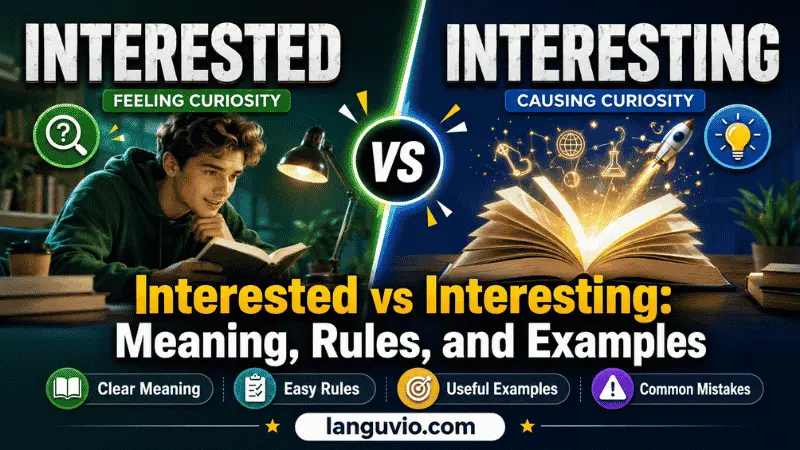
Interested and interesting are both correct English words, but they do different jobs. The confusion happens because both come from the verb interest and often appear after a form of be.
The key is to identify the direction of attention. Interested usually describes the person or group whose attention is engaged. Interesting describes the person, thing, idea, or experience that attracts attention.
For example, “I am interested in the class” describes your reaction. “The class is interesting” describes the class’s effect on you. This guide explains that difference, the sentence patterns each word follows, and the cases that simple rules often miss.
Quick Answer
Use interested for someone who feels curiosity, pays attention, wants to participate, or has a concern in something. It commonly appears in the pattern interested in.
Use interesting for someone or something that attracts or holds attention.
- I am interested in local history.
- Local history is interesting to me.
A person can be both. An interested person pays attention, while an interesting person attracts attention.
Why People Confuse Them
Both words look like forms of the same verb, and both commonly function as adjectives. They also fit after linking verbs:
- The students are interested.
- The students are interesting.
Both sentences are grammatical, but they do not mean the same thing. The first says the students are paying attention or feel curiosity. The second says the students attract other people’s attention.
The familiar rule “people are interested; things are interesting” helps in basic examples, but it is incomplete. People can be interesting, and groups can be interested. The reliable question is not “person or thing?” It is “Who receives the attention, and what creates it?”
Key Differences At A Glance
| Feature | Interested | Interesting |
| Main idea | Experiencing or showing interest | Causing or attracting interest |
| Typical subject | A person, group, audience, or involved party | A person, topic, object, event, or situation |
| Common pattern | interested in + noun or -ing form | interesting + noun; be/find + interesting |
| Basic example | Lena is interested in coding. | Coding is interesting to Lena. |
A useful relationship is:
Something interests someone → that person is interested → that thing is interesting.
This pattern shows why the words are related without treating them as interchangeable.
Meaning and Usage Difference
Interested describes a state, response, or involvement. Someone who is interested gives attention, wants to know more, considers taking part, or has something at stake.
- Jordan seemed interested in the proposal.
- Several parents are interested in joining the committee.
- The decision must be shared with all interested parties.
In interested parties, the word may mean affected, involved, or having a stake in the matter. It does not always mean curious or entertained.
Interesting describes a quality that attracts attention. A subject can be interesting because it is unusual, important, surprising, complex, or full of ideas. It does not have to be enjoyable.
- The report contains an interesting finding.
- She is an interesting speaker with unusual experiences.
- The discussion became more interesting after the questions began.
The contrast also works with people. “Nora is interested” describes Nora’s attention. “Nora is interesting” describes the effect Nora has on others.
For additional guidance, see Cambridge Grammar’s explanation of the difference between interested and interesting.
Tone, Context, and Formality
Both words are standard and neutral. They work in everyday conversation, school writing, business communication, and formal documents.
Interested often communicates willingness in professional settings:
- I am interested in the position.
- We would be interested to hear your proposal.
The phrase interested parties sounds more formal and often refers to people or organizations affected by a decision.
Interesting can express genuine approval, mild curiosity, surprise, or a cautious reaction. “That’s interesting” may sound positive, reserved, or doubtful depending on the speaker’s voice and the situation. The word itself does not automatically carry sarcasm.
Neither word guarantees strong emotion. A person can be slightly interested, and a topic can be interesting without being exciting or pleasant.
Which One Should You Use?
| Context | Best Choice | Why |
| Describing your curiosity about a topic | Interested | You experience the attention or curiosity. |
| Describing a book, class, or podcast | Interesting | It attracts or holds attention. |
| Describing an engaging person | Interesting | The person attracts other people’s attention. |
| Describing an attentive listener | Interested | The listener is engaged. |
| Expressing willingness to consider a job | Interested | You want to know more or take part. |
| Describing an attention-grabbing idea | Interesting | The idea creates interest. |
| Referring to people affected by a decision | Interested | They are involved or have a stake. |
Use this two-part check:
Who has the feeling or attention? Choose interested.
Who or what creates the attention? Choose interesting.
When One Choice Sounds Wrong
The wrong choice often reverses the intended meaning.
“I’m interesting in photography” sounds wrong because the speaker means that photography attracts their attention. Write: “I’m interested in photography.”
“The documentary was interested” sounds wrong in ordinary use because a documentary does not normally experience curiosity. Write: “The documentary was interesting.”
“Are you interesting in joining us?” should be “Are you interested in joining us?”
“She is an interested speaker” means the speaker herself is attentive, involved, or affected. To say that people enjoy listening to her, write: “She is an interesting speaker.”
However, “I am interesting” is not automatically incorrect. It is correct when you mean that you attract attention or have qualities that others find engaging.
Common Mistakes (and Quick Fixes)
Mistake: Using the person-versus-thing rule as an absolute.
Quick fix: Focus on the role. A person may be interested or interesting, depending on whether that person receives or attracts attention.
Mistake: Writing “interesting in” for personal interests.
Quick fix: Use interested in before a topic or activity: “He is interested in finance” and “He is interested in investing.”
Mistake: Saying “I feel interesting” when describing curiosity.
Quick fix: Say “I feel interested” or, more naturally, “I’m interested.”
Mistake: Using interested after find.
Quick fix: Say “I found the lecture interesting” when the lecture held your attention. “I found the audience interested” is possible, but it means you observed that the audience was engaged.
Mistake: Treating “interested to” as always wrong.
Quick fix: Interested to hear, learn, know, see, and discover are standard patterns. For a general topic or activity, interested in remains the safest and most common structure.
Everyday Examples
Interested
- Maya is interested in learning graphic design.
- Are you interested in attending Saturday’s workshop?
- The buyer sounded interested but requested more details.
- Anyone interested in volunteering should email the coordinator.
- I would be interested to hear how your interview went.
Interesting
- The museum’s new space exhibit is surprisingly interesting.
- He shared an interesting story about his first job.
- It will be interesting to see how the neighborhood changes.
- The survey produced several interesting responses.
- We found the final chapter more interesting than the opening.
Dictionary-Style Word Details
Verb
Interested: This can be the past tense or past participle of the verb interest. Example: “The internship interested several students.” In “The students were interested,” it commonly functions as an adjective describing their state.
Interesting: This can be the -ing form of the verb interest. Example: “The program is interesting young readers in science.” This verbal use is less common than the adjectival use: “The program is interesting.”
Noun
Interested: Not commonly used as a standalone noun in standard US English. It normally works as an adjective or as a form of the verb interest.
Interesting: Not commonly used as a standalone noun. In “Interesting children in science takes patience,” it begins a clause and keeps its verbal meaning rather than naming a person, place, thing, or idea by itself.
Synonyms
Interested: Closest plain alternatives include engaged, curious, attentive, intrigued, and involved, depending on context. A clear antonym is uninterested.
Interesting: Close alternatives include engaging, intriguing, absorbing, and fascinating. Some alternatives are stronger than interesting. Clear opposites include uninteresting and boring.
Example Sentences
Interested:
- The committee is interested in reviewing the revised plan.
- Ava looked interested when the coach explained the new strategy.
Interesting:
- The revised plan offers an interesting solution to the parking problem.
- Ava asked several interesting questions after practice.
Word History
Both words come from the verb interest.
Interested developed from the past-participle form and came to describe someone whose attention, concern, or involvement has been engaged.
Interesting developed from the present-participle form and came to describe something that arouses or holds attention.
The modern comparison follows that relationship: interested points toward the receiver of interest, while interesting points toward its source.
Phrases Containing
Interested:
- interested in
- interested to hear
- interested to learn
- interested party
- interested observer
Interesting:
- interesting to see
- interesting to note
- find something interesting
- an interesting point
- make things interesting
FAQs
Both can be correct, but they say different things. “I am interested” means something has your attention. “I am interesting” means other people may find you engaging or unusual. For hobbies or topics, use “I am interested in …”
Yes. An interested person is paying attention or wants to learn more. An interesting person attracts attention because of their ideas, experiences, or personality. The same person can be interested in a conversation and also be interesting to others.
No. Switching them usually changes who experiences the feeling and who causes it. “The students are interested” describes the students’ response. “The students are interesting” describes how other people view the students, so the sentences communicate different ideas.
Use “interested in” when naming the topic, person, or activity that attracts someone’s attention. Say “She is interested in design” or “They are interested in moving.” “Interesting in” does not normally introduce the topic in this pattern.
Yes, “interested to know” can be correct, especially when you mean curious to learn, hear, see, or discover a particular fact. “Interested in knowing” is also standard and often emphasizes a broader or continuing interest rather than one expected piece of information.
It sounds wrong in ordinary use because a movie normally causes interest rather than experiences it. Say “The movie was interesting” to describe its effect on viewers. Say “The audience was interested” to describe the viewers’ attention or curiosity.
Conclusion
Use interested for the person or group that experiences attention, curiosity, willingness, concern, or involvement. Use interesting for the person, thing, idea, or situation that attracts attention.
Remember the relationship: something interests you, so you are interested, and the thing is interesting. This approach works better than assuming that one word is only for people and the other is only for things.


