
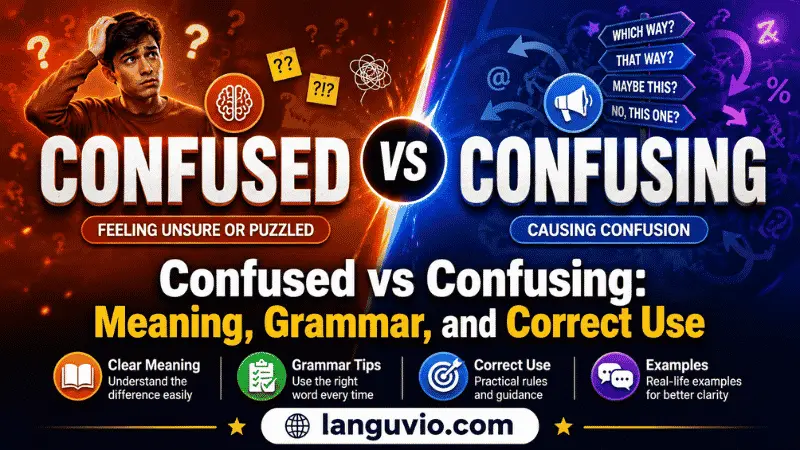
The words confused and confusing come from the verb confuse, but they express different ideas.
Use confused when someone struggles to understand something. Use confusing when a person, message, situation, or explanation causes that struggle.
For example, unclear directions may confuse a driver. The driver feels confused, while the directions seem confusing.
The word confused can also describe disorganized thoughts, writing, or information. Understanding these differences will help you choose the correct word in everyday conversations, school assignments, and professional communication.
Quick Answer
Use confused for someone who does not understand something or for ideas and information that lack clear organization.
Use confusing for someone or something that makes understanding difficult.
- “I feel confused about the instructions” means I do not understand them.
- “The instructions seem confusing” means they cause uncertainty.
- “I am confusing people” means my words or actions make other people uncertain.
A simple rule can help:
Confused experiences the problem. Confusing causes the problem.
Why People Confuse Them
Both words share the same root and often appear after linking verbs such as feel, look, seem, and sound. Their similar spelling makes the choice difficult for many English learners.
The endings provide the main clue:
- Confused usually describes the person who experiences uncertainty.
- Confusing usually describes the source that creates uncertainty.
However, the common rule that “confused describes people and confusing describes things” does not always work.
A person can act confusing when that person gives mixed answers, changes instructions, or communicates unclearly. A report can also contain confused thinking when its ideas lack logical organization.
Key Differences At A Glance
| Feature | Confused | Confusing |
| Main meaning | Unable to understand or think clearly | Causing uncertainty or difficulty |
| Main focus | The person or idea experiencing disorder | The source that creates uncertainty |
| Common patterns | confused about, confused by, confused with | confusing instructions, confusing message |
| Person example | “The customer looks confused.” | “The speaker sounds confusing.” |
| Thing example | “The report contains confused ideas.” | “The report gives confusing instructions.” |
A confused explanation lacks clear organization. A confusing explanation makes the audience struggle to understand.
Both descriptions may fit the same explanation, but each one emphasizes a different problem.
Meaning and Usage Difference
Confused commonly works as an adjective. It describes someone who cannot understand, decide, or think clearly.
“She felt confused after reading the email.”
This word can also describe thoughts, arguments, writing, or information that lack order.
“His confused answer jumped from one topic to another.”
Confusing also works as an adjective. It describes something that causes difficulty or uncertainty.
“The email seemed confusing because it listed two meeting times.”
Both words can also function as forms of the verb confuse.
“The schedule confused everyone.”
In this sentence, confused expresses a completed action in the past.
“The schedule keeps confusing everyone.”
Here, confusing helps express an ongoing action.
According to the British Council’s guide to adjectives ending in “-ed” and “-ing”, -ed adjectives describe how someone feels, while -ing adjectives describe what causes that feeling. Therefore, a person feels confused, but a situation is confusing.
Tone, Context, and Formality
Both words sound natural in casual and formal American English. Meaning determines the correct choice, not formality.
Calling someone confusing may sound critical because the statement places responsibility on that person.
“You are confusing” may suggest that the person communicates poorly or behaves inconsistently.
A gentler sentence can focus on the message instead:
“Your explanation seems confusing.”
You can also focus on your own experience:
“I feel confused about the timeline.”
These choices communicate the same general problem, but they create different tones.
Which One Should You Use?
| Context | Best Choice | Why |
| You cannot understand something | confused | You experience uncertainty |
| Directions cause difficulty | confusing | The directions create uncertainty |
| Someone gives mixed signals | confusing | The person’s behavior causes uncertainty |
| A report lacks clear organization | confused | Its ideas appear disordered |
| A report causes reader uncertainty | confusing | Readers struggle to understand it |
| You mistake one name for another | confused | The verb describes your completed action |
Ask one question before choosing:
Does the subject experience the problem or create it?
Choose confused when the subject experiences uncertainty. Choose confusing when the subject causes uncertainty.
Also check whether confused describes disorganized ideas, writing, or information.
When One Choice Sounds Wrong
“I feel confusing about the schedule” sounds incorrect because the speaker experiences uncertainty.
Write:
“I feel confused about the schedule.”
“The schedule feels confused” usually fails when you mean that people cannot understand it.
Write:
“The schedule seems confusing.”
However, “a confused schedule” can describe a schedule with mixed-up dates or disorganized entries.
“He looked confusing” suggests that his appearance or behavior caused uncertainty. To describe his puzzled expression, write:
“He looked confused.”
The surrounding sentence always determines the intended meaning.
Common Mistakes (and Quick Fixes)
Mistake: “I feel confusing.”
Fix: Write “I feel confused.”
Mistake: “The directions made me confusing.”
Fix: Write “The directions confused me” or “The directions made me feel confused.”
Mistake: Assuming that only objects can seem confusing.
Fix: People can seem confusing when their words or actions send mixed signals.
Mistake: Assuming that confused can describe only people.
Fix: The word can also describe disorganized thinking, writing, arguments, or information.
Mistake: “The teacher confused because the question was difficult.”
Fix: Write “The teacher felt confused because the question was difficult.”
Everyday Examples
- Maya felt confused about which entrance to use.
- The parking signs seemed confusing after dark.
- Our new coworker looked confused during orientation.
- The presenter sounded confusing because he kept changing the numbers.
- The witness gave a confused description that jumped between events.
- The witness gave a confusing description that left everyone uncertain.
- The new app layout confused several customers.
- Two different deadlines made the email confusing.
- Daniel felt confused when the meeting suddenly changed rooms.
- The manager’s mixed instructions kept confusing the team.
Dictionary-Style Word Details
Verb
- Confused: Functions as the simple past and past participle of confuse.
“The similar labels confused the customer.” - Confusing: Functions as the present participle of confuse.
“The similar labels keep confusing customers.”
Noun
- Confused: Standard American English does not commonly use this word as a standalone noun.
- Confusing: Standard American English does not commonly use this word as a standalone noun.
Use confusion when the sentence requires a noun.
“The unclear announcement caused confusion.”
Synonyms
Confused:
- puzzled
- uncertain
- bewildered
- mixed up
- unsure
Confusing:
- puzzling
- unclear
- bewildering
- complicated
- hard to follow
When confused describes disordered information, the closest plain alternatives include jumbled, unclear, and disorganized.
In many contexts, clear works as a useful opposite of both words.
Example Sentences
- Confused: “Jordan looked confused when the meeting room changed.”
- Confusing: “The two confirmation emails seemed confusing.”
- Confused as a verb: “The duplicate names confused the receptionist.”
- Confusing as a verb form: “The duplicate names keep confusing visitors.”
Word History
Both terms come from the verb confuse.
English adds -ed to create confused, which often describes the person or state that experiences uncertainty.
English adds -ing to create confusing, which often describes the source that produces uncertainty.
The same general pattern appears in many adjective pairs, but the sentence context still controls the meaning.
Phrases Containing
Confused:
- confused about
- confused by
- confused with
- confused expression
- confused thinking
- deeply confused
Confusing:
- confusing instructions
- confusing situation
- confusing message
- confusing signals
- confusing explanation
- extremely confusing
FAQs
Yes, but it means that your words, behavior, or actions cause other people to feel uncertain. It does not mean that you personally lack understanding. In most everyday situations, say “I feel confused” when you cannot understand something.
Yes. Someone can struggle to understand a situation and then communicate that situation poorly to others. For example, a manager may feel confused about a new policy and give the team a confusing explanation of its requirements.
Use confused by to identify what caused the uncertainty. Use confused about to identify the topic or issue. For example, write “The instructions confused me” or “I feel confused about the application process.”
Yes. Confused can describe writing, arguments, ideas, thinking, or information that lacks clear organization. A confused explanation jumps between ideas without a clear order. A confusing explanation makes the audience struggle to understand its message.
Yes. Both words fit casual conversations, academic writing, workplace emails, and other professional settings. They do not differ in formality. Choose the word that matches whether the subject experiences uncertainty or causes uncertainty for someone else.
Ask whether the subject experiences the difficulty or creates it. Choose confused when someone cannot understand. Choose confusing when someone or something makes understanding difficult. Then reread the sentence to confirm that the meaning remains clear.
Conclusion
Use confused when someone struggles to understand something or when ideas and information lack clear organization.
Use confusing when a person, message, explanation, or situation makes understanding difficult.
Remember this simple distinction:
Confused experiences uncertainty. Confusing creates uncertainty.


