
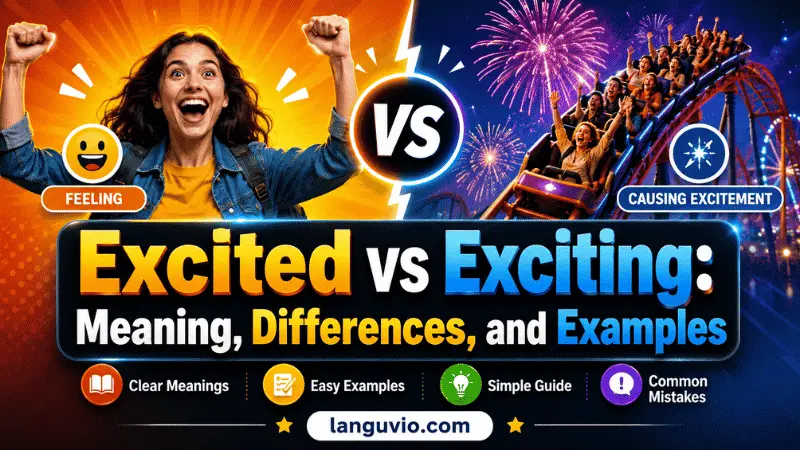
Both excited and exciting are correct English words, but they do not express the same idea. The choice depends on whether you are describing a feeling or the person, event, idea, or experience that produces that feeling.
A student may be excited about graduation because graduation is an exciting event. A family may feel excited before a vacation because the planned trip sounds exciting.
The difference is not simply “people versus things.” People can also be exciting when their personality, performance, or ideas create enthusiasm in others. The most reliable approach is to identify who experiences the feeling and what causes it.
Quick Answer
Use excited to describe someone who feels or shows enthusiasm, eagerness, or heightened emotion. Use exciting to describe someone or something that creates that reaction.
- We are excited about the concert.
- The concert should be exciting.
Both words are standard, but switching them usually changes the sentence’s meaning.
Why People Confuse Them
The words look similar because both come from the verb excite. They also commonly appear as adjectives after forms of be:
- Maya is excited.
- The announcement is exciting.
This similar structure makes the words appear interchangeable. They are not.
Another source of confusion is the common shortcut that -ed words describe people and -ing words describe things. That shortcut works in many basic examples, but it is incomplete.
A person can create excitement:
- Jordan is an exciting performer.
A crowd can experience excitement:
- The excited crowd cheered loudly.
The important question is not whether the subject is a person or thing. Ask whether the subject experiences the feeling or causes it.
Key Differences At A Glance
| Feature | excited | exciting |
| Main meaning | Experiencing or showing excitement | Producing or causing excitement |
| Main focus | The person’s or group’s reaction | The source of the reaction |
| Common subjects | I, we, children, fans, employees | News, games, trips, ideas, performers |
| Basic example | The fans were excited. | The final inning was exciting. |
| Common pattern | excited about or excited to | exciting event or something is exciting |
Neither word is more formal or more correct overall. Each fits a different meaning.
Meaning and Usage Difference
Excited usually describes the person, group, or animal experiencing a heightened emotional state. That state often involves happiness and anticipation, though the surrounding context can also suggest nervous energy or agitation.
- Leah felt excited before opening the letter.
- The children became excited when the music started.
Exciting describes the source of that reaction. It may refer to an event, opportunity, idea, person, story, change, or experience.
- The company announced an exciting new project.
- The championship game became exciting near the end.
Both words most often function as adjectives in this comparison. However, they can also appear as forms of the verb excite.
- The unexpected result excited public interest.
- The discovery is exciting researchers across the country.
Sentence structure and meaning reveal whether the word is acting as an adjective or part of a verb phrase.
Tone, Context, and Formality
Both words are standard in casual conversation, professional communication, academic writing, and formal announcements. Neither one is automatically more formal.
In everyday speech, excited often expresses personal enthusiasm:
- I’m excited to see everyone tonight.
In business writing, it can communicate positive anticipation:
- Our team is excited to begin the partnership.
The word exciting frequently appears in announcements and promotional descriptions:
- We have an exciting update to share.
- This role offers exciting opportunities for growth.
Because exciting is strongly positive, repeated use can make business writing sound exaggerated. That is a matter of tone, not grammar.
An exciting speaker creates enthusiasm in the audience. An excited speaker personally feels enthusiastic. Both descriptions can be correct, but they focus on different qualities.
Which One Should You Use?
| Context | Best Choice | Why |
| Describing your own enthusiasm | excited | You experience the feeling |
| Describing an enjoyable event | exciting | The event produces the feeling |
| Describing enthusiastic fans | excited | The fans feel or show excitement |
| Describing an energetic performer | exciting | The performer creates excitement |
| Describing positive news | exciting | The news causes an emotional reaction |
| Describing your reaction to the news | excited | You experience the reaction |
Use this sentence test:
- Who or what feels the emotion? Choose excited.
- Who or what creates the emotion? Choose exciting.
This test is more accurate than separating people from things.
When One Choice Sounds Wrong
The wrong word often creates a meaning that the writer did not intend.
Unnatural for the intended meaning:
I am exciting about my new job.
Correct:
I am excited about my new job.
The first sentence does not follow the normal pattern for naming a person’s feeling. It also incorrectly places exciting before about.
Consider another example:
Unnatural:
We attended an excited conference.
Correct:
We attended an exciting conference.
A conference does not normally experience enthusiasm. It can create enthusiasm, interest, or energy for the people attending it.
However, “The presenter was exciting” can be correct. It means the presenter was engaging or stimulating. “The presenter was excited” means the presenter personally felt enthusiastic.
Common Mistakes (and Quick Fixes)
A common mistake is assuming that every person must be described with excited. A person may be exciting when that person causes excitement.
- Correct: The new coach is exciting to watch.
- Correct: The new coach is excited about the season.
Another mistake involves linking verbs:
- Incorrect: The students seemed exciting about the field trip.
- Correct: The students seemed excited about the field trip.
The students experience the feeling, so excited is required.
Writers also sometimes attach about to the wrong form:
- Incorrect: There is something exciting about our plans?
- Correct when describing a quality: There is something exciting about our plans.
- Correct when describing a reaction: We are excited about our plans.
The first correct sentence says the plans contain an exciting quality. The second describes the speakers’ feelings.
Everyday Examples
- I’m excited to start classes at the new campus.
- The science program includes several exciting experiments.
- Ava sounded excited when she called her parents.
- The final episode was more exciting than I expected.
- Our neighbors are excited about moving into their new home.
- The museum has an exciting exhibit opening this weekend.
- Malik is an exciting player because he takes creative risks.
- The volunteers were excited to see how many people attended.
- Planning the road trip has been exciting for the whole family.
- Everyone looked excited when the winner entered the room.
A sentence may naturally contain both words:
- We are excited because the next stage of the project looks exciting.
Here, excited describes the team’s reaction, while exciting describes the quality of the project stage.
Dictionary-Style Word Details
Verb
- Excited: The simple past and past participle of excite. It means caused someone or something to experience increased interest, activity, enthusiasm, or emotion.
The announcement excited the audience. - Exciting: The present participle of excite. It appears in progressive verb phrases when something is currently producing a reaction.
The discovery is exciting interest among local researchers.
In everyday comparisons, both words are more commonly encountered as adjectives.
Noun
- Excited: Not commonly used as a noun in standard US English.
- Exciting: Not commonly used as a noun in standard US English.
Use excitement when a noun is needed:
- The announcement created excitement.
- Her voice was filled with excitement.
Synonyms
- Excited: Closest plain alternatives include thrilled, eager, enthusiastic, animated, and worked up. Their meanings and intensity differ by context. Closest opposites include unexcited, calm, and unenthusiastic.
- Exciting: Closest plain alternatives include thrilling, stimulating, exhilarating, gripping, and electrifying. Common opposites include boring, dull, and uneventful.
The two words are related, but they are not synonyms for each other.
Example Sentences
- Excited: Nina was excited to receive her college acceptance letter.
- Excited: The employees appeared excited about the updated schedule.
- Excited: His enthusiastic message excited everyone in the group.
- Exciting: The team made an exciting comeback in the fourth quarter.
- Exciting: Starting a small business can be exciting and demanding.
- Exciting: The new evidence is exciting debate among historians.
Word History
Both words developed from the verb excite. Their endings help explain their grammatical relationship.
- Excited is the -ed form and commonly describes the resulting emotional state.
- Exciting is the -ing form and commonly describes the source producing that state.
No separate origin story is needed to explain the modern distinction. Their current meanings follow directly from how the two forms developed from the same verb.
Phrases Containing
Common phrases with excited include:
- excited about the opportunity
- excited to begin
- excited for the weekend
- visibly excited
- genuinely excited
- too excited to sleep
Common phrases with exciting include:
- exciting news
- exciting opportunity
- exciting experience
- exciting development
- exciting to watch
- new and exciting
These patterns reflect the main distinction: excited commonly connects to someone’s reaction, while exciting commonly modifies the source of that reaction.
FAQs
“I am excited” is correct when you mean you feel eager, happy, or enthusiastic. “I am exciting” describes you as someone who creates excitement for others. That sentence can be grammatical, but it usually communicates a very different idea.
Yes. Exciting can describe a person who is stimulating, impressive, or enjoyable to watch or hear. “She is an exciting speaker” means she creates excitement in her audience. It does not describe how she feels during the speech.
Yes. Excited can describe any people or animals experiencing or showing the feeling. An excited crowd, excited students, and excited fans are natural phrases. The noun after excited does not have to be singular or refer to one person.
No. Swapping them usually changes who experiences the feeling and what causes it. “The children were excited” describes their reaction. “The children were exciting” says the children caused excitement, which may be correct in a special context but means something else.
Use excited about when naming the reason for someone’s feeling: “We are excited about the move.” Exciting about is not the normal pattern. Use exciting before a noun or after a linking verb, as in “exciting plans” or “The move is exciting.”
No. Excited often expresses happy anticipation, but it can also describe heightened emotion or agitation. Context shows the intended tone. Even so, the excited versus exciting choice remains the same: excited identifies the experiencer, while exciting identifies the cause.
Conclusion
Use excited for the person, group, or animal experiencing or showing the feeling. Use exciting for the person, event, idea, or thing that creates the feeling.
Do not rely only on “people versus things.” A person can be excited, exciting, or both:
- The excited musician gave an exciting performance.
Ask one final question before choosing: Does the subject experience excitement, or does it produce excitement? The answer will point you to the correct word.


