Hair vs hare is a simple comparison, but it causes real spelling mistakes because the two words sound the same. In writing, they are not interchangeable.
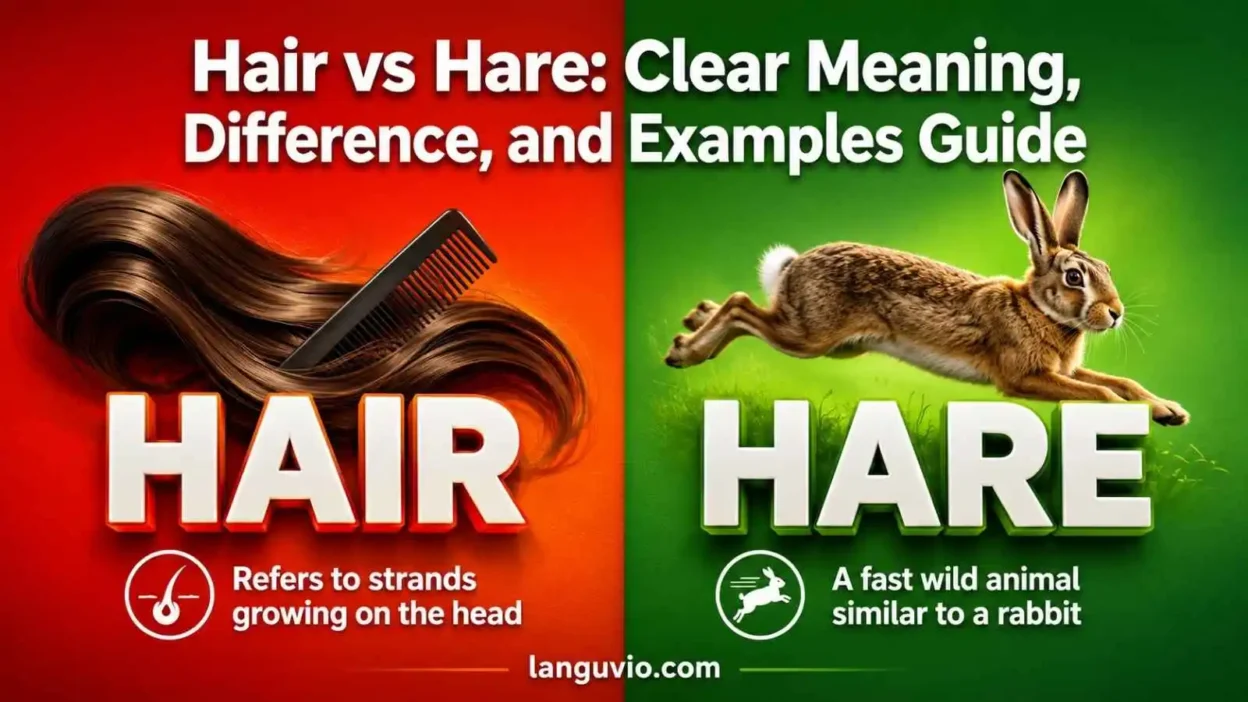
Hair means the threadlike strands that grow from a person’s head or from the skin of many animals. Hare means a fast, long-eared animal that looks like a large rabbit. The difference is about meaning, not pronunciation.
Use hair for grooming, style, body strands, or animal coats. Use hare when you mean the animal, especially in nature writing, stories, or wildlife contexts.
Quick Answer
Hair is the correct word for strands that grow from the head, face, or body. Hare is the correct word for a fast, long-eared animal similar to a rabbit. They sound alike in normal American English, so context and spelling decide the meaning.
Correct: “She brushed her hair.”
Correct: “A hare ran across the trail.”
Why People Confuse Them
People confuse hair and hare because they are homophones. That means they sound the same but have different spellings and meanings.
In speech, “I saw a hare” and “I saw a hair” may sound alike. The listener uses context to understand the meaning. In writing, the spelling must do that job.
The mistake often happens when someone writes quickly or trusts sound alone. A spell-checker may not catch the error because both words are real English words.
Key Differences At A Glance
Here is the core difference:
• Hair = strands growing from skin or the head
• Hare = a fast, long-eared animal
• Hair is usually a noun
• Hare is usually a noun, but it can rarely work as a verb meaning to run quickly
• Hair and hare sound the same in common American speech
• The spelling must match the meaning
A helpful memory trick: hair has air in it, and hair can air-dry. Hare has are in it, as in “hares are animals.”
Meaning and Usage Difference
Hair refers to one strand, many strands, or the whole covering on someone’s head or body. It can be uncountable when you mean hair as a mass: “She has curly hair.” It can be countable when you mean individual strands: “I found three hairs on my jacket.”
Hare is a countable noun for the animal. You can say “a hare,” “two hares,” or, in some wildlife contexts, “several hare.”
The main pronunciation note is useful here: hair and hare are pronounced the same in normal American English, like “hair.” The difference appears in spelling and meaning.
Tone, Context, and Formality
Hair is an everyday word. You can use it in casual speech, school writing, health writing, beauty writing, and normal conversation.
Examples:
“She has short hair.”
“The dog’s hair was all over the couch.”
“I need a hair appointment.”
Hare is also a standard word, but it appears in more specific contexts. You may see it in nature writing, animal facts, folktales, and phrases like “the tortoise and the hare.”
In everyday US speech, people often say “rabbit” more often than “hare” unless they truly mean a hare. A hare is not just a fancy word for any rabbit.
Which One Should You Use?
Use the word that matches the thing you mean. If you are talking about strands, grooming, texture, color, or a coat on an animal, choose hair. If you are talking about the wild long-eared animal, choose hare.
| Context | Best Choice | Why |
| Talking about a haircut | hair | It refers to strands on the head. |
| Describing a fast animal in a field | hare | It names the animal. |
| Mentioning one strand on a shirt | hair | It means an individual strand. |
| Retelling the tortoise story | hare | The character is the animal. |
| Talking about a salon visit | hair | It relates to grooming and style. |
| Describing wildlife on a trail | hare | It fits the animal context. |
When One Choice Sounds Wrong
The wrong word can make the sentence confusing or funny.
Wrong: “She brushed her long hare.”
Correct: “She brushed her long hair.”
Wrong: “A hair jumped across the field.”
Correct: “A hare jumped across the field.”
Wrong: “I found a hare in my soup.”
Correct: “I found a hair in my soup.”
Wrong: “The hare stylist fixed my bangs.”
Correct: “The hair stylist fixed my bangs.”
The sound may be the same, but the written word changes the picture in the reader’s mind.
Common Mistakes (and Quick Fixes)
One common mistake is using hare when talking about someone’s head.
Wrong: “His hare is getting long.”
Correct: “His hair is getting long.”
Another mistake is using hair for the animal.
Wrong: “The hair ran into the woods.”
Correct: “The hare ran into the woods.”
Writers also get confused with countable and uncountable hair. Say “her hair is dark” when you mean all of it. Say “two hairs” when you mean two individual strands.
For animals, use hare only when the animal is actually a hare. Do not use it as a general replacement for every rabbit.
Everyday Examples
Hair:
“She pulled her hair into a ponytail before work.”
“I found a gray hair near my temple.”
“The baby has soft brown hair.”
“Cat hair stuck to my black sweater.”
“He washed his hair after practice.”
Hare:
“A hare darted across the hiking trail.”
“The kids read a story about a tortoise and a hare.”
“We saw a hare near the edge of the field.”
“The hare froze when it heard footsteps.”
“A jackrabbit is a type of hare, not a true rabbit.”
Dictionary-Style Word Details
Verb
Hair: Not commonly used as a verb in standard US English. In normal writing, use hair as a noun or as part of noun phrases such as “hair care” or “hair salon.”
Hare: Can be used as a verb meaning to run or go very quickly, but this use is uncommon in everyday US English and often sounds British or literary.
Example: “He hared down the road.”
More natural in US writing: “He raced down the road.”
Noun
Hair: A noun meaning strands that grow from the skin of people or animals. It can be uncountable or countable.
Uncountable: “She has thick hair.”
Countable: “There are two hairs on the sink.”
Hare: A countable noun meaning a fast, long-eared animal related to rabbits.
Example: “A hare crossed the meadow.”
Synonyms
Hair: Exact synonyms are limited. Closest plain alternatives include strand, lock, tress, fur, and coat, depending on context. “Fur” fits many animals but not every use of human hair.
Hare: Exact synonyms are limited. Closest plain alternatives include large rabbit-like animal or jackrabbit in some US contexts. However, “rabbit” is not always an exact synonym.
Clear antonyms do not help much for either word, so they should not be forced.
Example Sentences
Hair:
“She cut her hair before the interview.”
“I found a dog hair on the blanket.”
“His hair turned lighter in the summer.”
Hare:
“The hare disappeared into the tall grass.”
“A hare can move very quickly across open ground.”
“The old story compares the slow tortoise with the quick hare.”
Word History
Hair: The word comes from Old English and has long referred to the threadlike growth on people and animals.
Hare: The word also comes from Old English and has long named the long-eared animal.
The two words developed separately. Their similar sound today does not mean they share the same meaning.
Phrases Containing
Hair:
“bad hair day”
“split hairs”
“hairline crack”
“let your hair down”
“make your hair stand on end”
Hare:
“the tortoise and the hare”
“harebrained idea” or “hare-brained idea”
“March hare”
“hare and hounds”
These phrases keep the same basic meaning: hair relates to strands, while hare relates to the animal or ideas linked to it.
FAQs
What is the difference between hair and hare?
Hair means the strands that grow on a person’s head, face, or body. It can also describe the covering on some animals. Hare means a fast, long-eared animal related to rabbits. The words sound the same, but their meanings are different.
Are hair and hare pronounced the same?
Yes. In normal American English, hair and hare are pronounced the same. They are homophones, which means they sound alike but have different spellings and meanings.
Which word should I use?
Use hair when you mean strands, grooming, style, or body covering. For example, “She brushed her hair.” Use hare when you mean the animal. For example, “A hare ran across the field.”
Can hair be plural?
Yes. Hair is often uncountable when you mean all the strands together: “Her hair is curly.” It becomes countable when you mean individual strands: “I found three hairs on my shirt.”
Is a hare the same as a rabbit?
A hare is related to a rabbit, but it is not exactly the same animal. Hares are usually larger, faster, and have longer ears and legs than rabbits.
Can hare be used as a verb?
Yes, but it is uncommon in everyday American English. As a verb, hare can mean to run or move quickly. Most US writers would use “race,” “run,” or “rush” instead.
How can I remember hair vs hare?
Think of it this way: hair grows on your head, while a hare runs in a field. If the sentence is about strands, choose hair. If it is about the animal, choose hare.
Conclusion
The difference between hair and hare is simple: hair means the strands that grow from skin, and hare means a fast, long-eared animal. They sound the same in normal American English, so the spelling must carry the meaning.
Use hair for grooming, strands, body covering, or animal coats. Use hare for the animal or, rarely, for the verb meaning to run quickly. When in doubt, picture the sentence: if you see strands, write hair; if you see the animal, write hare.
Hair means the strands that grow on a person’s head, face, or body. It can also describe the covering on some animals. Hare means a fast, long-eared animal related to rabbits. The words sound the same, but their meanings are different.
Yes. In normal American English, hair and hare are pronounced the same. They are homophones, which means they sound alike but have different spellings and meanings.
Use hair when you mean strands, grooming, style, or body covering. For example, “She brushed her hair.” Use hare when you mean the animal. For example, “A hare ran across the field.”
Yes. Hair is often uncountable when you mean all the strands together: “Her hair is curly.” It becomes countable when you mean individual strands: “I found three hairs on my shirt.”
A hare is related to a rabbit, but it is not exactly the same animal. Hares are usually larger, faster, and have longer ears and legs than rabbits.
Yes, but it is uncommon in everyday American English. As a verb, hare can mean to run or move quickly. Most US writers would use “race,” “run,” or “rush” instead.
Think of it this way: hair grows on your head, while a hare runs in a field. If the sentence is about strands, choose hair. If it is about the animal, choose hare.