
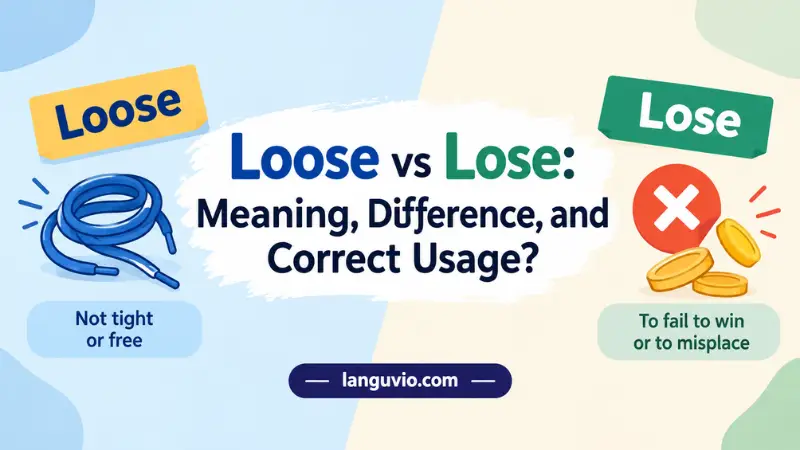
Loose and lose are both correct English words, but they have different meanings and grammatical roles. Loose usually describes something that is not tight or firmly attached. Lose is a verb that means to misplace something, stop having something, or fail to win.
Compare these examples:
- The screw is loose.
- Don’t lose the screw.
In the first sentence, loose describes the screw’s condition. In the second, lose describes something that could happen to it.
Although the words look similar, choosing the right one is simple once you understand their meanings and pronunciation.
Quick Answer
Use loose when you mean not tight, not secure, or free from restraint. Use lose when you mean to misplace something, no longer have something, or fail to win.
| Context | Best Choice | Why |
|---|---|---|
| Clothing that is not tight | Loose | Describes how clothing fits. |
| Misplacing your phone | Lose | Describes failing to keep track of something. |
| A screw that needs tightening | Loose | Describes an insecure connection. |
| Failing to win a game | Lose | Describes the result of a contest. |
| Releasing an animal | Loose, in a suitable expression | Can describe freedom from restraint. |
The easiest reminder is that loose has two O’s and usually describes extra room or freedom. Lose has one O and commonly describes losing something or failing to keep it.
Why People Confuse Them
The words differ by only one letter, and both contain a similar vowel sound. When people type quickly, they may choose the wrong spelling without noticing.
Their final sounds also differ:
- Loose rhymes with goose and ends with an /s/ sound.
- Lose rhymes with choose and ends with a /z/ sound.
Their grammatical roles provide another clue. Loose is most often an adjective, while lose is a verb.
However, loose can also function as a verb meaning “to release.” That less common use is valid, but it does not make loose a substitute for lose in ordinary sentences about misplacing things or failing to win.
Key Differences At A Glance
| Feature | Loose | Lose |
|---|---|---|
| Main grammatical role | Adjective | Verb |
| Main meaning | Not tight or securely fixed | Misplace, stop having, or fail to win |
| Final sound | /s/, as in goose | /z/, as in choose |
| Common example | A loose button | Lose your wallet |
| Common verb forms | Loosen, loosened; loose can also be a verb | Lose, loses, losing, lost |
The words are not interchangeable. Changing one to the other can alter the sentence’s meaning or make it incorrect.
Meaning and Usage Difference
What does loose mean?
Loose usually describes something that is not tight, firmly attached, or securely held.
Examples include:
- My jacket feels loose around the shoulders.
- A loose floorboard makes a noise when I step on it.
- The dog was running loose in the yard.
It can also describe something relaxed, not compact, or lacking strict control.
In less common verb use, loose means to release or set free:
The handler loosed the birds from their cages.
In everyday conversation, however, the adjective is much more common.
What does lose mean?
Lose is a verb with several common meanings.
It can mean to misplace something:
I always lose my sunglasses when I travel.
It can mean to fail to win:
Our team doesn’t want to lose the championship game.
It can also mean to stop having or maintaining something:
She doesn’t want to lose her job.
Other common expressions include lose weight, lose interest, lose time, and lose control.
The verb changes form according to tense and sentence structure:
- Present: I lose my keys.
- Third-person singular: He loses his keys.
- Past: He lost his keys.
- Ongoing action: He is losing his keys less often.
Remember that the past tense is lost, not loosed, when the meaning is misplacing something or failing to keep it.
Tone, Context, and Formality
Neither word is inherently more formal than the other. Both appear in everyday conversation, professional writing, school assignments, and formal documents.
The difference is meaning, not tone.
Loose is appropriate when describing clothing, connections, objects, or freedom of movement:
Please check the loose railing before anyone uses the stairs.
Lose fits situations involving possessions, results, opportunities, or changes:
We cannot afford to lose another customer.
The verb use of loose is more limited in everyday communication. In most ordinary sentences, writers should use it only when the intended meaning is genuinely to release something.
Which One Should You Use?
Choose the word based on what you want to say.
Use loose if you are describing a condition:
- The dog has a loose collar.
- These pants are too loose.
- One of the cabinet handles is loose.
- Keep the screws in a loose pile rather than tightening them together.
Use lose if you are describing an action, change, or result:
- Don’t lose your boarding pass.
- I hope we don’t lose the game.
- You could lose your place in line.
- She wants to lose weight for health reasons.
- Try not to lose focus during the meeting.
A practical test is to ask yourself whether you are describing something or talking about losing it.
If you can replace the word with not tight, not secure, or free, loose may fit. If you mean misplace, fail to win, or stop having, use lose.
When One Choice Sounds Wrong
Certain expressions make the distinction especially clear.
Incorrect: I don’t want to loose my wallet.
Correct: I don’t want to lose my wallet.
The sentence refers to misplacing a wallet, so the verb lose is required.
Incorrect: My new shoes are too lose.
Correct: My new shoes are too loose.
Here, the word describes how the shoes fit.
Incorrect: Our team might loose the final.
Correct: Our team might lose the final.
A team can lose a contest, but loose does not mean to be defeated.
There is one important exception to remember: loose is correct as a verb when it means to release something. For example, “They loosed the horses into the field” uses the word in a valid but less common sense.
Common Mistakes (and Quick Fixes)
– Wrong: I hope I don’t loose my phone.
Right: I hope I don’t lose my phone.
– Wrong: These jeans are too lose.
Right: These jeans are too loose.
– Wrong: He could loose control of the vehicle.
Right: He could lose control of the vehicle.
– Wrong: Don’t loose the game.
Right: Don’t lose the game.
– Wrong: The handle is lose.
Right: The handle is loose.
A useful memory trick is to associate the extra O in loose with extra space. Loose clothing has room, while a loose connection is not firmly secured.
For lose, remember the final Z sound in choose. If you are talking about misplacing something or failing to win, the one-O spelling is the correct choice.
Everyday Examples
Here are realistic examples showing how the words work in American English.
Using loose
- My headphones have a loose wire, so the sound cuts out.
- The puppy got loose when someone opened the gate.
- I prefer loose shirts when the weather is hot.
- One of the buttons on my work shirt is loose.
- Please keep the papers together instead of leaving them loose on the desk.
Using lose
- I don’t want to lose my phone during the trip.
- We could lose our reservation if we arrive too late.
- She doesn’t want to lose the progress she made at the gym.
- If the team loses tonight, it will miss the playoffs.
- I tend to lose focus when I’m tired.
A useful contrast
The bolt is loose, so be careful not to lose it.
Both words appear in the same sentence, but each serves a different purpose. Loose describes the bolt, while lose describes the possibility of misplacing it.
Dictionary-Style Word Details
Verb
Loose: Can be a verb meaning to release, free, or let something go. This use is less common in everyday American English. Example: “The soldiers loosed the arrows.”
Lose: A common verb meaning to misplace something, stop having something, or fail to win. Its forms are lose, loses, losing, and lost. Example: “I lost my ticket.”
Noun
Loose: Not normally used as a noun by itself in standard everyday American English. Related nouns include looseness and loose change, though loose change is a phrase rather than a single noun.
Lose: Not normally used as a noun. The related noun loss describes the act or result of losing something. For example, “The company reported a loss.”
Synonyms
Loose: Depending on context, closest alternatives include baggy, slack, unfastened, unsecured, or free. These words are not exact substitutes in every sentence.
Lose: Depending on context, closest alternatives include misplace, forfeit, drop, or fail to win. The correct alternative depends on whether something is misplaced, given up, or not won.
There is no single synonym that accurately replaces either word in every use.
Example Sentences
Loose:
- The lid is loose and needs to be secured.
- She likes wearing loose clothing at home.
- The dog broke free and ran loose through the yard.
Lose:
- Please don’t lose the receipt.
- We may lose the match if we stop practicing.
- He hopes to lose less time during his morning commute.
Word History
Loose and lose are separate English words with different histories and meanings. Their similar spelling does not make them interchangeable.
Modern usage preserves the distinction between loose, commonly associated with slackness or freedom, and lose, associated with loss, misplacement, or failure to retain something. No special historical rule is needed to choose between them today.
Phrases Containing
Loose:
- Loose change — coins, especially small-value coins.
- Loose ends — unfinished details or matters that need attention.
- Let loose — allow someone or something to move or behave freely.
- On the loose — free and not under control.
- Loose-fitting — designed to fit without being tight.
Lose:
- Lose weight — become lighter in body weight.
- Lose control — no longer be able to manage or direct something.
- Lose interest — stop feeling interested.
- Lose track of — no longer know where something is or how it is progressing.
- Lose your temper — become angry.
These phrases are useful because they show how each word appears naturally in common expressions.
FAQs
What is the main difference between loose and lose?
Loose usually describes something that is not tight, firmly attached, or restrained. Lose is a verb about misplacing something, failing to win, or no longer having something. The words have different meanings, so choosing the correct one depends on your sentence.
Is loose ever correct as a verb?
Yes. Loose can be a verb meaning to release or set something free, as in “They loosed the horses.” This use is uncommon in ordinary conversation. Do not use it when you mean to misplace something or fail to win.
How do you pronounce loose and lose?
Loose ends with an unvoiced S sound and rhymes with goose. Lose ends with a voiced Z sound and rhymes with choose. Listening for that final sound can help you distinguish the words when speaking or proofreading your writing.
Should I write lose weight or loose weight?
Write lose weight when referring to reducing body weight. In this expression, lose is the verb describing a change. Loose weight is not the standard spelling for this meaning, even though loose is a valid English word.
Can loose and lose ever mean the same thing?
They are not interchangeable in ordinary usage. The verb loose can mean release, while lose can mean misplace or fail to retain something. Those ideas may overlap in a few situations, but each word still has its own grammatical role and meaning.
What is an easy way to remember loose vs. lose?
Associate the two O’s in loose with extra room, like loose-fitting clothing. Remember that lose ends with a Z sound, as in choose. When in doubt, ask whether you mean something is not tight or that you might no longer have it.
Conclusion
Loose and lose look similar, but their meanings and grammatical roles are different.
Use loose to describe something that is not tight, is not securely attached, or is free from restraint. Use lose when talking about misplacing something, failing to win, or no longer having something.
Remember the pronunciation difference: loose rhymes with goose, while lose rhymes with choose. That sound clue, along with the meaning of your sentence, will help you choose correctly.


