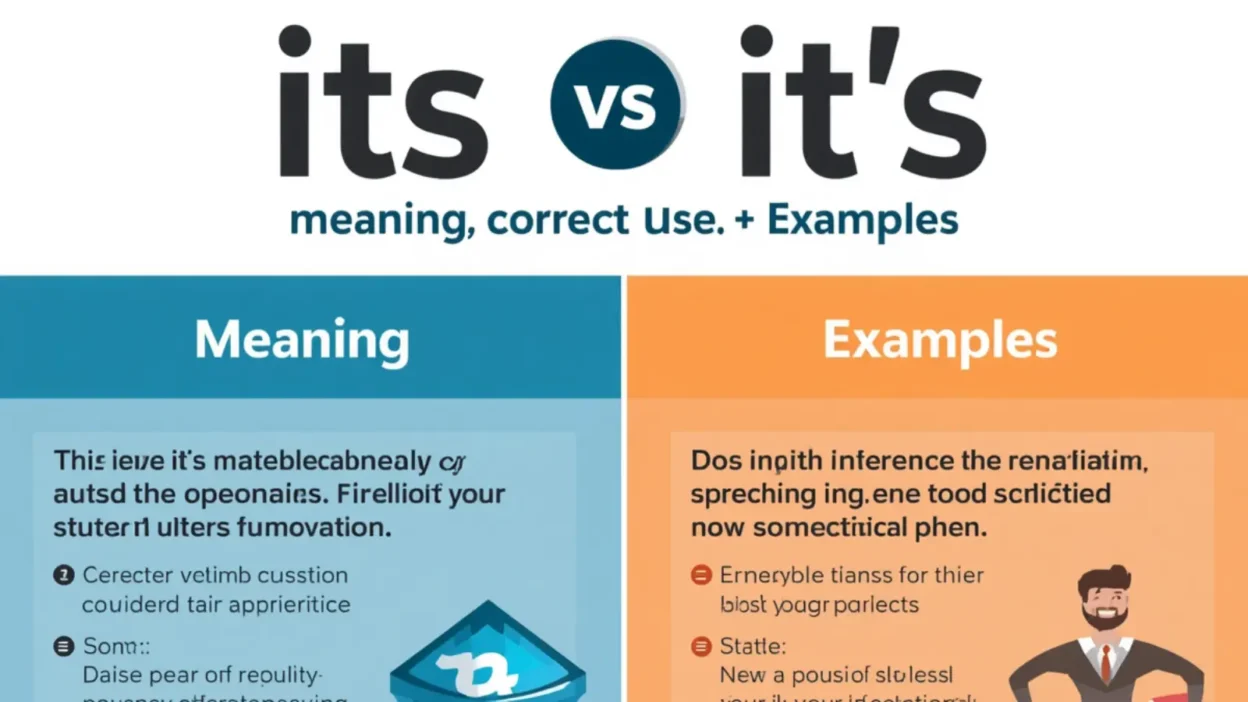
Which is correct: its or it’s? Both are correct, but they are used in different ways.
Use its when you mean something belongs to, comes from, or relates to “it.”
Use it’s when you mean it is or it has.
The apostrophe is the key. In it’s, the apostrophe shows that letters are missing. It does not show ownership.
Quick Answer
Its means “belonging to it” or “relating to it.”
Example:
The laptop lost its charge.
It’s means “it is” or “it has.”
Example:
It’s almost time for the meeting.
It’s been a long week.
The fastest test is this: replace the word with it is or it has. If the sentence still makes sense, use it’s. If not, use its.
Why People Confuse Them
People confuse its and it’s because they sound exactly the same. You cannot hear the apostrophe in speech.
The other reason is that apostrophes often show possession in nouns.
You write:
The dog’s leash
Maya’s phone
The company’s policy
So it feels natural to write it’s for possession. But that is not how this word works.
Its is like his, her, and their. These possessive words do not use apostrophes.
Key Differences At A Glance
| Context | Best Choice | Why |
|---|---|---|
| Means “it is” | it’s | The apostrophe replaces missing letters. |
| Means “it has” | it’s | It works as a short form of “it has.” |
| Shows possession | its | It means “belonging to it.” |
| Comes before a noun it owns or relates to | its | It often appears before words like name, color, tail, battery, policy, or price. |
| Formal writing | its or it’s | Both are standard, but contractions may sound more casual. |
| Very formal writing | its, or write out it is / it has | Avoid contractions when a formal tone requires it. |
Meaning and Usage Difference
Its is the possessive form of it. It points to something connected to a thing, animal, place, idea, group, or organization.
Examples:
The phone updated its software overnight.
The restaurant changed its hours.
The cat curled its tail around the chair.
It’s is a contraction. It shortens it is or it has.
Examples:
Rain is falling in Chicago.
Finding parking downtown has been hard.
Clearly, the plan needs more work.
The words are pronounced the same: its sounds like it’s. That is why this is mainly a writing problem, not a speaking problem.
Tone, Context, and Formality
Its is neutral. It works in casual, formal, academic, and business writing.
Example:
The report explains its main findings in the first section.
It’s is also standard, but because it is a contraction, it can sound more conversational.
Example:
It’s easier to read the chart on a laptop.
In very formal writing, you may choose it is or it has instead of it’s.
More formal:
It is important to review the contract.
More conversational:
It’s important to review the contract.
Do not use it’s for ownership in any tone. That mistake looks wrong in schoolwork, work emails, resumes, reports, and public posts.
Which One Should You Use?
Use its when the next idea is something owned by or connected to “it.”
Choose its in sentences like these:
The app changed its layout.
The city raised its parking rates.
The dog found its toy.
Use it’s when you can replace it with it is or it has.
Choose it’s in sentences like these:
Already 5 p.m.
The morning has been busy.
That’s not the answer we expected.
Compact comparison:
- its = belonging to it
- it’s = it is
- it’s = it has
- its’ = not the standard choice
When One Choice Sounds Wrong
A good way to catch the error is to read the sentence with it is or it has.
Wrong:
The car needs it’s oil changed.
Test:
The car needs it is oil changed.
That does not make sense.
Correct:
The car needs its oil changed.
Wrong:
Its going to be cold tonight.
Test:
It is going to be cold tonight.
That makes sense.
Correct:
It’s going to be cold tonight.
This test works for most everyday sentences.
Common Mistakes (and Quick Fixes)
Mistake 1: Using it’s for possession.
Wrong:
The company updated it’s website.
Correct:
The company updated its website.
Why:
The website belongs to or relates to the company. You need the possessive form.
Mistake 2: Using its for “it is.”
Wrong:
Its hard to focus with all that noise.
Correct:
It’s hard to focus with all that noise.
Why:
You can say, “It is hard to focus.”
Mistake 3: Using its for “it has.”
Wrong:
Its been a great season for the team.
Correct:
It’s been a great season for the team.
Why:
You can say, “It has been a great season.”
Mistake 4: Writing its’.
Wrong:
The store changed its’ return policy.
Correct:
The store changed its return policy.
Why:
Its’ is not the standard form for this meaning.
Everyday Examples
Here are natural examples you might use in US English.
Its examples:
The school posted its calendar online.
The phone kept its charge all day.
The bird built its nest above the porch light.
The team announced its new coach on Monday.
The coffee shop raised its prices again.
The TV lost its signal during the storm.
It’s examples (revised):
Too early to call her.
We haven’t visited Austin in months.
Driving in that weather is not safe.
The update is finally working.
Saving the receipt is a good idea.
What a strange week at work it’s been!
Mixed examples:
The camera lost its focus, but it’s working now.
The dog wagged its tail because it’s excited.
The store changed its hours, so it’s closed on Sundays.
Dictionary-Style Word Details
Verb
• its: Not used as a verb in standard US English. It is a possessive word.
• it’s: Not a verb by itself. It is a contraction made from the pronoun it plus the verb is or has.
Examples:
It’s raining. = It is raining.
It’s been fun. = It has been fun.
Noun
• its: Not commonly used as a noun in standard US English.
• it’s: Not commonly used as a noun in standard US English. It is a contraction.
Synonyms
• its: No exact synonym fits every sentence. Closest plain alternatives are of it, belonging to it, or related to it.
Example:
The house lost its charm.
The house lost the charm of it.
The second version is possible but less natural.
• it’s: Closest plain alternatives are it is and it has. These are not loose synonyms; they are the full forms of the contraction.
Examples:
It’s late. = It is late.
It’s been fixed. = It has been fixed.
Clear antonyms do not really apply to its or it’s because this is a grammar-choice pair, not a meaning pair like hot/cold.
Example Sentences
• its:
The museum opened its new exhibit Friday.
The puppy chased its shadow across the yard.
The laptop shut down because its battery died.
• it’s:
It’s almost time to leave.
It’s been a busy day at the office.
It’s not what I ordered.
Word History
• its: The history of its is not as simple as “apostrophes always show possession.” Older English usage was less settled, and the modern form developed over time. Today, standard English uses its without an apostrophe for possession.
• it’s: It’s is the contraction of it is or it has. In current standard English, the apostrophe marks missing letters, not ownership.
The practical modern rule is clear: use it’s only for it is or it has, and use its for possession.
Phrases Containing
• its:
on its own
in its place
at its best
do its job
lose its way
serve its purpose
• it’s:
it’s okay
it’s time
it’s been a while
it’s worth it
it’s up to you
it’s not a problem
- FAQ: Understanding “Its” vs “It’s”
Q1: What is the difference between “its” and “it’s”?
its = possessive form, meaning “belonging to it” or “relating to it.” Example: The laptop lost its charge.
it’s = contraction of “it is” or “it has.” Example: It’s been a long week.
Q2: How can I quickly test which one to use?
Try replacing the word with “it is” or “it has”: If it makes sense, use it’s.
If not, use its.
Example: Wrong: The car needs it’s oil changed. → The car needs it is oil changed ❌
Correct: The car needs its oil changed ✅
Q3: Why do people often confuse them?
They sound identical in speech.
Apostrophes often indicate possession in English, so writers mistakenly use it’s for ownership.
Remember: its (possession) does not take an apostrophe.
Q4: Are there common mistakes I should watch for?
Using it’s for possession: Wrong: The company updated it’s website.
Correct: The company updated its website.
Using its for “it is” or “it has”: Wrong: Its been a great season.
Correct: It’s been a great season.
Writing its’: Wrong: The store changed its’ return policy.
Correct: The store changed its return policy.
Q5: Can you give some everyday examples?
its: The school posted its calendar online.
The bird built its nest above the porch light.
The TV lost its signal during the storm.
it’s: It’s too early to call her.
It’s finally working after the update.
It’s been a strange week at work.
Mixed example: The dog wagged its tail because it’s excited.
Q6: Formal vs casual writing tips
Both its and it’s are standard in everyday writing.
For very formal writing, spell out contractions: Instead of it’s, use it is or it has.
Example: Formal: It is important to review the contract.
Conversational: It’s important to review the contract.
Q7: Quick recap
its → ownership/possession
it’s → it is / it has
Test tip: Expand it’s → if it works, use it’s; if not, use its.
This FAQ format makes it easy to reference common mistakes, examples, and quick tests for proper usage.
If you want, I can also make a short, printable version with a table that visually compares its vs it’s for easier memorization. Do you want me to do that?
Conclusion
The difference between its and it’s is simple once you know what the apostrophe does.
Use its for possession:
The cat licked its paw.
Use it’s for it is or it has:
It’s late.
It’s been fun.
When you are unsure, expand the word. If it is or it has works, write it’s. If not, write its.