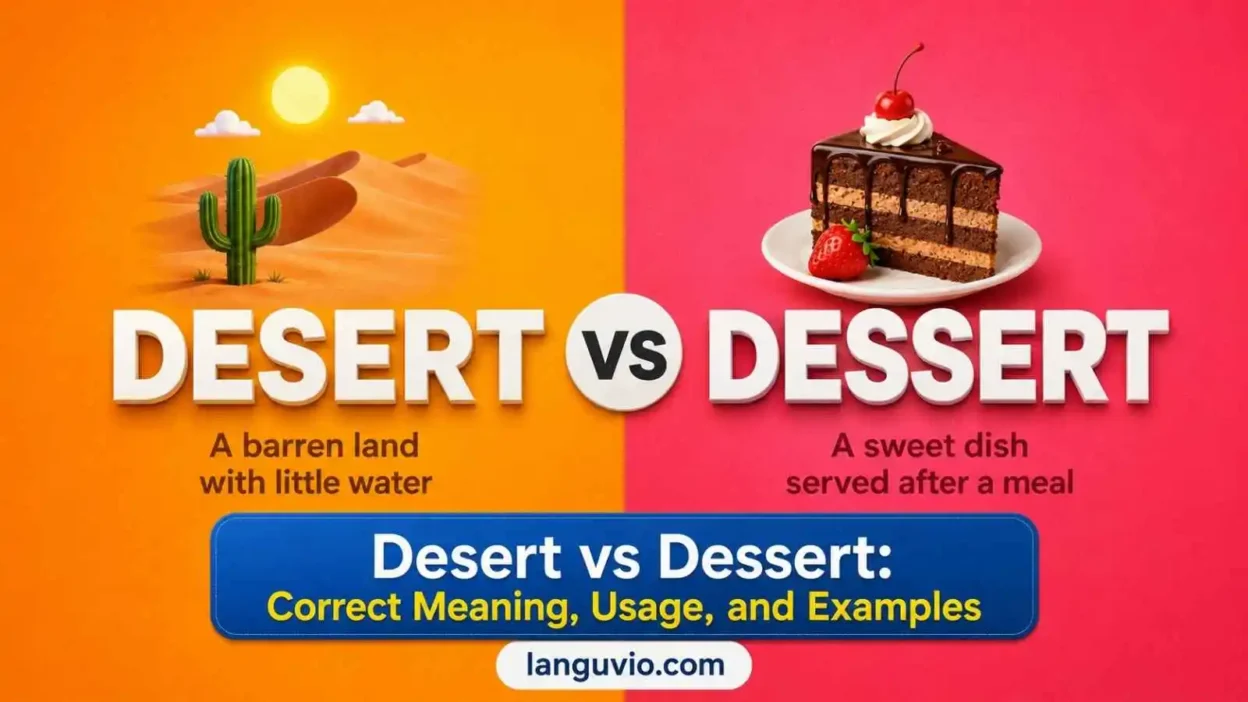
Desert vs dessert is a common mix-up because the words look almost the same. One extra s changes the meaning completely.
The correct word depends on what you mean. Use desert for a dry place, an abandoned place, or the act of leaving someone or something. Use dessert for sweet food served after a meal.
Quick Answer
Use desert for a dry area of land, as in “the Arizona desert.”
When referring to abandoning someone or something, choose desert, as in “Do not desert your team.”
For sweet food served after a meal, the correct word is dessert, as in “We had pie for dessert.”
The easiest memory tip: dessert has two s’s because people often want seconds of sweets.
Why Do “Desert” and “Dessert” Seem Backwards?
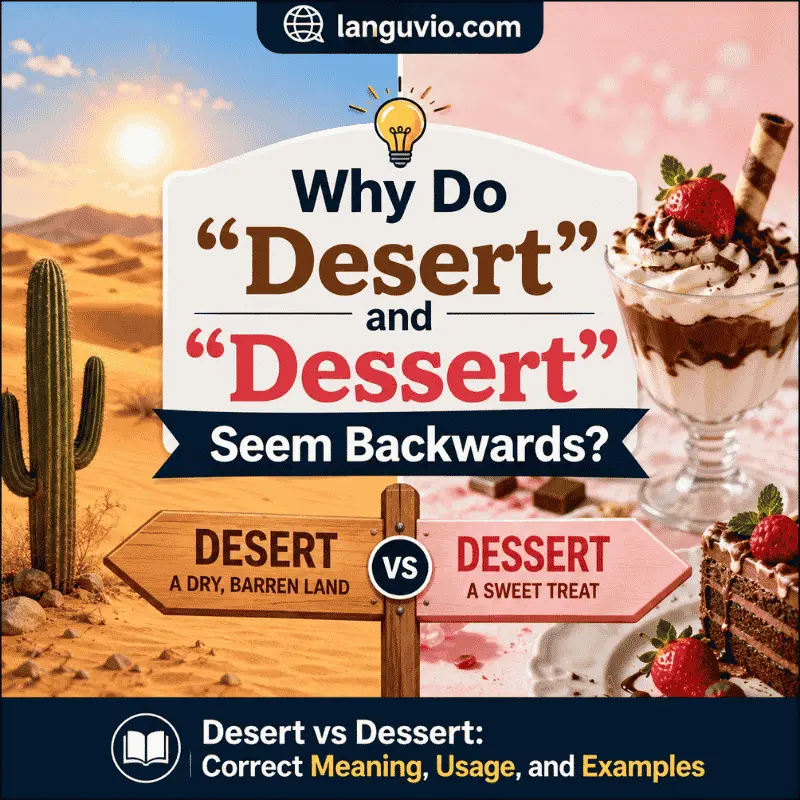
Desert and dessert may seem as though their spellings are backwards, but neither word breaks a special spelling rule. They are separate words that developed from different historical roots, and their similar appearance is mostly coincidental.
The confusion becomes stronger because desert has two pronunciations. When it means a dry region, the stress falls on the first syllable: DEZ-ert. When it is a verb meaning to abandon, the stress moves to the second syllable: di-ZERT. That pronunciation is the same as dessert, the sweet course served after a meal.
Their spelling differs by only one letter, so the context of the sentence matters more than the sound. A sentence about sand, dry land, or abandonment needs desert. A sentence about cake, ice cream, or another after-meal treat needs dessert.
The familiar memory trick still works: dessert has two s’s because you may want seconds of something sweet.
Key Differences At A Glance
| Context | Best Choice | Why |
| Dry land | desert | It names a dry area with little water or plant life. |
| Leaving someone or something | desert | It works as a verb meaning abandon. |
| Sweet food after a meal | dessert | It names the sweet course. |
| “Just deserts” | desert | This phrase means deserved punishment or outcome. |
| Restaurant menu | dessert | It refers to cakes, pies, ice cream, fruit, or other sweet dishes. |
| Travel or climate writing | desert | It fits geography, land, heat, sand, and dry regions. |
Meaning and Usage Difference
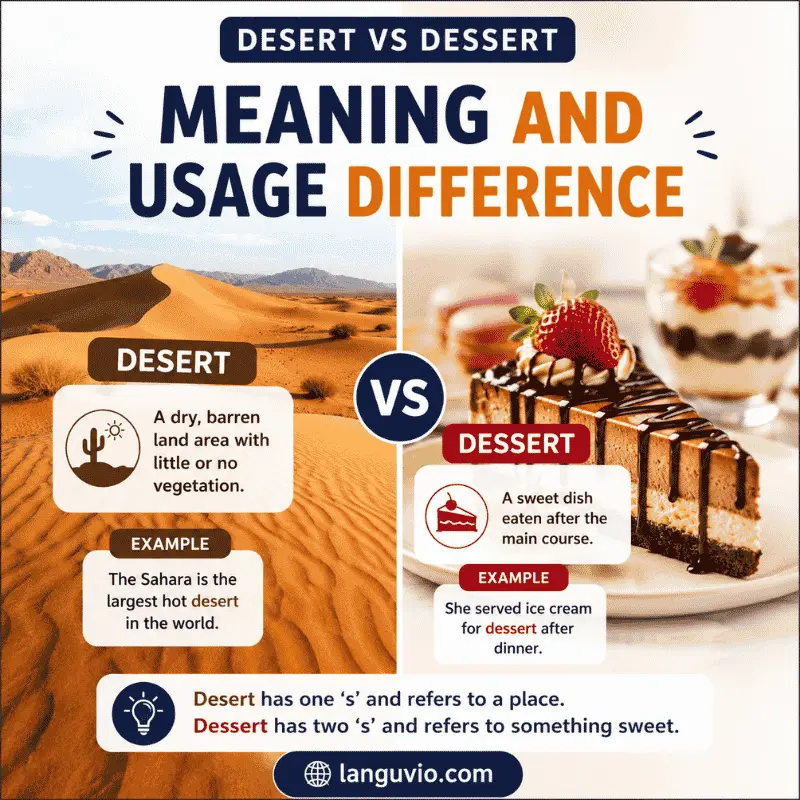
Desert has more than one use. As a noun, it means a dry area of land with little water and few plants. You might write about the Mojave Desert, desert heat, or a desert trail.
As a verb, desert means to leave or abandon someone, a place, a duty, or a group. A person can desert a friend, desert a post, or desert a cause.
Dessert is much narrower. It is a noun for sweet food served after a meal. Cake, pie, cookies, pudding, ice cream, and fruit can all be dessert.
Pronunciation matters here. Desert as dry land sounds like DEZ-ert. Desert as a verb sounds like di-ZERT. Dessert also sounds like di-ZERT.
Tone, Context, and Formality
Neither word is especially formal or casual. The difference is mainly about meaning and context.
Desert fits geography, weather, travel, nature, military writing, and situations where someone leaves a duty or person behind. It can also work as an adjective in phrases like desert climate, desert road, or desert island.
Dessert fits food, dining, recipes, menus, family meals, restaurants, and party plans. It is ordinary, everyday English.
A sentence can sound wrong if the context points to food but the spelling points to land. “We ordered desert” looks like you ordered a dry region, not cake.
Which One Should You Use?
Choose desert when your sentence is about land:
“I packed extra water for the desert hike.”
Choose desert when your sentence is about leaving:
“He promised he would not desert his friends.”
Choose dessert when your sentence is about food:
“She brought brownies for dessert.”
Choose desert in just deserts:
“The scammer finally got his just deserts.”
That phrase is tricky because deserts sounds like desserts, but the spelling with one s is the traditional form.
When One Choice Sounds Wrong
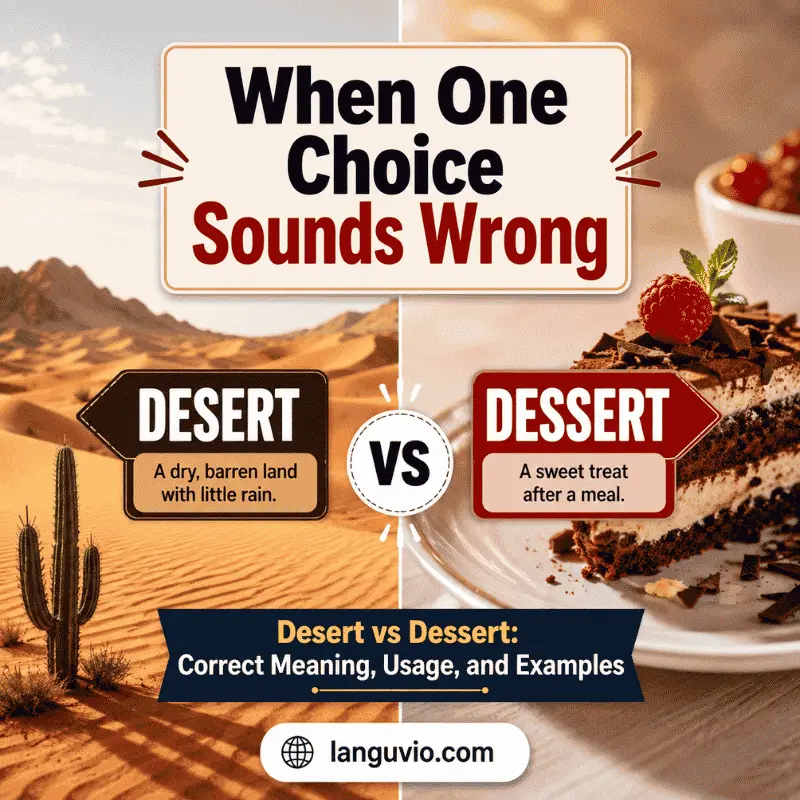
Dessert island sounds wrong unless you are making a joke about an island made of cake or candy. The normal phrase is desert island.
Chocolate desert sounds wrong unless you mean a dry landscape somehow made of chocolate. The food word is dessert.
He desserted his job is wrong. The verb is deserted.
Just desserts is common in informal writing, but the standard phrase is just deserts when you mean a deserved punishment or outcome.
Compact comparison:
• desert = dry land
• desert = to abandon
• desert = deserved outcome in “just deserts”
• dessert = sweet food after a meal
Common Mistakes (and Quick Fixes)
Mistake: We had ice cream for desert.
Fix: We had ice cream for dessert.
Mistake: The soldiers desserted the post.
Fix: The soldiers deserted the post.
Mistake: She crossed the dessert in July.
Fix: She crossed the desert in July.
Mistake: He got his just desserts.
Fix: He got his just deserts.
Mistake: The menu has three deserts.
Fix: The menu has three desserts.
The best quick check is this: if it is sweet, use dessert. If it is dry land or leaving, use desert.
Everyday Examples
“I forgot to pack sunscreen for the desert trip.”
“The road through the desert was quiet after sunset.”
“You should never desert a friend who needs help.”
“The old shopping center looked deserted.”
“We’re having cheesecake for dessert.”
“Do you want coffee with dessert?”
“The kids voted for ice cream instead of cake for dessert.”
“After years of lying, he finally got his just deserts.”
Dictionary-Style Word Details
Verb
desert: Commonly used as a verb meaning to abandon, leave behind, or stop supporting.
Example: “She would never desert her family.”
dessert: Not commonly used as a verb in standard US English.
Noun
desert: A dry area of land with little water and few plants. It can also mean something deserved, mainly in the phrase just deserts.
Example: “The desert was cold at night.”
dessert: A sweet course or dish usually eaten after a meal.
Example: “We shared dessert after dinner.”
Synonyms
desert: For dry land, closest plain alternatives include arid region, wasteland, and dry landscape. For the verb, useful synonyms include abandon, leave, and forsake. A close opposite for the verb is support or stay with.
dessert: Closest plain alternatives include sweet course, sweet dish, and treat. Exact antonyms do not fit well because dessert is a meal course, not a simple opposite idea.
Example Sentences
Desert as a noun: “The hikers crossed the desert before sunrise.”
Desert as a verb: “Do not desert your responsibilities when the work gets hard.”
Deserts meaning deserved consequences: “The dishonest manager got his just deserts.”
dessert: “My mom made peach cobbler for dessert.”
dessert: “The restaurant serves dessert until 10 p.m.”
Word History
desert: The land and abandon meanings are connected to older ideas of leaving, forsaking, or leaving a place empty. The just deserts meaning is a separate noun tied to what someone deserves.
dessert: The food word is connected to the idea of clearing the table and serving the final course. The details are useful, but you do not need the history to choose the right word today.
Phrases Containing
desert: desert island, desert climate, desert storm, desert road, desert heat, just deserts
dessert: dessert menu, dessert plate, dessert spoon, dessert wine, dessert table, for dessert
FAQs
Is desert or dessert correct?
Both words are correct, but they mean different things. Use desert for dry land or the act of abandoning someone. Use dessert for sweet food after a meal.
What is the main difference between desert and dessert?
Desert can mean a dry place, like the Mojave Desert, or it can mean to leave someone behind. Dessert means cake, pie, ice cream, or another sweet food served after a meal.
How do you remember desert vs dessert?
A simple trick is: dessert has two s’s because people often want seconds of sweets. Desert has one s when it means dry land.
Is it “just deserts” or “just desserts”?
The standard phrase is just deserts. It means someone got what they deserved, usually as a punishment or fair result. It is not about dessert.
Why does desert sometimes sound like dessert?
The noun desert, meaning dry land, is usually pronounced DEZ-ert. The verb desert, meaning to abandon, is pronounced di-ZERT, the same way as dessert.
Can desert be a verb?
Yes. Desert can be a verb meaning to abandon or leave behind.
Example: “He chose not to desert his team.”
Can dessert be a verb?
No. Dessert is not commonly used as a verb in standard US English. It is normally a noun.
Which word should I use for cake or ice cream?
Use dessert.
Example: “We had chocolate cake for dessert.”
Which word should I use for sand, heat, and dry land?
Use desert.
Example: “They drove across the desert in Nevada.”
Is “dessert island” correct?
Usually, no. The correct phrase is desert island, meaning an island that is empty or uninhabited. Dessert island only works as a joke or creative phrase about sweets.
Conclusion
The difference between desert vs dessert is simple once you connect each word to its meaning.
Use desert for dry land, for abandoning someone or something, and in the phrase just deserts. Use dessert for sweet food after a meal.
When you are unsure, ask one quick question: Is it sweet? If yes, choose dessert with two s’s. If not, desert is probably the word you need.