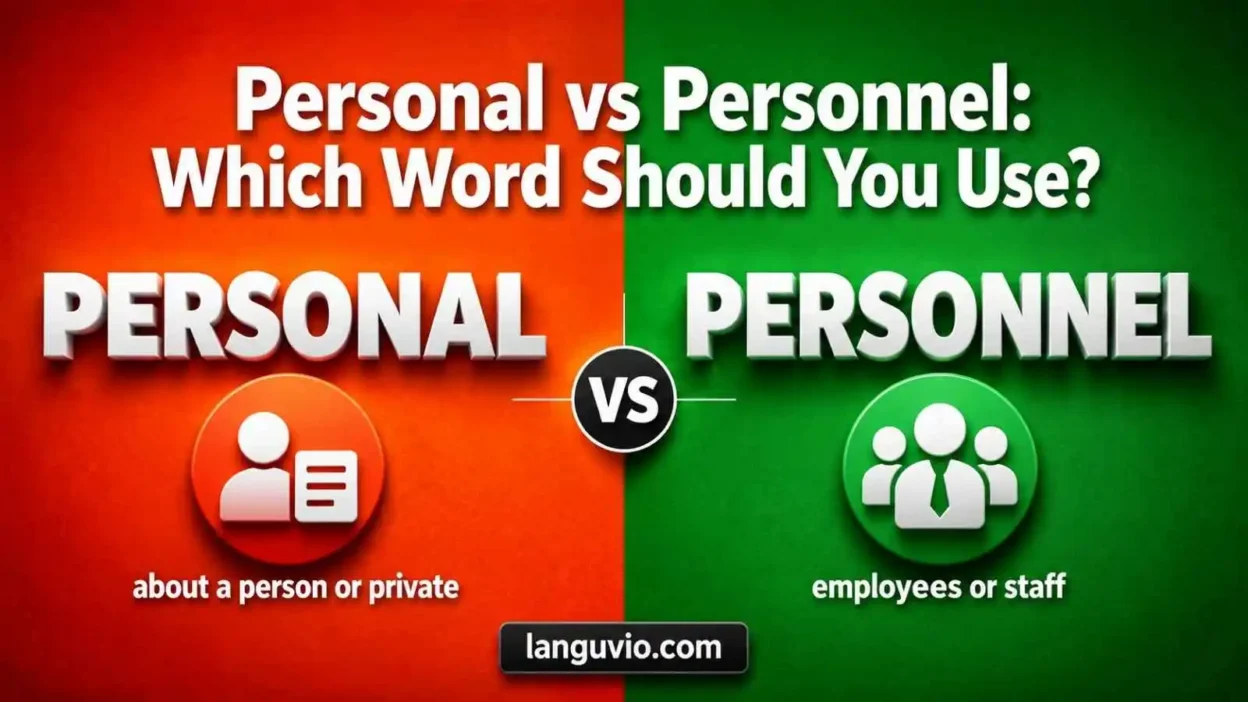
Personal vs personnel is a common word-choice problem because the words look almost the same. They are both real words, but they do not mean the same thing.
Use personal when something belongs to, affects, or relates to a person as an individual. Use personnel when you mean employees, staff, or people working for an organization. The difference is simple once you connect each word to its job in a sentence.
Quick Answer
Personal usually describes private, individual, or person-specific things.
Example:
I do not share my personal phone number at work.
Personnel is a noun that means staff, employees, or workers in an organization, business, agency, or military group.
Example:
Only authorized personnel may enter the lab.
They are not interchangeable. A personal file is a private file. A personnel file is an employee record.
Why People Confuse Them
People confuse personal and personnel for three main reasons.
First, the spelling is close. Personnel has only a few extra letters.
Second, both words relate to people. That shared idea makes the wrong choice feel possible.
Third, the pronunciation is close but not the same. In everyday US speech, personal sounds like PUR-suh-nul. Personnel sounds like pur-suh-NEL, with stress near the end.
That stress difference can help you hear the right word, but meaning matters most.
Key Differences At A Glance
Here is the core difference:
• personal: describes something private, individual, or related to one person
• personnel: names the staff or employees of a group
• use personal before words like life, opinion, account, belongings, choice, reason, and information
• use personnel with workplace, military, safety, staffing, or employee contexts
A good memory clue: personal often points to one person. personnel points to people working in a group.
Meaning and Usage Difference
Personal is most often an adjective. It describes a noun.
You can have a personal opinion, a personal account, a personal goal, or a personal matter. In each case, the word tells us the thing is tied to a person, not to a whole group.
Personnel is a noun. It means the people who work for an organization or serve in an organized group.
You can talk about school personnel, medical personnel, security personnel, or military personnel. In these examples, the word means staff members or service members as a group.
Be careful with workplace writing. Personal information means private details about a person. Personnel information usually means information related to employees or staffing.
Tone, Context, and Formality
Personal works in everyday, business, legal, and private contexts. It can sound neutral, warm, serious, or sensitive depending on the noun it describes.
Examples include personal email, personal story, personal property, and personal reasons.
Personnel sounds more formal and workplace-based. You will often see it in company policies, office signs, safety notices, military writing, and official instructions.
Examples include authorized personnel, personnel records, personnel changes, and emergency personnel.
In casual speech, many people say staff or employees instead of personnel. In official writing, personnel is still common and useful.
Which One Should You Use?
| Context | Best Choice | Why |
| A private phone number | personal | It belongs to one person. |
| Workers at a company | personnel | It means staff or employees. |
| A reason someone is absent | personal | It concerns private life. |
| People allowed into a restricted room | personnel | It refers to authorized staff. |
| A file about an employee’s job record | personnel | It belongs to workplace records. |
| A diary, bag, or laptop | personal | It is tied to private use or ownership. |
| Doctors, nurses, and support staff | personnel | It refers to workers in a group. |
| An opinion or belief | personal | It belongs to an individual. |
Use personal when the sentence needs a describing word. Use personnel when the sentence needs a noun for staff.
When One Choice Sounds Wrong
Some mistakes are easy to spot.
Wrong: Please update your personnel email address.
Correct: Please update your personal email address.
The email address belongs to a person, so personal is right.
Wrong: All personal must wear badges.
Correct: All personnel must wear badges.
The sentence means staff members, so personnel is right.
Wrong: The manager checked the employee’s personal file for pay records.
Better: The manager checked the employee’s personnel file for pay records.
A workplace record about an employee is a personnel file.
Common Mistakes (and Quick Fixes)
Mistake: Using personnel when you mean private details.
Fix: Use personal for private or individual information.
Wrong: Do not share your personnel details online.
Correct: Do not share your personal details online.
Mistake: Using personal when you mean staff.
Fix: Use personnel for employees or workers.
Wrong: The hospital hired more personal.
Correct: The hospital hired more personnel.
Mistake: Treating a personnel as one worker.
Fix: Say an employee, a staff member, or a team member.
Wrong: A personnel helped me at the front desk.
Correct: A staff member helped me at the front desk.
Mistake: Confusing personal issue and personnel issue.
Fix: A personal issue is private. A personnel issue involves employees or staffing.
Everyday Examples
She keeps her personal life separate from her job.
The company added more personnel for the holiday rush.
Please do not leave personal items in the conference room.
Emergency personnel arrived within minutes.
This is my personal opinion, not the team’s decision.
All security personnel must complete the new training.
He missed the meeting for personal reasons.
The office is reviewing its personnel policies.
Dictionary-Style Word Details
Verb
• personal: Not commonly used as a verb in standard US English.
• personnel: Not commonly used as a verb in standard US English.
Noun
• personal: Usually an adjective. It can be a noun in limited uses, such as a short personal notice or ad, but that use is not the main one readers need for this comparison.
• personnel: A noun meaning staff, employees, or people working in an organization or organized service.
Synonyms
• personal: Closest plain alternatives include private, individual, own, and one’s own. Possible opposites, depending on context, include public, shared, or impersonal.
• personnel: Closest plain alternatives include staff, employees, workers, and workforce. No single everyday antonym fits all uses.
Example Sentences
• personal: She changed her personal password after the alert.
• personal: That question feels too personal for a first meeting.
• personal: I use a separate card for personal expenses.
• personal: His personal goal is to run a half marathon this year.
• personnel: Maintenance personnel fixed the elevator this morning.
• personnel: The school sent new safety rules to all personnel.
• personnel: Military personnel assisted after the storm.
• personnel: The company needs more warehouse personnel this summer.
Word History
• personal: The word is historically tied to the idea of a person. Its modern everyday use focuses on what belongs to, affects, or concerns an individual.
• personnel: The word is also historically connected to “person,” but its modern meaning developed around staff, employees, and organized service members.
The shared background explains why the spellings look close. It does not make the words interchangeable.
Phrases Containing
• personal: personal information, personal opinion, personal reasons, personal belongings, personal account, personal choice, personal property
• personnel: authorized personnel, military personnel, medical personnel, security personnel, personnel file, personnel records, personnel department
FAQs
Is “personal” or “personnel” correct?
Both are correct, but they mean different things. Use personal for private or individual things. Use personnel for staff, employees, or workers.
What is the main difference between personal and personnel?
Personal is usually an adjective. It describes something related to one person, such as a personal opinion or personal account. Personnel is a noun that means staff or employees, such as office personnel or medical personnel.
Is it “personal file” or “personnel file”?
Both can be correct, but they mean different things. A personal file is a private file. A personnel file is a workplace record about an employee.
Is it “personal information” or “personnel information”?
Use personal information when you mean private details about a person, such as a phone number, address, or date of birth. Personnel information refers to employee-related or staffing information.
Can “personnel” mean one person?
Usually, no. Personnel refers to staff or workers as a group. For one person, say an employee, a staff member, or a worker.
Is “personnel” formal?
Yes, personnel sounds more formal than staff or employees. It is common in workplace policies, safety signs, military writing, and official documents.
How do you pronounce personal and personnel?
Personal sounds like PUR-suh-nul. Personnel sounds like pur-suh-NEL, with the stress near the end.
What is an easy way to remember personal vs personnel?
Use personal if you mean private or individual. Use personnel if you mean staff or employees.
Conclusion
Use personal for private, individual, or person-specific things. Use personnel for employees, staff, or workers in an organization. The easiest test is this: if you can replace the word with private or individual, choose personal. If you can replace it with staff or employees, choose personnel. So, personal vs personnel is not a style preference. It is a real meaning and grammar difference. Pick the word that matches the sentence, and your writing will sound clear and correct.