
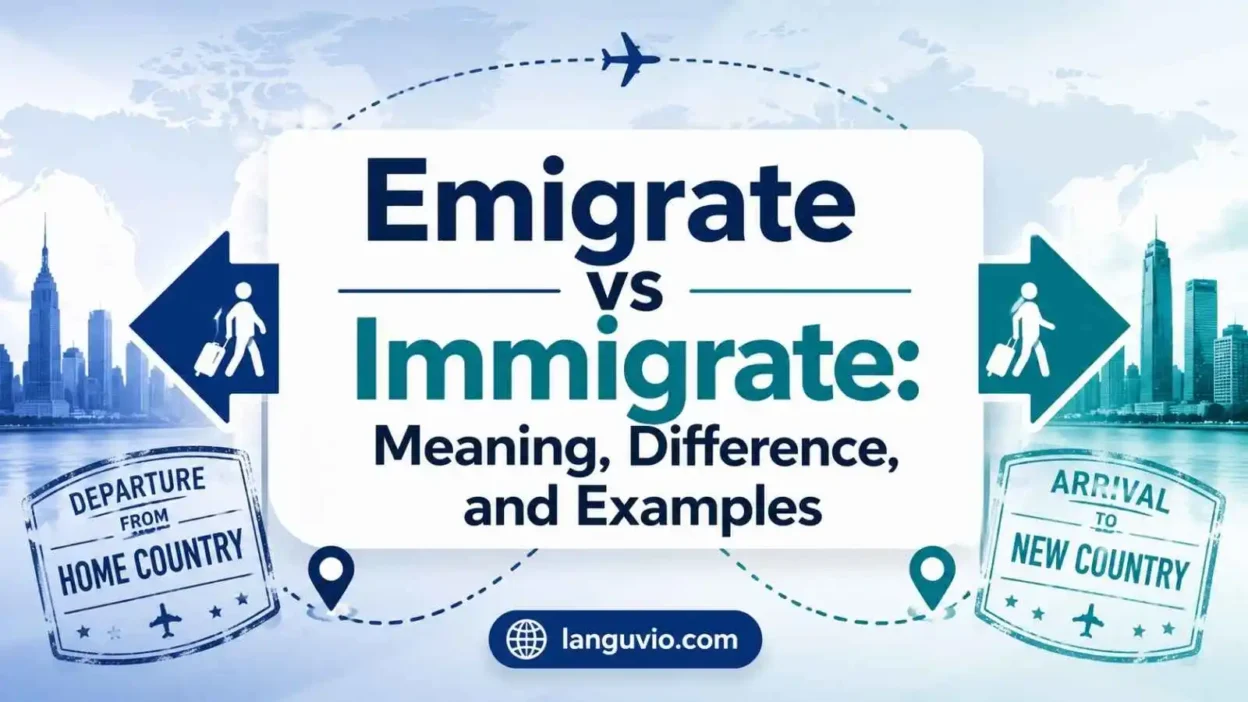
Emigrate vs immigrate is a choice about direction.
Use emigrate when you mean someone is leaving a country to live in another one. Use immigrate when you mean someone is entering a new country to live there.
So one person can do both. If Sofia leaves Colombia and moves to the United States, she emigrates from Colombia and immigrates to the United States.
Quick Answer
Emigrate means to leave your country to live somewhere else.
Immigrate means to come into a new country to live there.
The easiest pattern is:
- emigrate from a country
- immigrate to a country
Correct: My grandparents emigrated from Italy.
Correct: My grandparents immigrated to the United States.
Both sentences can describe the same move. The word you choose depends on which side of the move you are talking about.
Why People Confuse Them
These words look alike, sound alike, and describe the same kind of life change. That makes them easy to mix up.
The key difference is not the person. It is the viewpoint.
When your sentence looks back at the country someone left, use emigrate. When your sentence looks ahead to the country someone entered, use immigrate.
Pronunciation can also add to the confusion. Emigrate starts with an em sound, like EM-uh-grayt. Immigrate starts with an im sound, like IM-uh-grayt. Both end like migrate.
Key Differences At A Glance
| Context | Best Choice | Why |
| Leaving a home country | emigrate | The focus is departure |
| Entering a new country | immigrate | The focus is arrival |
| Using “from” | emigrate | “From” points to the place left |
| Using “to” as the main focus | immigrate | “To” points to the destination |
| Family history from the old country | emigrate | The old country is central |
| Legal status in the new country | immigrate | The new country is central |
Meaning and Usage Difference
Emigrate means to leave one country and go live in another. It points away from the old country.
Example:
They emigrated from Ireland in the 1980s.
The sentence focuses on Ireland as the place they left.
Immigrate means to enter a country to live there. It points toward the new country.
Example:
They immigrated to the United States in the 1980s.
The sentence focuses on the United States as the place they entered.
A full sentence can include both directions:
They emigrated from Ireland to the United States.
They immigrated to the United States from Ireland.
Both are possible, but they do not emphasize the same thing.
Tone, Context, and Formality
Both emigrate and immigrate are standard words in US English. Neither one is slang. Neither one is more casual than the other.
The difference is context.
Use emigrate in writing about departures, family origins, population leaving a country, or a person’s decision to move away.
Use immigrate in writing about arrivals, settling in a new country, visas, residency, citizenship, or life after arrival.
In everyday speech, many people use simpler phrases like move from or move to. In careful writing, emigrate and immigrate are more exact.
Which One Should You Use?
Ask one question:
Is the sentence about leaving or arriving?
Use emigrate if the answer is leaving.
- She emigrated from Mexico with her parents.
- Many families emigrated after the war.
- He plans to emigrate from the country where he was born.
Use immigrate if the answer is arriving.
- She immigrated to the United States with her parents.
- Many families immigrated after the war.
- He plans to immigrate to Canada next year.
Here is the compact comparison:
| Feature | emigrate | immigrate |
| Direction | Out of a country | Into a country |
| Common preposition | from | to |
| Main focus | Origin | Destination |
| Example idea | left Vietnam | entered the United States |
When One Choice Sounds Wrong
Immigrate from can sound wrong if the sentence only names the country someone left.
Weak: She immigrated from Peru in 2012.
Better: She emigrated from Peru in 2012.
But immigrated from can work when the destination is clear too:
Clear: She immigrated to the United States from Peru in 2012.
Emigrate to is more nuanced. It can appear when both leaving and destination are part of the move.
Acceptable: They emigrated from Poland to Chicago.
But if your sentence only cares about arrival, immigrate to is usually clearer.
Better for arrival: They immigrated to the United States.
Common Mistakes (and Quick Fixes)
Mistake: My grandparents immigrated Italy.
Fix: My grandparents emigrated from Italy.
Why: Italy is the place they left.
Mistake: My grandparents emigrated the United States.
Fix: My grandparents immigrated to the United States.
Why: The United States is the place they entered.
Mistake: He immigrated away from his home country.
Fix: He emigrated from his home country.
Why: “Away from” points to departure.
Mistake: She emigrated into Canada.
Fix: She immigrated to Canada.
Why: “Into” points to entry.
Everyday Examples
Emigrate examples:
- My aunt emigrated from the Philippines before I was born.
- His family emigrated from Cuba and later settled in Florida.
- They decided to emigrate after years of planning.
- The article described why young workers were emigrating from the region.
Immigrate examples:
- My aunt immigrated to the United States before I was born.
- His family immigrated to Florida and opened a small restaurant.
- They hope to immigrate after their paperwork is approved.
- The report looked at people who immigrated to the country as children.
Same move, two viewpoints:
- Amina emigrated from Egypt.
- Amina immigrated to the United States.
Both can be true. The sentence chooses the camera angle.
Dictionary-Style Word Details
Verb
- emigrate: A verb meaning to leave a country to live in another one. It is usually used without a direct object: emigrate from Spain, not emigrate Spain.
- immigrate: A verb meaning to enter a country to live there. It is also usually used without a direct object in everyday US English: immigrate to the United States, not immigrate the United States.
Noun
- emigrate: Not commonly used as a noun in standard US English. The related noun is emigration for the act, and emigrant for a person.
- immigrate: Not commonly used as a noun in standard US English. The related noun is immigration for the act or process, and immigrant for a person.
Synonyms
- emigrate: Closest plain alternatives include leave, move away from, and depart from, but only when the meaning includes moving to live somewhere else.
- immigrate: Closest plain alternatives include enter, move to, and settle in, but only when the meaning includes living in a new country.
These are not perfect one-word swaps in every sentence. Leave can mean many things, and enter does not always mean settle permanently.
Helpful directional opposites:
- emigrate is the opposite viewpoint of immigrate
- emigration is the opposite viewpoint of immigration
- emigrant is the opposite viewpoint of immigrant
Example Sentences
- emigrate: My parents emigrated from South Korea before I started school.
- emigrate: Some workers emigrate for better job opportunities.
- emigrate: The family emigrated from Brazil to the United States.
- immigrate: My parents immigrated to the United States before I started school.
- immigrate: Some workers immigrate for better job opportunities.
- immigrate: The family immigrated to the United States from Brazil.
Word History
- emigrate: The word is tied to the idea of moving out or away. That history matches its modern use: leaving a country.
- immigrate: The word is tied to the idea of moving in or into. That history matches its modern use: entering a country.
The shared idea is movement. The first part of each word gives the direction.
Phrases Containing
- emigrate: emigrate from, emigrate to, emigrate from one country to another
- immigrate: immigrate to, immigrate into, immigrate from one country to another
Most of the time, use emigrate from for the place left and immigrate to for the place entered.
FAQs
Is it emigrate or immigrate?
Use emigrate when the sentence focuses on leaving a country. Use immigrate when it focuses on entering a new country to live there.
What is the main difference between emigrate and immigrate?
Emigrate means “leave from.” Immigrate means “come into.” The difference is direction.
Can one person both emigrate and immigrate?
Yes. A person can emigrate from one country and immigrate to another. For example, someone can emigrate from India and immigrate to the United States.
Do you emigrate from or immigrate from?
Usually, use emigrate from.
Example: She emigrated from Brazil.
You can use immigrated from only when the destination is also clear.
Example: She immigrated to the United States from Brazil.
Do you emigrate to or immigrate to?
Usually, use immigrate to.
Example: They immigrated to Canada.
You may see emigrated from France to Canada when both the starting place and destination are named.
Is “emigrate to the United States” wrong?
Not always, but immigrate to the United States is usually clearer when the United States is the destination. Use emigrate when the focus is the country someone left.
What is the noun form of emigrate?
The noun forms are emigration for the act and emigrant for the person.
What is the noun form of immigrate?
The noun forms are immigration for the act or process and immigrant for the person.
Are emigrate and immigrate interchangeable?
No. They can describe the same move, but from different viewpoints. Emigrate looks at leaving. Immigrate looks at arriving.
What is an easy way to remember emigrate vs immigrate?
Think: E in emigrate = exit.
Think: I in immigrate = in.
Conclusion
Use emigrate for leaving. Use immigrate for entering.
The same person can emigrate from one country and immigrate to another. That does not make the words interchangeable. It means each word shows a different side of the same move.
When you are unsure, check the preposition and the focus:
from = emigrate
to = immigrate