Anyone and any one are easy to mix up because they look almost the same. The only visible difference is the space, but that space changes the meaning.
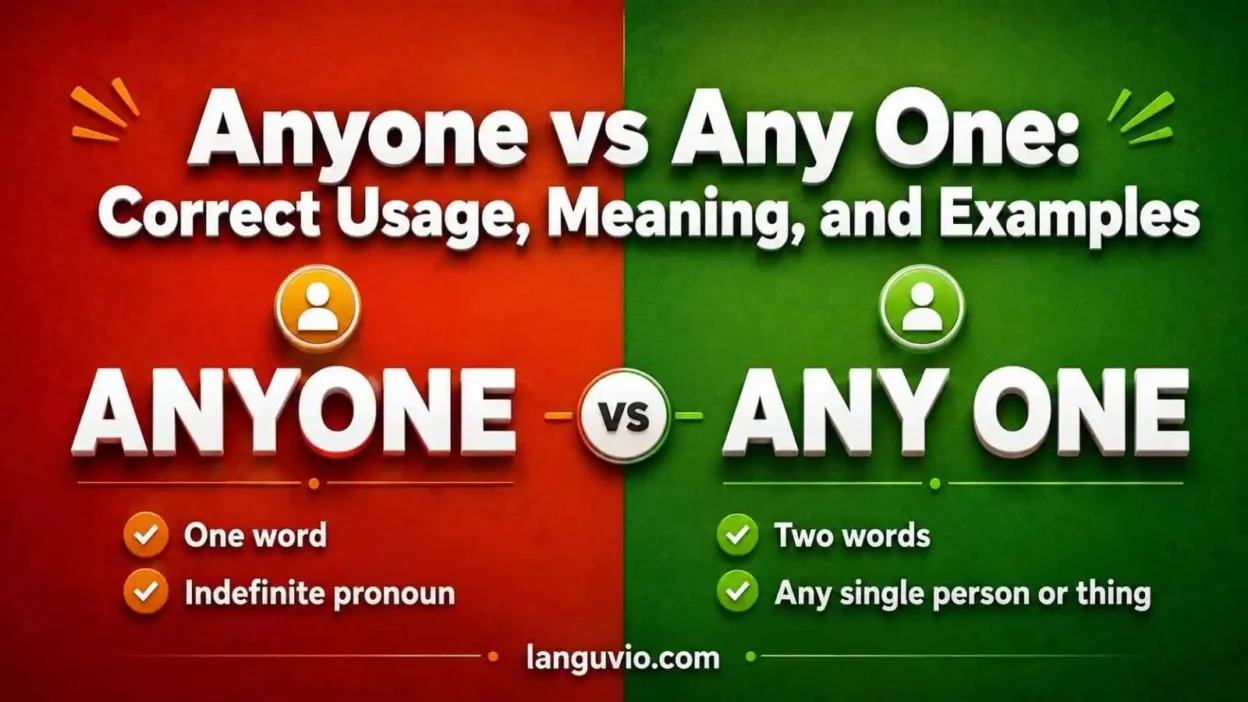
Both forms can be correct. Use anyone when you mean “any person.” Use any one when you mean “any single person or thing from a group.” The difference is not about style alone. It is about what the sentence is trying to say.
Quick Answer
Use anyone as one word when you mean “any person.” Example: “Can anyone help me?” Use any one as two words when you mean “any single one” from a group. Example: “Choose any one of these seats.” If “of” follows the phrase, any one is often the better choice.
Why People Confuse Them
People confuse anyone and any one because they sound alike in speech. A simple pronunciation guide is EN-ee-wun for both forms in everyday American English.
Because the sound is the same, the choice depends on grammar and meaning, not pronunciation.
The one-word form, anyone, points to a person without naming who that person is.
The two-word form, any one, points to one selected member of a group. That group may contain people, objects, options, books, seats, files, or other countable things.
Key Differences At A Glance
| Context | Best Choice | Why |
| Asking for an unspecified person | anyone | It means any person at all. |
| Talking about one member of a group | any one | It means any single one from a set. |
| Referring to people only | anyone | It does not refer to objects. |
| Referring to people or things in a group | any one | The word one can stand for a person or thing. |
| Before “of these,” “of them,” or “of you” | any one | The phrase means one member from that group. |
| Replacing the word with “anybody” | anyone | Anyone and anybody are close alternatives. |
Meaning and Usage Difference
Anyone is an indefinite pronoun. It means “any person,” “no particular person,” or “a person, no matter who.”
Examples:
“Does anyone know the answer?”
“Anyone can sign up for the class.”
“I do not want anyone to miss the deadline.”
In each sentence, anyone refers to a person, but not to one named person.
Any one is a two-word phrase. It means “any single one.” It usually points to one person or one thing from a known group.
Examples:
“Pick any one of the folders.”
“Any one of the students could lead the project.”
“You may choose any one dessert from the menu.”
In these sentences, any one means one selected member from a group.
Here is the simplest difference:
| Feature | anyone | any one |
| Basic meaning | any person | any single one |
| Main grammar role | indefinite pronoun | two-word phrase |
| Refers to things? | no | yes |
| Often followed by “of”? | no | yes |
| Easy replacement | anybody | any single one |
Tone, Context, and Formality
Anyone is normal in everyday, school, business, and professional writing. It does not sound casual or careless.
Example: “Please tell me if anyone needs more time.”
Any one can sound more specific because it singles out one member from a group. It often appears when the writer wants to stress “one individual item or person.”
Example: “Any one of these errors could delay the report.”
The tone difference is small, but useful. Anyone feels open and general. Any one feels more selective.
Which One Should You Use?
Use anyone when the sentence means any person.
Good: “Can anyone join the meeting?”
Correct: “I did not see anyone in the lobby.”
Natural: “Anyone who wants a copy can email me.”
Use any one when the sentence means one member of a group.
Good: “Can any one of you join the meeting?”
Correct: “I did not choose any one candidate yet.”
Natural: “Any one of these plans could work.”
A simple test helps:
If you can replace the word with anybody, use anyone.
“Does anyone know?”
“Does anybody know?”
If you mean any single one of a group, use any one.
“Choose any one of the three options.”
“Choose any single one of the three options.”
When One Choice Sounds Wrong
Anyone sounds wrong before “of” when you mean one member of a group.
Wrong: “Anyone of you can answer.”
Correct: “Any one of you can answer.”
Wrong: “Anyone of these laptops will work.”
Correct: “Any one of these laptops will work.”
Any one sounds wrong when no group is being selected and the meaning is simply “any person.”
Wrong: “Can any one help me?”
Correct: “Can anyone help me?”
Wrong: “I do not know any one here.”
Usually better: “I do not know anyone here.”
The two-word form is not wrong in every possible sentence, but it needs a clear reason. If you only mean a person in general, use anyone.
Common Mistakes (and Quick Fixes)
Mistake 1: Using anyone before “of you.”
Wrong: “Does anyone of you have a charger?”
Correct: “Does any one of you have a charger?”
Also natural: “Does anyone have a charger?”
Mistake 2: Using any one for a general person.
Wrong: “Any one can make a mistake.”
Correct: “Anyone can make a mistake.”
Mistake 3: Using anyone for objects.
Wrong: “Take anyone of the notebooks.”
Correct: “Take any one of the notebooks.”
Mistake 4: Forgetting that any one can refer to people or things.
Correct: “Any one of the players could win.”
Correct: “Any one of the routes could be faster.”
Mistake 5: Adding a hyphen.
Wrong: “Any-one can apply.”
Correct: “Anyone can apply.”
Correct: “Any one of the applicants may be selected.”
Everyday Examples
Anyone
Let me know if anyone calls while I am out.
Because the website is open, anyone can register.
I do not think anyone noticed the typo.
Can anyone from the team cover Friday?
Any one
Choose any one of the available appointment times.
To prove the purchase, any one of these receipts could work.
She said any one of us could present the update.
Today, the manager can approve any one request.
Anyone: “I would not ask anyone to work late without notice.”
Any one: “Any one mistake in the address could delay delivery.”
Dictionary-Style Word Details
Verb
• Anyone: Not used as a verb in standard American English.
• Any one: Not used as a verb. It is a two-word phrase, not an action word.
Noun
• Anyone: Not a noun. It is an indefinite pronoun that refers to an unspecified person.
• Any one: Often works as a noun phrase because one can stand for a single person or thing from a group.
Examples:
“Anyone may enter.”
“Any one of the entries may win.”
Synonyms
• Anyone: closest plain alternatives include anybody, any person, whoever. The best opposite is no one or nobody.
• Any one: closest plain alternatives include any single one, one of them, whichever one. A useful opposite depends on the sentence, such as none of them or no single one.
Do not treat the alternatives as perfect swaps in every sentence. Choose the one that keeps the same meaning.
Example Sentences
• Anyone: “Anyone can ask a question after the presentation.”
• Anyone: “The office was quiet, and I did not see anyone at the front desk.”
• Anyone: “If anyone needs help, send me a message.”
• Any one: “Any one of the three plans could save money.”
• Any one: “You can take any one chair from the storage room.”
• Any one: “Any one of her teammates could step in.”
Word History
• Anyone: A long-established compound pronoun meaning “any person.” It is standard as one word when it refers to an unspecified person.
• Any one: This remains a normal two-word phrase when any modifies one. The space matters because the phrase points to one selected person or thing.
The key history point is practical: English keeps both forms because they do different jobs.
Phrases Containing
• Anyone: anyone else, anyone who, if anyone, hardly anyone, just anyone, anyone at all.
• Any one: any one of, any one person, any one item, any one time, any one of them, any one of you.
These phrases show the difference clearly. Anyone stands alone as a pronoun. Any one often points forward to a group.
FAQs
Is it anyone or any one?
Both are correct, but they mean different things. Use anyone when you mean any person. Use any one when you mean one single person or thing from a group. For example, “Can anyone help me?” means any person can help. “Choose any one of these books” means choose one book from the group.
What is the main difference between anyone and any one?
The main difference is meaning. Anyone is one word and refers to an unspecified person. Any one is two words and means one selected member from a group. If you can replace the word with “anybody,” use anyone. If you can replace it with “any single one,” use any one.
Is “anyone of you” correct?
No, anyone of you is usually incorrect. Use any one of you when you mean one person from a group. Example: “Any one of you can answer this question.” You can also say, “Anyone can answer this question.”
Can any one refer to things?
Yes. Any one can refer to people or things. For example, “Any one of these laptops will work” is correct because you mean one laptop from a group. Anyone should refer to people, not objects.
Is anyone the same as anybody?
Anyone and anybody usually mean the same thing. Both refer to an unspecified person. For example, “Does anyone know?” and “Does anybody know?” mean the same thing. In writing, anyone often sounds slightly more polished.
How can I remember the difference?
Use this simple test: if anybody fits, write anyone. If any single one fits, write any one. Example: “Can anyone join?” means any person. “Choose any one of the seats” means choose one seat from the group.
Conclusion
Anyone and any one are both correct, but they are not interchangeable.
Use anyone when you mean any person. Use any one when you mean any single person or thing from a group. The fastest memory rule is this: if anybody fits, write anyone. If “one of them” fits, write any one.
Both are correct, but they mean different things. Use anyone when you mean any person. Use any one when you mean one single person or thing from a group. For example, “Can anyone help me?” means any person can help. “Choose any one of these books” means choose one book from the group.
The main difference is meaning. Anyone is one word and refers to an unspecified person. Any one is two words and means one selected member from a group. If you can replace the word with “anybody,” use anyone. If you can replace it with “any single one,” use any one.
No, anyone of you is usually incorrect. Use any one of you when you mean one person from a group. Example: “Any one of you can answer this question.” You can also say, “Anyone can answer this question.”
Yes. Any one can refer to people or things. For example, “Any one of these laptops will work” is correct because you mean one laptop from a group. Anyone should refer to people, not objects.
Anyone and anybody usually mean the same thing. Both refer to an unspecified person. For example, “Does anyone know?” and “Does anybody know?” mean the same thing. In writing, anyone often sounds slightly more polished.
Use this simple test: if anybody fits, write anyone. If any single one fits, write any one. Example: “Can anyone join?” means any person. “Choose any one of the seats” means choose one seat from the group.