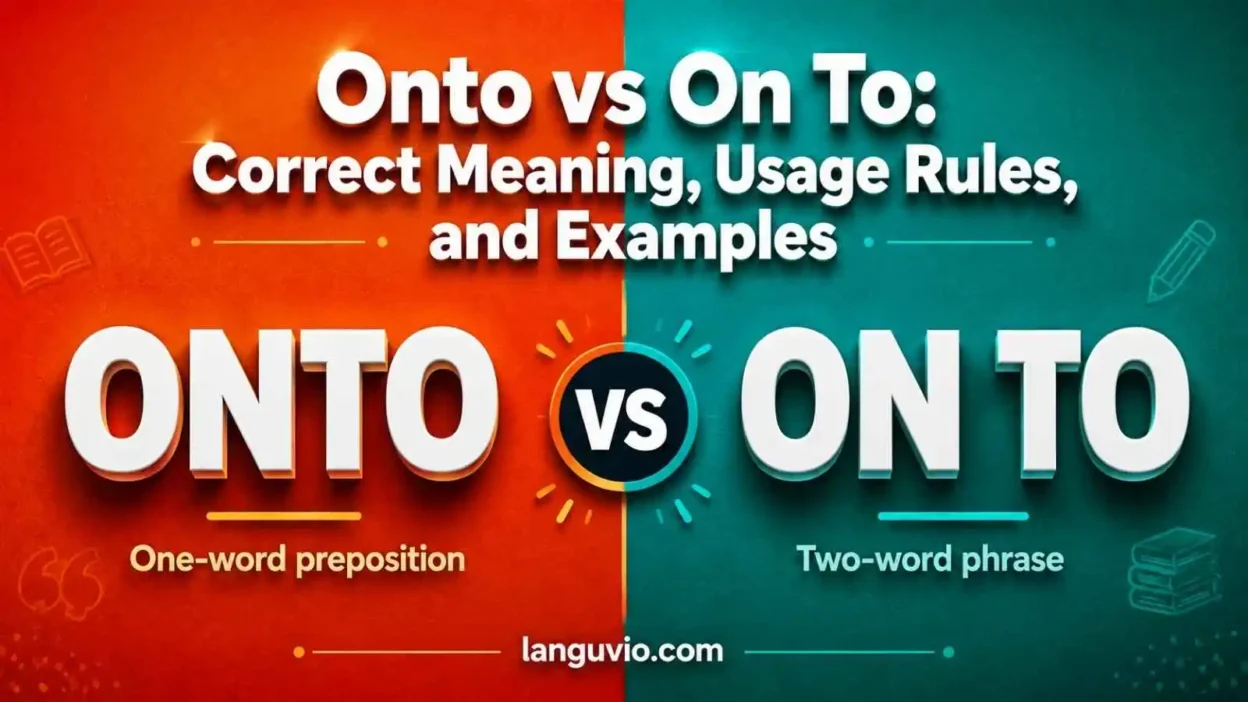
Onto vs on to can confuse even careful writers because the only visible difference is a space. Still, that space can change the grammar of the sentence.
Use onto when you mean movement to a position on a surface or when you mean someone is aware of something. Use on to when on belongs with the verb before it, such as in move on to, go on to, hold on to, or log on to.
Quick Answer
Both forms can be correct, but they do different jobs. Onto is usually one preposition: “The cat jumped onto the couch.” On to is two words when on is part of the verb and to begins the next phrase: “Let’s move on to the next topic.”
Why People Confuse Them
People confuse these forms because they sound the same in speech. When you say “move on to the next slide,” the ear hears one smooth phrase. In writing, though, the sentence structure matters.
Another reason is that both forms can suggest progress. “Step onto the stage” shows physical movement. “Move on to the next step” shows progress in a process. Those ideas feel close, but the grammar is not the same.
The best test is simple: ask what on belongs to. If on belongs with the verb, keep on to as two words.
Key Differences At A Glance
| Context | Best Choice | Why |
| Movement to the top or surface of something | onto | It works as one preposition. |
| Becoming aware of a plan or trick | onto | It appears in phrases like “I’m onto you.” |
| Continuing to the next step, topic, or stage | on to | “On” belongs with verbs like move, go, carry, or pass. |
| Keeping or gripping something | on to | “Hold on” is the verb phrase. |
| Signing into a system with “log on” | on to | “Log on” is the verb phrase, followed by “to.” |
| Putting something on a surface | onto | The object moves to a position on that surface. |
Meaning and Usage Difference
Onto is a preposition. It often means “to a position on.” Use it when something moves from one place to another and ends up on a surface.
Examples:
“The toddler climbed onto the chair.”
“She dropped her keys onto the counter.”
“The coach walked onto the field.”
Onto can also mean “aware of” in everyday language.
Examples:
“I think she is onto our plan.”
“The detective was onto the suspect.”
On to is not usually one combined unit. It is two separate words that meet in a sentence. The word on often belongs to the verb before it, and to introduces the next object, place, step, or idea.
Examples:
“Let’s move on to the next question.”
“He went on to become a lawyer.”
“Please hold on to your receipt.”
In these examples, the real verb ideas are move on, go on, and hold on.
Compact comparison:
• Onto = movement to a surface, position, or awareness.
• On to = a verb ending in on followed by to.
• Onto the roof = someone gets on the roof.
• On to the next task = someone continues to the next task.
Tone, Context, and Formality
Both forms are normal in American English. Neither one is slang by itself. The right choice depends on grammar, not formality.
Onto works well in everyday, school, business, and formal writing when it shows movement or awareness.
Examples:
“The files were uploaded onto the server.”
“She stepped onto the platform.”
“We are onto a better solution.”
On to is also standard when it follows a verb phrase. It often appears in meetings, instructions, lessons, sports writing, and workplace updates.
Examples:
“Now let’s move on to budget planning.”
“The team went on to win the final game.”
“Log on to your account before the meeting.”
The phrase may look less compact, but it is often the cleaner choice.
Which One Should You Use?
Use onto when you can replace it with on or upon and the sentence still keeps the basic idea.
Correct:
“She placed the laptop onto the desk.”
“The dog jumped onto the bed.”
“The team is onto a serious problem.”
Use on to when the verb before it feels complete with on.
Correct:
“We moved on to the final chapter.”
“Hang on to the railing.”
“He signed on to the project.”
A helpful question is: “Can I pause after on?” If yes, you probably need on to.
Example:
“Let’s move on / to the next slide.”
That pause shows that on belongs with move.
When One Choice Sounds Wrong
Onto sounds wrong when on is part of the verb.
Incorrect:
“Let’s move onto the next topic.”
Better:
“Let’s move on to the next topic.”
The topic is not a physical surface. You are continuing from one idea to another, so move on should stay together.
On to sounds wrong when you mean direct movement to a surface.
Incorrect:
“She jumped on to the couch.”
Better:
“She jumped onto the couch.”
Some writers may still separate the words in older or very formal styles, but modern American usage usually favors onto for direct movement to a surface.
Common Mistakes (and Quick Fixes)
Mistake: “Please log onto your account.”
Better: “Please log on to your account.”
Why: The verb is log on. The word to introduces the account.
Mistake: “Hold onto your ticket.”
Better: “Hold on to your ticket.”
Why: The verb phrase is hold on when you mean grip, keep, or retain.
Mistake: “The cat jumped on to the table.”
Better: “The cat jumped onto the table.”
Why: The cat moved to a position on the table.
Mistake: “We are moving onto the next section.”
Better: “We are moving on to the next section.”
Why: The phrase means continue, not move onto a physical surface.
Mistake: “The detective was on to the scam.”
Better: “The detective was onto the scam.”
Why: Here, onto means aware of or informed about.
Everyday Examples
“Put the groceries onto the counter.”
“After the intro, we’ll move on to the main lesson.”
“She stepped onto the bus just before the doors closed.”
“Please hold on to this confirmation number.”
“The kids climbed onto the picnic table.”
“The speaker went on to explain the rule.”
“I think Dad is onto the surprise.”
“Log on to the portal before noon.”
“The road opens onto a quiet beach.”
“After lunch, the class moved on to spelling practice.”
Dictionary-Style Word Details
Verb
• Onto: Not used as a verb in standard American English. It is mainly a preposition. In special technical contexts, it can also appear as an adjective, but that use is not part of everyday word choice.
• On to: Not a verb by itself. It often appears after verbs that include on, such as move on, go on, hold on, log on, and sign on.
Noun
• Onto: Not commonly used as a noun in standard American English.
• On to: Not a noun. It is two separate words that may appear together inside a larger sentence structure.
Synonyms
• Onto: Closest plain alternatives include on, upon, and to a position on. For the awareness meaning, close alternatives include aware of, informed about, and catching on to.
• On to: Exact synonyms do not fit because this is not one word with one fixed meaning. In phrases, closest alternatives depend on the verb: move on to can mean continue to; hold on to can mean keep or grip; log on to can mean access.
Clear antonyms are not useful for the whole comparison because the meanings change by sentence.
Example Sentences
Onto: “The waiter set the tray onto the table.”
“She walked onto the stage with confidence.”
“The manager is onto the billing error.”
On to: “Let’s go on to the next example.”
“Hold on to your backpack in the crowd.”
“The employee logged on to the company system.”
Word History
• Onto: The word is built from on and to, and it is now standard as a one-word preposition in American English for movement to a position on something. It also has an informal awareness meaning.
• On to: This is not a separate historical word in the same way. It is the result of on and to appearing next to each other when a verb phrase ending in on is followed by a phrase beginning with to.
Phrases Containing
• Onto: onto the stage, onto the roof, onto the table, onto the bus, onto something, onto someone.
• On to: move on to, go on to, hold on to, hang on to, log on to, sign on to, pass on to, carry on to.
FAQs
Is it onto or on to?
Both can be correct, but they are not used the same way. Use onto as one word when something moves to a position on a surface. Example: “She climbed onto the chair.” Use on to as two words when on belongs with the verb before it and to starts the next phrase. Example: “Let’s move on to the next topic.”
Is “on to the next” or “onto the next” correct?
The correct phrase is usually on to the next. In this phrase, on belongs with the verb idea move on or go on, and to points to the next thing. Example: “Now we are on to the next question.” Use onto only if something is physically moving onto a surface.
Do you write “hold onto” or “hold on to”?
Both forms appear, but hold on to is the clearer traditional choice when you mean grip, keep, or not lose something. Example: “Hold on to your ticket.” Many people write hold onto, and readers usually understand it, but hold on to shows the verb phrase more clearly.
What is an easy test for onto vs on to?
Pause after on. If the sentence still works, use on to: “Let’s move on / to the next slide.” If it shows movement to a surface, use onto: “The cat jumped onto the bed.”
Is “log onto” or “log on to” correct?
The clearer form is log on to because log on is the verb phrase, and to introduces the account, website, or system. Example: “Log on to your account before noon.” In casual writing, “log onto” is common, but log on to is more precise.
Conclusion
The difference between onto and on to comes down to structure. Use onto when one preposition shows movement to a surface or awareness of something. Use on to when on belongs with the verb before it and to starts the next phrase.
Write “jumped onto the platform,” but “moved on to the next topic.” That one-space choice makes your sentence cleaner and easier to read.
Both can be correct, but they are not used the same way. Use onto as one word when something moves to a position on a surface. Example: “She climbed onto the chair.” Use on to as two words when on belongs with the verb before it and to starts the next phrase. Example: “Let’s move on to the next topic.”
The correct phrase is usually on to the next. In this phrase, on belongs with the verb idea move on or go on, and to points to the next thing. Example: “Now we are on to the next question.” Use onto only if something is physically moving onto a surface.
Both forms appear, but hold on to is the clearer traditional choice when you mean grip, keep, or not lose something. Example: “Hold on to your ticket.” Many people write hold onto, and readers usually understand it, but hold on to shows the verb phrase more clearly.
Pause after on. If the sentence still works, use on to: “Let’s move on / to the next slide.” If it shows movement to a surface, use onto: “The cat jumped onto the bed.”
The clearer form is log on to because log on is the verb phrase, and to introduces the account, website, or system. Example: “Log on to your account before noon.” In casual writing, “log onto” is common, but log on to is more precise.