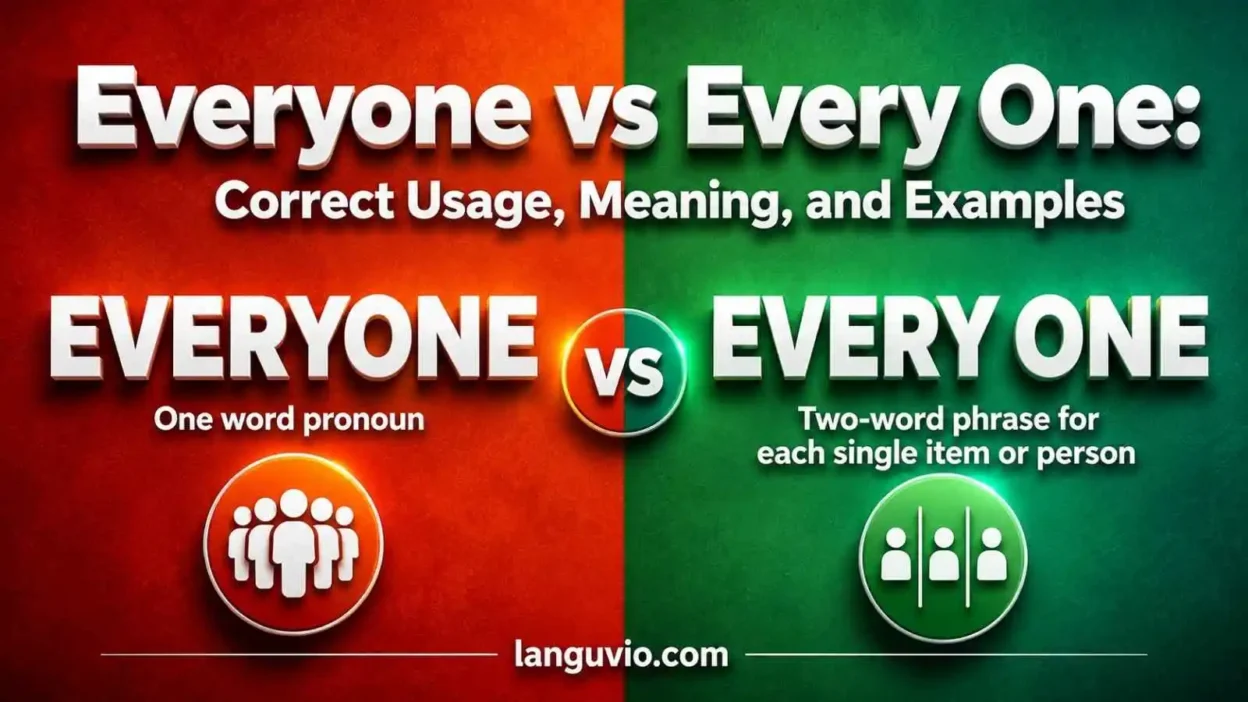
Everyone vs every one is a common writing mix-up because the two forms look almost the same. The space is small, but the meaning changes.
Use everyone when you mean all people in a group. Use every one when you mean each individual person or thing in a group. Both forms are correct, but they fit different sentence structures.
Quick Answer
Use everyone as one word when you mean “every person” or “everybody.” Example: “Everyone is invited.”
Use every one as two words when you mean “each one,” especially before of. Example: “Every one of the tickets sold out.”
The fastest check is simple: if each one fits, use every one.
Why People Confuse Them
Writers confuse these forms because they contain the same words: every and one. In speech, they can also sound very similar.
However, spelling changes the job of the phrase. Everyone works as a single pronoun. It points to all people in a group.
Every one works as a two-word phrase. It points to each member separately. That member can be a person, an object, an answer, a file, or another countable thing.
Key Differences At A Glance
| Context | Best Choice | Why |
| You mean all people | everyone | It means every person or everybody. |
| You mean each person separately | every one | It stresses individual members of a group. |
| You mean each thing separately | every one | Everyone refers to people, not things. |
| The next word is “of” | every one | “Every one of” is the standard structure. |
| You want a natural group statement | everyone | It sounds smoother for broad people statements. |
| You can replace it with “each one” | every one | The sentence is about individual members. |
Meaning and Usage Difference
Everyone is an indefinite pronoun. It means all people in a group. It does not refer to objects.
Correct: “Everyone in the office received the update.”
Correct: “Everyone should bring their ID.”
Incorrect: “Everyone of the reports is finished.”
In the last sentence, reports are things, and the phrase uses of. The correct form is every one.
Every one means each individual person or thing. It often appears before of, as in every one of them, every one of the students, or every one of the files.
Correct: “Every one of the reports is finished.”
“She checked every one of the boxes.”
“On my birthday, every one of my cousins called me.”
Pronunciation can help a little. Everyone is usually spoken as one smooth word. With every one, the word one may get more stress because the meaning is closer to “each one.” In writing, though, the space is the key.
Tone, Context, and Formality
Both forms are standard in American English. The difference is not really about formal or informal style. It is about meaning and sentence structure.
Everyone sounds natural in everyday statements about people.
Example: “Everyone loved the new coffee shop.”
Every one sounds more specific. It draws attention to each separate member.
Example: “Every one of the guests signed the card.”
That second sentence does more than say the group signed. It says each individual guest signed.
Here is the compact difference:
| Feature | everyone | every one |
| Main meaning | every person | each individual person or thing |
| Grammar role | indefinite pronoun | two-word phrase |
| Common pattern | everyone + singular verb | every one of + plural noun or pronoun + singular verb |
| Refers to things? | No | Yes |
| Example | Everyone is ready. | Every one of the seats is taken. |
Which One Should You Use?
Use everyone when your sentence means all people.
“Everyone needs to submit the form by Friday.”
The sentence is about all people in the group. You do not need to point to each person separately.
Use every one when your sentence means each one.
“Every one of the forms needs a signature.”
The sentence is about each form separately. Since forms are things, everyone would not work.
A helpful test is to replace the phrase with each one.
“Each one of the forms needs a signature.”
That works, so every one is correct.
Now try it with a people sentence:
“Each one should arrive by 9.”
That can work, but it sounds more individual. If you simply mean the whole group, write: “Everyone should arrive by 9.”
When One Choice Sounds Wrong
Everyone of is the most common wrong form. Do not use it before of.
Incorrect: “Everyone of the students passed.”
Correct: “Every one of the students passed.”
Incorrect: “Everyone of these chairs is broken.”
Correct: “Every one of these chairs is broken.”
Incorrect: “Everyone are ready.”
Correct: “Everyone is ready.”
Everyone takes a singular verb because it acts as a singular pronoun. So write everyone is, everyone has, and everyone needs.
Every one of also usually takes a singular verb because the main idea is one.
Correct: “Every one of the files is saved.”
Correct: “Every one of my friends has a copy.”
Common Mistakes (and Quick Fixes)
Mistake: “Everyone of them agreed.”
Fix: “Every one of them agreed.”
Mistake: “Everyone should bring his or her ticket” when you want a smoother modern sentence.
Fix: “Everyone should bring their ticket.”
Mistake: “Every one liked the movie” when you mean the audience as a whole.
Fix: “Everyone liked the movie.”
Mistake: “Everyone of the answers were correct.”
Fix: “Every one of the answers was correct.”
Mistake: “I read everyone of the chapters.”
Fix: “I read every one of the chapters.”
The quick fix is this: before of, choose every one. For a general statement about people, choose everyone.
Everyday Examples
Everyone: “Everyone on the team got the memo.”
“Please make sure everyone signs in at the front desk.”
“Most people want the meeting to end on time.”
“The teacher asked if everyone understood the assignment.”
Every one: “Every one of the laptops needs an update.”
“She saved every one of the receipts.”
“After the storm, every one of my neighbors helped.”
“Before noon, the bakery sold every one of its cupcakes.”
Mixed example: “Everyone was excited because every one of the prizes had a gift card inside.”
Dictionary-Style Word Details
Verb
• everyone: Not used as a verb in standard American English. It is a pronoun.
• every one: Not used as a verb. It is a two-word phrase built from every and one.
Noun
• everyone: Not a noun. It is an indefinite pronoun meaning every person.
• every one: Not a single noun. In this phrase, one stands for an individual person or thing already named or understood.
Synonyms
• everyone: Closest plain alternatives include everybody, all people, and all of us when the speaker is included. Clear opposites include no one and nobody.
• every one: Closest plain alternatives include each one, every single one, and each individual one. A useful opposite in many contexts is none of them.
Example Sentences
• everyone: “Everyone in the building heard the alarm.”
• everyone: “Not everyone agreed with the final decision.”
• every one: “Every one of the forms was signed.”
• every one: “I checked the batteries, and every one still worked.”
Word History
• everyone: The word has been used in English for a long time as a pronoun meaning every person.
• every one: This is a phrase made from two common English words. It is not usually treated as one separate headword with one single origin story. The safe point is the modern use: every one means each individual one.
Phrases Containing
• everyone: everyone else, everyone in the room, everyone who’s anyone, everyone’s opinion.
• every one: every one of them, every one of us, every one of these, each and every one.
FAQs
Is it everyone or every one?
Both are correct, but they mean different things. Use everyone when you mean all people. Example: “Everyone is welcome.” Use every one when you mean each individual person or thing. Example: “Every one of the chairs was cleaned.”
What is the difference between everyone and every one?
Everyone is a pronoun that means “every person” or “everybody.” Every one is a two-word phrase that means “each one.” The space matters because it changes the grammar and meaning of the sentence.
Is “everyone of them” correct?
No. The correct phrase is every one of them. When the phrase is followed by of, use the two-word form. Correct: “Every one of them agreed.” Incorrect: “Everyone of them agreed.”
Can every one refer to things?
Yes. Every one can refer to people or things. For example, “Every one of the files was saved” is correct. Everyone only refers to people, so it would not work for files, boxes, tickets, or chairs.
Is everyone singular or plural?
Everyone is singular, so use a singular verb. Correct: “Everyone is ready.” Correct: “Everyone has a ticket.” Do not write: “Everyone are ready.”
How can I remember the difference?
Use this simple test: if you can replace the phrase with each one, use every one. Example: “Every one of the forms is signed” means “Each one of the forms is signed.” If you mean all people as a group, use everyone.
Conclusion
The difference between everyone and every one comes down to meaning and structure. Use everyone when you mean all people. Use every one when you mean each individual person or thing.
Remember this simple rule: everyone means everybody; every one means each one. If the sentence uses of, you probably need the two-word form.
Both are correct, but they mean different things. Use everyone when you mean all people. Example: “Everyone is welcome.” Use every one when you mean each individual person or thing. Example: “Every one of the chairs was cleaned.”
Everyone is a pronoun that means “every person” or “everybody.” Every one is a two-word phrase that means “each one.” The space matters because it changes the grammar and meaning of the sentence.
No. The correct phrase is every one of them. When the phrase is followed by of, use the two-word form. Correct: “Every one of them agreed.” Incorrect: “Everyone of them agreed.”
Yes. Every one can refer to people or things. For example, “Every one of the files was saved” is correct. Everyone only refers to people, so it would not work for files, boxes, tickets, or chairs.
Everyone is singular, so use a singular verb. Correct: “Everyone is ready.” Correct: “Everyone has a ticket.” Do not write: “Everyone are ready.”
Use this simple test: if you can replace the phrase with each one, use every one. Example: “Every one of the forms is signed” means “Each one of the forms is signed.” If you mean all people as a group, use everyone.