
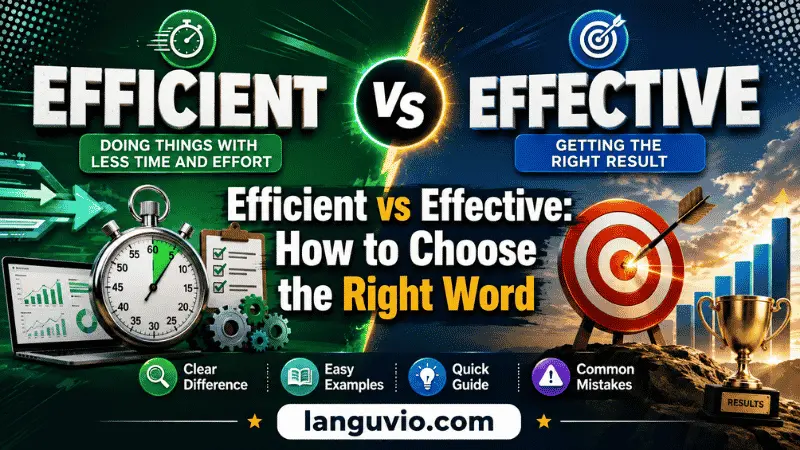
Efficient and effective are both correct, but they describe different kinds of success. The distinction matters when you discuss people, plans, machines, treatments, communication, or workplace performance.
Effective focuses on the outcome. Something is effective when it produces the result you wanted.
Efficient focuses on how well resources are used. A process is efficient when it works successfully without wasting unnecessary time, energy, money, effort, or materials.
Because the meanings overlap, one method can be effective without being efficient. Another may seem efficient in a narrow sense but still fail to achieve the real goal. Understanding that difference makes the right word much easier to choose.
Quick Answer
Choose effective when the result matters most. Select efficient when successful performance and low waste matter together.
- “The new reminder system was effective.”
It achieved the intended result. - “The new checkout process was efficient.”
It worked smoothly while saving time and effort.
When both ideas apply, the two words can appear together: “The team created an efficient and effective response plan.”
Why People Confuse Them
Both words can describe something that works well, so the confusion is understandable. A successful employee, process, or system may deserve either adjective, depending on what the speaker wants to emphasize.
Efficient often includes success, but it adds another question: How much time, effort, energy, money, or material did the work require?
Effective asks a more direct question: Did it produce the intended result?
A common memory aid says that efficiency means doing things right, while effectiveness means doing the right things. That shortcut can help, but it does not cover every case. The clearest distinction remains resource use versus desired outcome.
Key Differences At A Glance
- Efficient: emphasizes organized performance and minimal waste.
- Effective: emphasizes success, impact, or the intended result.
- Both: function mainly as standard adjectives in everyday US English.
- Together: describe work that succeeds while using resources wisely.
An effective solution solves the problem. An efficient solution solves it with a sensible use of available resources.
Meaning and Usage Difference
Efficient describes a person, machine, method, or system that performs well without unnecessary waste. The resources involved may include labor, fuel, electricity, materials, money, or time.
- “Our warehouse introduced an efficient packing system.”
- “Maya is efficient and completes accurate reports ahead of schedule.”
Effective describes something that produces the intended effect or achieves the desired goal.
- “Revised safety messaging proved effective.”
- “Regular practice is an effective way to improve fluency.”
Grammatically, both words are adjectives. Each may appear before a noun or after a linking verb:
- “an efficient process”
- “the process is efficient”
- “an effective strategy”
- “the strategy was effective”
Effective also has another established meaning. A policy may become effective on a certain date, meaning it comes into force. In this comparison, however, the main issue is successful results versus careful resource use.
Tone, Context, and Formality
Neither word is unusually formal or casual. Both fit conversation, school writing, business communication, technical discussions, and professional reports.
Context determines the kind of praise being given.
Calling an employee efficient highlights organization, speed, accuracy, or careful use of time. Describing that employee as effective highlights results, influence, or goal achievement.
For machines, efficient usually refers to energy, fuel, output, or operating cost. With treatments, effective normally means that the treatment produces the intended benefit.
The words can describe the same person or system, but they point to different strengths.
Which One Should You Use?
The best choice depends on what you are evaluating.
| Context | Best Choice | Why |
| A plan achieved its goal | Effective | The result is the main point |
| A worker completed accurate tasks with little delay | Efficient | Time and effort are the focus |
| A treatment produced the intended benefit | Effective | Success of the treatment matters |
| An appliance uses less electricity for the same job | Efficient | Energy use is being compared |
| A speech changed the audience’s opinion | Effective | The speech created the intended impact |
| A delivery route reduced miles and fuel use | Efficient | The route reduced wasted resources |
| A process reached the goal with little waste | Both | It succeeded and used resources well |
Two questions usually resolve the choice:
- Did it achieve the goal? Use effective.
- Did it use resources wisely? Select efficient.
When both answers are yes, both adjectives may be appropriate.
When One Choice Sounds Wrong
Some contexts strongly favor one word.
For treatments, messages, arguments, and strategies, effective is usually the natural choice when the sentence focuses only on results:
- Natural: “The medication was effective at reducing the pain.”
- Awkward without a resource comparison: “The medication was efficient at reducing the pain.”
Energy use, fuel use, and production systems often call for efficient:
- Natural: “This furnace is more energy-efficient.”
- Too vague for the intended point: “This furnace is more energy-effective.”
In other cases, either word may be grammatical, but the meaning changes:
- “She is an effective manager” means she achieves the needed results.
- “She is an efficient manager” means she manages work with little wasted time or effort.
The right choice depends on the type of success you want to describe.
Common Mistakes (and Quick Fixes)
Mistake: Treating efficient as another word for fast.
A rushed process may be quick but inaccurate or wasteful. Reserve efficient for work that performs successfully while using resources well.
Mistake: Assuming effective always means high quality.
Something can achieve a narrow goal without being elegant, cheap, or pleasant. Effective simply indicates that the intended result occurred.
Mistake: Calling a failed process efficient because it finished quickly.
Speed does not help when the method misses its purpose. Describe the process as fast, then explain that it was ineffective.
Mistake: Using only one word when both ideas matter.
A method that reaches the target and reduces waste can be both efficient and effective.
Mistake: Replacing cost-effective with cost-efficient automatically.
Cost-effective usually means that the result is worthwhile for the money spent. Cost-efficient emphasizes minimizing waste or getting more output from the available budget.
Everyday Examples
At work:
- “The shorter approval chain made the department more efficient.”
- “Our customer follow-up campaign was effective and increased renewals.”
At school:
- “Reviewing the hardest material first was an effective study strategy.”
- “Grouping similar assignments made her study routine more efficient.”
At home:
- “New insulation offers a more efficient way to heat the house.”
- “Using a written schedule was effective in reducing missed chores.”
In communication:
- “One-page instructions were effective because new employees understood them.”
- “A shared template made weekly updates more efficient.”
Consider a meeting that ends in fifteen minutes but settles nothing. It may appear efficient because it was brief, yet it was not effective. A longer meeting that resolves the issue may be effective but still inefficient if the same result could have been reached sooner.
Dictionary-Style Word Details
Verb
- Efficient: Not commonly used as a verb in standard US English. An adverbial form, such as “work efficiently,” can describe how an action is performed.
- Effective: Not commonly used as a verb. Do not confuse it with the separate verb “effect,” which means to bring something about.
Noun
- Efficient: Not commonly used as a noun in standard US English. It normally functions as an adjective.
- Effective: Usually an adjective. A rare specialized noun use can refer to a person or unit ready for service, but everyday writers should treat effective as an adjective.
Synonyms
- Efficient: Closest plain alternatives include economical, streamlined, productive, organized, and competent, depending on context. Clear opposites include inefficient and wasteful.
- Effective: Closest plain alternatives include successful, useful, powerful, convincing, and operative, depending on the intended sense. The clearest general opposite is ineffective.
The two words can overlap as near-equivalents, but they are not exact replacements in every sentence.
Example Sentences
- Efficient: “Our revised form created a more efficient intake process.”
- Efficient: “Jordan works efficiently without sacrificing accuracy.”
- Effective: “The coach gave an effective halftime speech.”
- Effective: “This new filter is effective at removing the odor.”
- Both: “The clinic introduced an efficient and effective scheduling system.”
Word History
Both words entered English through French and Latin forms connected with producing or bringing something about. Their shared background helps explain why the meanings overlap.
Modern usage gives each word a different emphasis. Effective centers on producing an effect or result, while efficient centers on useful performance with limited waste. Exact historical dates are unnecessary for making the present-day choice.
Phrases Containing
Common phrases with efficient include:
- energy-efficient
- fuel-efficient
- cost-efficient
- efficient process
- efficient use of time
Common phrases with effective include:
- effective communication
- effective treatment
- effective strategy
- effective immediately
- effective date
The phrase “effective immediately” uses the meaning “in force from now,” not “successful.”
FAQs
No, they are not fully interchangeable. Effective emphasizes whether something achieves the intended result. Efficient focuses on whether it performs successfully with little wasted time, effort, money, energy, or material. Some people, plans, and systems can accurately be described with both words.
Yes. A method may reach its goal while consuming more resources than necessary. For example, a team could solve a small problem after several long meetings. The approach was effective because it worked, but inefficient because it required excessive time and effort.
Yes, especially when someone measures a narrow process instead of the real goal. A team might send hundreds of messages quickly and cheaply but receive no useful responses. The sending process was efficient, yet the overall communication was not effective.
Choose efficient when praising organization, speed, accuracy, or careful use of resources. Effective fits better when praising results, influence, or goal achievement. A strong employee may be both: effective at reaching goals and efficient in completing the necessary work.
Either word may fit, depending on your focus. Call it effective when it solves the intended problem. Describe it as efficient when it limits waste while performing successfully. Both words fit when the method reaches the goal and makes sensible use of resources.
Yes, and the combination is common and logical. It means the person, process, or system achieves the desired result while using time, energy, money, or materials wisely. For maximum clarity, state what result it achieved and what waste it reduced.
Conclusion
Efficient and effective describe two related but different kinds of success. Effective answers the question, “Did it work?” Efficient asks, “Did it work with minimal waste?”
Treatments, arguments, plans, and messages are often described as effective because the outcome matters most. Workers, machines, routes, and systems are often called efficient when the focus is careful use of time, energy, money, or materials.


