
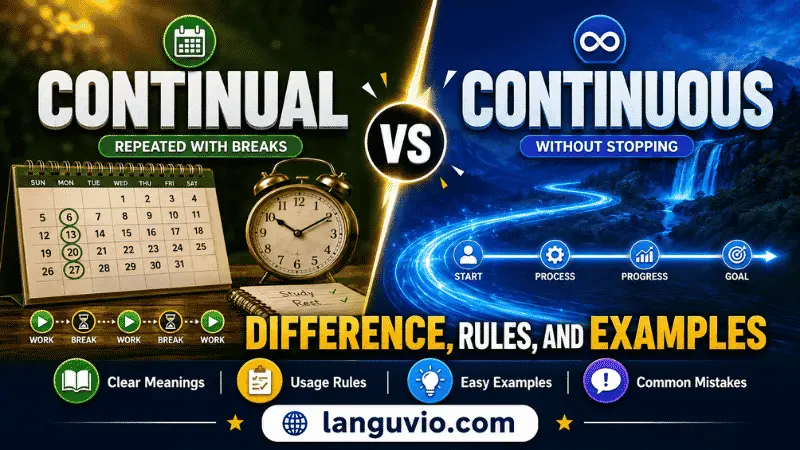
Continual and continuous are both correct English adjectives, but they usually describe different patterns. Use continual for repeated events with pauses. Use continuous for something that proceeds without a meaningful break.
A phone may cause continual interruptions because each alert ends. A fan may produce a continuous hum because the sound does not pause. Real usage overlaps, so this is a strong default rather than an absolute law.
Quick Answer
Both words are correct. Choose continual for something that happens again and again with breaks, such as continual complaints. Choose continuous for something unbroken in time, space, or sequence, such as continuous service or a continuous line.
Why People Confuse Them
The words share the idea of continuation. Both are adjectives, can modify similar nouns, and sometimes overlap.
Continual pressure may describe pressure that keeps returning or seems ever-present. Continuous pressure more strongly emphasizes that it never lets up. Context can make the difference small, so speakers do not always maintain a strict separation.
Key Differences At A Glance
| Context | Best Choice | Why |
| Repeated phone alerts | continual | Each alert ends before another begins |
| An unbroken electrical current | continuous | The flow does not stop |
| Problems that keep returning | continual | The problems recur over time |
| A solid line on a road | continuous | The line has no gaps |
| Pain with no relief during the period | continuous | The condition remains uninterrupted |
| Short rain showers throughout the day | continual | The rain stops and starts |
Meaning and Usage Difference
Continual most often means repeated, recurring, or happening frequently over a period. It allows pauses. Continuous most often means uninterrupted, unbroken, or forming a connected whole. It can describe time, physical space, movement, sound, or sequence.
Both words normally modify nouns:
- continual: repeated occurrences, usually with intervals
- continuous: one unbroken occurrence, flow, line, or state
The distinction becomes especially clear with the same noun. Continual noise may stop briefly and return. Continuous noise remains present throughout the stated time.
Because usage overlaps, do not treat the rule as a test of grammatical correctness in every sentence. Treat it as a precision choice: select the word that best shows whether breaks matter.
Tone, Context, and Formality
Both adjectives are standard, and neither is inherently more formal.
Continual often appears with unwanted repetition, as in continual delays or complaints. This can create an irritated tone, but the word itself is not negative; continual support can be positive.
Continuous often sounds neutral or technical in phrases such as continuous data, motion, or coverage. Its central idea is lack of interruption.
Which One Should You Use?
Ask one question: Did it stop during the period you are describing?
Use continual when the event stopped but returned repeatedly. Use continuous when it did not stop or when separate parts form one unbroken whole.
Some contexts allow either word. Continual improvement can highlight repeated rounds of change; continuous improvement can present improvement as an ongoing operating principle. Follow an organization’s official wording when it has one.
When One Choice Sounds Wrong
Some nouns make the intended pattern clear.
A continual line usually sounds wrong when you mean a line with no gaps. Continuous is the natural choice because the description concerns spatial connection.
Continuous interruptions can also sound awkward when separate interruptions occur throughout the day. Continual interruptions better shows repeated events. However, a continuous interruption could describe one disruption that never ended.
Medical or practical descriptions require similar care. Continuous pain means no meaningful relief. Continual pain may suggest recurring episodes, although context should make the intended pattern explicit.
Common Mistakes (and Quick Fixes)
Treating the words as perfect opposites: Their meanings overlap, so apply the standard distinction when it improves clarity.
Using continual for an unbroken form: Write a continuous line, surface, or path when there are no gaps.
Assuming continual is always negative: Let context set the tone. Continual encouragement is positive.
Using an adjective as an adverb: Use continual or continuous before a noun; use continually or continuously to modify an action.
Everyday Examples
- The app sent continual reminders until I completed the form.
- The backup system provided continuous power during the outage.
- Our team faced continual scheduling changes this month.
- The livestream ran continuously for six hours.
- Construction caused continual delays on my morning commute.
- A continuous strip of lighting ran beneath the cabinets.
- Her continual check-ins helped the new employee feel supported.
- The machine requires continuous airflow while operating.
These examples show why context matters. Repeated events take continual; an unbroken state, connection, or flow normally takes continuous.
Dictionary-Style Word Details
Verb
- continual: Not commonly used as a verb in standard US English. It functions as an adjective.
- continuous: Not commonly used as a verb in standard US English. It also functions as an adjective.
Use a verb such as continue when the sentence needs an action rather than a describing word.
Noun
- continual: Not commonly used as a noun. Related noun forms are uncommon in everyday writing.
- continuous: Not commonly used as a noun in this comparison. Continuity is the usual related noun for an unbroken connection or sequence.
Synonyms
- continual — closest plain alternatives: repeated, recurring, frequent, persistent.
- continuous — closest plain alternatives: uninterrupted, unbroken, nonstop, seamless.
Helpful contrasts include sporadic for continual and interrupted or discontinuous for continuous. The best alternative depends on the noun and context.
Example Sentences
- continual: Continual revisions pushed the launch date into September.
- continual: The puppy’s continual scratching suggested that something was bothering it.
- continuous: The sensor records continuous temperature data.
- continuous: A continuous fence surrounds the property.
Word History
Continual is the older English word and was historically used for both repeated and uninterrupted continuation. Continuous entered English later and became strongly associated with an unbroken flow or connection. Their shared history helps explain why present-day meanings still overlap.
Phrases Containing
- continual: continual improvement, continual interruptions, continual complaints, continual learning.
- continuous: continuous improvement, continuous flow, continuous line, continuous service, present continuous.
Both improvement phrases are established. The intended viewpoint, field, or official name often determines the choice.
FAQs
Yes. Both are standard adjectives, but they usually describe different patterns. Continual commonly points to repeated events with pauses between them, while continuous usually describes something that remains unbroken in time, space, or sequence.
Sometimes, especially in ordinary speech and writing. Dictionaries record overlap, and continual can occasionally mean uninterrupted. Still, choosing continual for recurrence and continuous for an unbroken state gives readers the clearest meaning in most situations.
No. Continual is not automatically negative, though it often appears with complaints, interruptions, delays, and other unwanted events. It can also describe neutral or positive repetition, such as continual practice, support, learning, or improvement.
Both phrases are established. Continual improvement often suggests repeated steps made over time, while continuous improvement may present improvement as an ongoing process or management principle. Follow the wording used by your organization when it has a defined program name.
Choose according to whether it stops. Continuous pain, noise, or rain has no meaningful break during the stated period. Continual pain, noise, or rain returns repeatedly, although short pauses may occur between episodes.
No major grammatical difference exists between them. Both normally function as adjectives before a noun or after a linking verb. Their related adverbs are continually and continuously, which describe how an action happens rather than naming a quality.
Conclusion
The continual vs continuous choice depends mainly on interruption. Use continual for events that recur with breaks, and continuous for an unbroken state, flow, connection, or sequence. Because real usage overlaps, focus on the meaning you want readers to picture rather than treating the distinction as an inflexible rule.