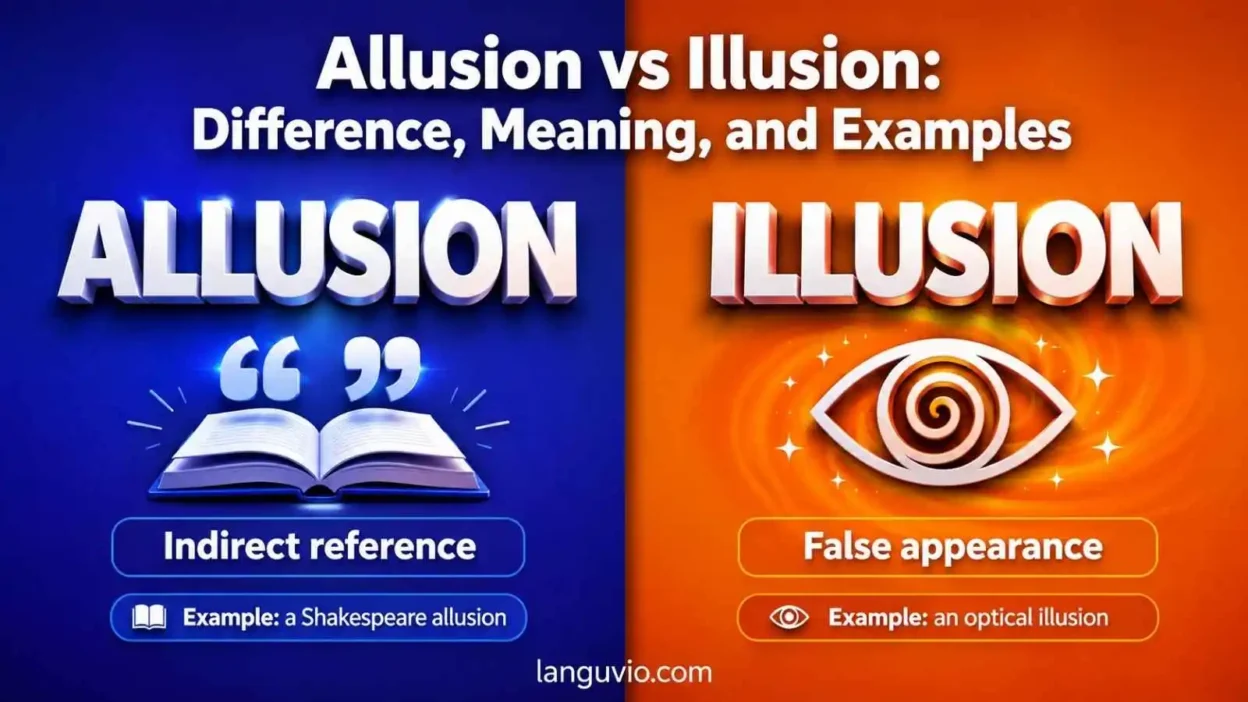
Allusion and illusion are both correct words, but they do not mean the same thing.
Use allusion when you mean an indirect reference to something. Use illusion when you mean something false, misleading, or not as real as it seems.
The easiest way to remember it is this: an allusion points to something; an illusion tricks you.
Quick Answer
Allusion means a reference, often indirect.
Example: The movie made an allusion to a famous fairy tale.
Illusion means a false appearance, false belief, or mistaken perception.
Example: The mirrors created the illusion of a larger room.
They sound very close, which is why people mix them up. In plain pronunciation, allusion sounds like uh-LOO-zhun. Illusion sounds like ih-LOO-zhun. The first syllable is slightly different, but the real difference is meaning.
Why People Confuse Them
People confuse allusion and illusion because they look alike, sound alike, and are both nouns.
They also appear in serious writing, school assignments, reviews, speeches, and everyday comments. That makes the mistake easy to miss.
But the words do very different jobs. Allusion is about reference. Illusion is about false appearance or false belief.
Key Differences At A Glance
| Feature | allusion | illusion |
| Main meaning | An indirect reference | A false appearance or belief |
| Common use | Books, speeches, jokes, headlines, analysis | Magic, design, sight, belief, perception |
| Common pattern | allusion to | illusion of, under the illusion that |
| Main idea | It points to something | It misleads the mind or senses |
Meaning and Usage Difference
An allusion happens when a speaker or writer refers to something without explaining it fully. The reference may be to a book, movie, event, person, song, myth, or shared memory.
Example: Calling the new employee “a real Sherlock” is an allusion to Sherlock Holmes.
The sentence does not explain the full story. It depends on the reader knowing that Sherlock Holmes is linked with sharp detective work.
An illusion happens when something seems true or real but is not. It can involve the eyes, the mind, or a belief.
Example: The stage lights created the illusion that the singer was floating.
The singer was not floating. It only looked that way.
Tone, Context, and Formality
Allusion often sounds a little more literary or analytical, but it is not limited to literature. People make allusions in jokes, speeches, ads, movie reviews, social posts, and everyday conversation.
Illusion is common in both everyday and formal writing. You can use it for a magic trick, a false hope, a mistaken belief, or a visual effect.
Neither word is slang. Both are standard in American English.
The main context difference is simple: allusion belongs with meaning and reference; illusion belongs with appearance, belief, and perception.
Which One Should You Use?
| Context | Best Choice | Why |
| A novel hints at Greek myth | allusion | It refers to another story |
| A mirror makes a room look bigger | illusion | It creates a false appearance |
| A speech hints at a past scandal | allusion | It refers indirectly to an event |
| Someone wrongly thinks the deadline changed | illusion | It is a mistaken belief |
| A headline echoes a movie title | allusion | It depends on a known reference |
| A magician makes a coin seem to disappear | illusion | It tricks the eye |
When One Choice Sounds Wrong
Use allusion when someone is making a reference.
Wrong: The poem has an illusion to Greek myths.
Right: The poem has an allusion to Greek myths.
Use illusion when something seems real but is false or misleading.
Wrong: The hallway mirrors created an allusion of depth.
Right: The hallway mirrors created an illusion of depth.
A helpful test: Can you replace the word with reference? Choose allusion. Can you replace it with false appearance or mistaken belief? Choose illusion.
Common Mistakes (and Quick Fixes)
Mistake: Using illusion for a reference.
Fix: Use allusion for a hint, mention, or reference.
Mistake: Using allusion for a visual trick.
Fix: Use illusion for something that fools the eyes or mind.
Mistake: Thinking the words are interchangeable because they sound alike.
Fix: Match the word to the meaning, not the sound.
Mistake: Writing an allusion of.
Fix: In most cases, write an allusion to.
Mistake: Writing under the allusion that.
Fix: The standard phrase is under the illusion that.
Everyday Examples
- Her joke was an allusion to an old sitcom.
- The campaign slogan made a clear allusion to a famous speech.
- The mural creates the illusion of a window.
- He was under the illusion that the meeting started at noon.
- The song includes several allusions to small-town life.
- The app’s design gives the illusion of depth.
- The teacher explained the allusion before the class read the poem.
- The sale price created the illusion of a better deal.
Dictionary-Style Word Details
Verb
allusion: Not used as a verb in standard American English. The related verb is allude, meaning to refer indirectly.
Example: The speaker alluded to last year’s mistake.
illusion: Not commonly used as a verb in standard American English. A rare related verb, illude, means to deceive, but most readers will find it unusual. In normal writing, use deceive, mislead, or create an illusion.
Noun
allusion: A noun meaning an indirect or brief reference. It can be singular or plural.
Example: The article included an allusion to a classic novel.
illusion: A noun meaning a false appearance, false belief, or mistaken perception. It can also be singular or plural.
Example: She had no illusions about how hard the project would be.
Synonyms
allusion: Closest plain alternatives include reference, hint, indirect mention, and suggestion. These are not always exact, because an allusion often depends on shared knowledge.
A useful opposite in some contexts is direct mention, but there is no perfect one-word opposite for every use.
illusion: Closest plain alternatives include false impression, mirage, mistaken belief, fantasy, and false appearance. The best choice depends on the sentence.
A useful contrast is reality, but it does not work as a direct opposite in every sentence.
Example Sentences
allusion: The graduation speech included an allusion to the school’s first winning season.
allusion: The headline made a playful allusion to a famous movie quote.
illusion: The open shelving gave the illusion of more space in the kitchen.
illusion: He was under the illusion that everyone had already approved the plan.
Word History
allusion: The word is tied to the idea of alluding, or referring indirectly. Its history connects with older forms meaning to play toward or hint at something.
illusion: The word is tied to older meanings of deception, mockery, and false appearance.
Their histories help explain why they look and sound similar, but history does not make them interchangeable. In modern use, allusion is a reference, and illusion is something misleading or unreal.
Phrases Containing
allusion:
- allusion to
- make an allusion to
- literary allusion
- historical allusion
- subtle allusion
illusion:
- optical illusion
- under the illusion that
- illusion of safety
- illusion of space
- no illusions about
FAQs
Is it allusion or illusion?
Use allusion when you mean an indirect reference. Use illusion when you mean something false, misleading, or not real in the way it appears.
Example: The novel makes an allusion to Greek myth.
Example: The mirrors create the illusion of a larger room.
What is the main difference between allusion and illusion?
An allusion points to something else. An illusion tricks the eyes, mind, or expectations.
Think: allusion = reference and illusion = false appearance.
Can allusion and illusion be used interchangeably?
No. They are not interchangeable. They sound similar, but they have different meanings.
Wrong: The speech made an illusion to history.
Right: The speech made an allusion to history.
What is an example of an allusion?
Her comment about “crossing the Rubicon” was an allusion to a major point of no return.
The sentence refers to a known historical idea without explaining the full story.
What is an example of an illusion?
The painting creates the illusion of a hallway.
The hallway is not really there. It only appears to be there.
Is an allusion always literary?
No. Allusions are common in books, but they also appear in speeches, movies, ads, jokes, headlines, and everyday conversation.
Example: His “May the Force be with you” comment was an allusion to Star Wars.
Is an illusion always visual?
No. An illusion can be visual, but it can also be a mistaken belief.
Example: She was under the illusion that the deadline had moved.
Which phrase is correct: allusion to or illusion to?
Allusion to is the correct phrase when talking about a reference.
Correct: The song contains an allusion to childhood.
Usually wrong: The song contains an illusion to childhood.
Which phrase is correct: illusion of or allusion of?
Illusion of is correct when talking about a false appearance or impression.
Correct: The design gives the illusion of more space.
Usually wrong: The design gives the allusion of more space.
How can I remember allusion vs illusion?
Use this quick memory trick: an allusion points; an illusion tricks.
Conclusion
The difference between allusion vs illusion is about meaning, not spelling.
Choose allusion when you mean a reference: The book makes an allusion to a myth.
Choose illusion when you mean something false, misleading, or not as real as it seems: The mirror creates an illusion of space.
Remember: allusion points; illusion tricks.