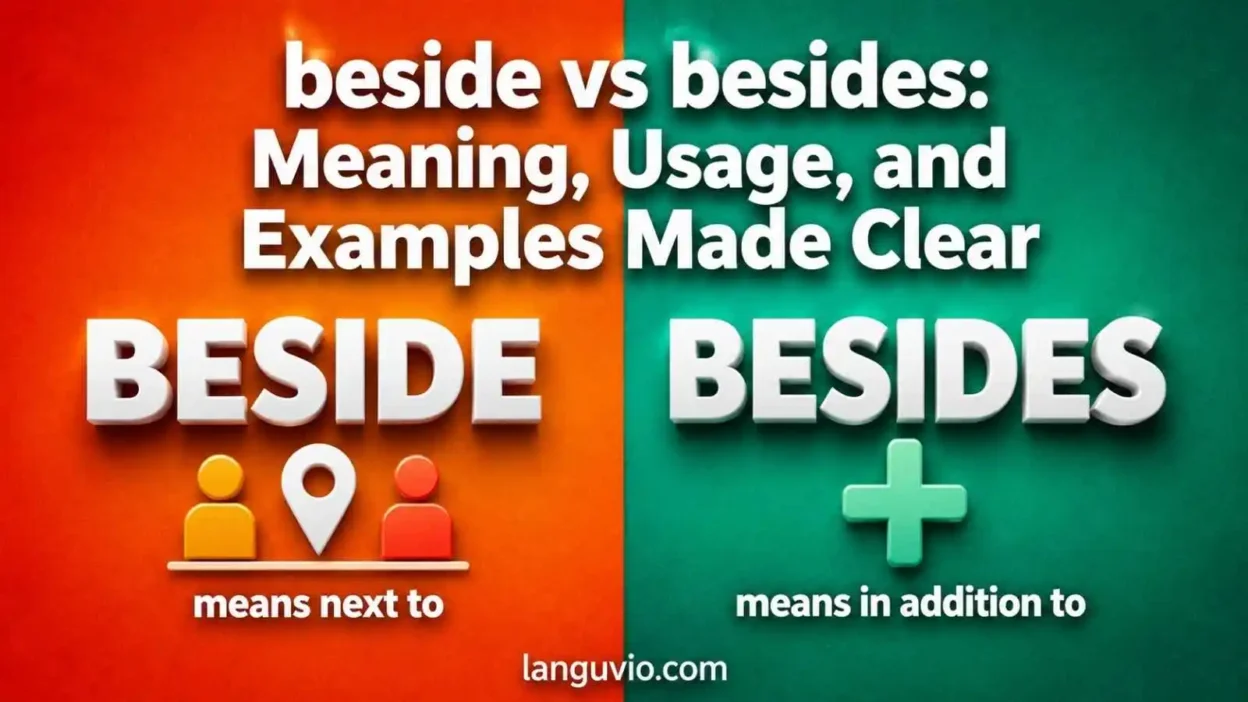
Beside and besides are both correct words, but they do not mean the same thing in most sentences.
Use beside when you mean next to or at the side of.
Use besides when you mean in addition to, also, or other than.
The final s changes both the meaning and the grammar. That is why a sentence can sound wrong even when the spelling looks close.
Quick Answer
Beside means next to.
Example:
The charger is beside my laptop.
Besides means in addition to or also.
Example:
Besides coffee, we also have tea.
So, if you are talking about location, choose beside. If you are adding something, choose besides.
Why People Confuse Them
People confuse beside and besides because the words look and sound almost alike. The only spelling difference is the final s.
They also both often appear before a noun.
Example:
She sat beside Mark.
Besides Mark, three other people joined.
Both sentences are correct, but they say different things. In the first sentence, she sat next to Mark. In the second sentence, Mark is one person in a larger group.
Key Differences At A Glance
| Feature | beside | besides |
| Main meaning | next to; at the side of | in addition to; also; other than |
| Main grammar role | preposition | preposition or adverb |
| Best for | location or comparison | adding information |
| Common phrase | beside the point | besides that |
Meaning and Usage Difference
Beside is about position. It tells where something or someone is.
Examples:
The dog slept beside the couch.
Please leave the box beside the front door.
It can also mean compared with, though this is less common in everyday speech.
Example:
My old phone looks tiny beside my new one.
Besides adds information. It can mean in addition to before a noun or noun-like phrase.
Example:
Besides rent, I need to pay utilities.
It can also work as an adverb meaning also or moreover.
Example:
I do not want to drive tonight. Besides, it is snowing.
Tone, Context, and Formality
Both words are standard in US English.
Beside is common in clear description, especially when you are talking about where something is. It can sound a little more polished than next to, but it is not overly formal.
Example:
She stood beside the podium.
Besides is common in speech and writing when you add another point, reason, or item.
Example:
We should order pizza. Besides, everyone is already here.
In formal writing, besides can sometimes feel casual at the start of a sentence. If the tone needs to be more formal, in addition or furthermore may fit better.
Which One Should You Use?
| Context | Best Choice | Why |
| Something is next to something else | beside | It shows physical position. |
| You are adding another item | besides | It means in addition to. |
| You are adding another reason | besides | It works like also or moreover. |
| You mean “compared with” | beside | It can show comparison. |
| You mean “irrelevant” in the common phrase | beside | The standard phrase is beside the point. |
When One Choice Sounds Wrong
Use beside only when the idea is about side-by-side position, comparison, or a set phrase such as beside the point.
Wrong:
Besides the couch, there is a lamp.
Correct:
Beside the couch, there is a lamp.
Use besides when you are adding something.
Wrong:
Beside math, she is taking biology.
Correct:
Besides math, she is taking biology.
The wrong word may still be understandable, but it can make the sentence sound careless or unclear.
Common Mistakes (and Quick Fixes)
Mistake 1: Using besides for location
Wrong:
The keys are besides the bowl.
Correct:
The keys are beside the bowl.
Quick fix: If you can replace the word with next to, use beside.
Mistake 2: Using beside for addition
Wrong:
Beside lunch, the ticket includes parking.
Correct:
Besides lunch, the ticket includes parking.
Quick fix: If you can replace the word with in addition to, use besides.
Mistake 3: Writing “besides the point”
Wrong:
That comment is besides the point.
Correct:
That comment is beside the point.
Quick fix: The standard phrase is beside the point.
Everyday Examples
I put my phone beside the sink while I washed my hands.
The new store is beside the pharmacy on Main Street.
He sat beside his sister at the graduation ceremony.
Besides water, the runners received bananas and granola bars.
I am not going out tonight. Besides, I have an early meeting tomorrow.
Besides the monthly fee, there may be a setup charge.
My apartment looks small beside yours.
That detail is interesting, but it is beside the point.
Dictionary-Style Word Details
Verb
• beside: Not commonly used as a verb in standard US English.
• besides: Not commonly used as a verb in standard US English.
Noun
• beside: Not commonly used as a noun in standard US English.
• besides: Not commonly used as a noun in standard US English.
Synonyms
• beside: Closest plain alternatives include next to, by, alongside, and at the side of. For comparison, compared with may fit.
• besides: Closest plain alternatives include in addition to, also, as well as, apart from, and other than.
Clear antonyms are not always direct because these words work mainly by showing relationship. For beside, a practical opposite may be away from in location-based sentences. For besides, except for can fit only when the meaning is exclusion, not addition.
Example Sentences
• beside: The backpack is beside the desk.
• beside: Her design looked simple beside the final version.
• besides: Besides soccer, Maya plays tennis.
• besides: I do not want dessert. Besides, I am full.
Word History
• beside: The word is tied to the idea of being by the side of something. That history matches its modern meaning: next to or at the side of.
• besides: The word is related to beside, but modern usage gives it a different job. It usually adds information, meaning in addition to, also, or other than.
The exact history is not needed for everyday choice. The safest modern rule is based on meaning, not origin.
Phrases Containing
• beside: beside the point, beside oneself, stand beside, sit beside, right beside
• besides: besides that, besides me, besides everything else, besides being, nothing besides
FAQs
Is it “beside me” or “besides me”?
Use beside me when you mean next to me.
Example:
She sat beside me during the meeting.
Use besides me when you mean in addition to me or other than me.
Example:
Besides me, two other people volunteered.
Is “besides the point” correct?
No. The correct phrase is beside the point.
Correct:
That detail is beside the point.
It means the detail is not relevant to the main issue.
Can “besides” mean “except”?
Yes, in some sentences besides can mean except or other than.
Example:
No one besides Alex knew the password.
Here, besides Alex means other than Alex.
Can I use “beside” instead of “next to”?
Yes. Beside and next to often mean the same thing when talking about location.
Example:
The lamp is beside the bed.
The lamp is next to the bed.
Both are correct.
Is “beside” formal?
Beside is standard and natural. It can sound a little more polished than next to, but it is not overly formal.
Example:
She stood beside the flag.
Is “besides” formal?
Besides is standard, but it can sound conversational when it starts a sentence.
Example:
Besides, we already paid for the tickets.
In more formal writing, in addition or furthermore may sound smoother.
What is the easiest way to remember beside vs besides?
Use beside if next to fits.
Use besides if in addition to or also fits.
Example:
The shoes are beside the door.
Besides shoes, she bought a jacket.
Are beside and besides interchangeable?
No. They are usually not interchangeable.
Beside points to location or comparison.
Besides adds information or means other than.
Using the wrong one can change the meaning of the sentence.
Conclusion
The difference between beside and besides is simple once you focus on meaning.
Use beside for next to, at the side of, or compared with.
Use besides for in addition to, also, or other than.
The easiest test is this: if next to fits, choose beside. If in addition to or also fits, choose besides.