
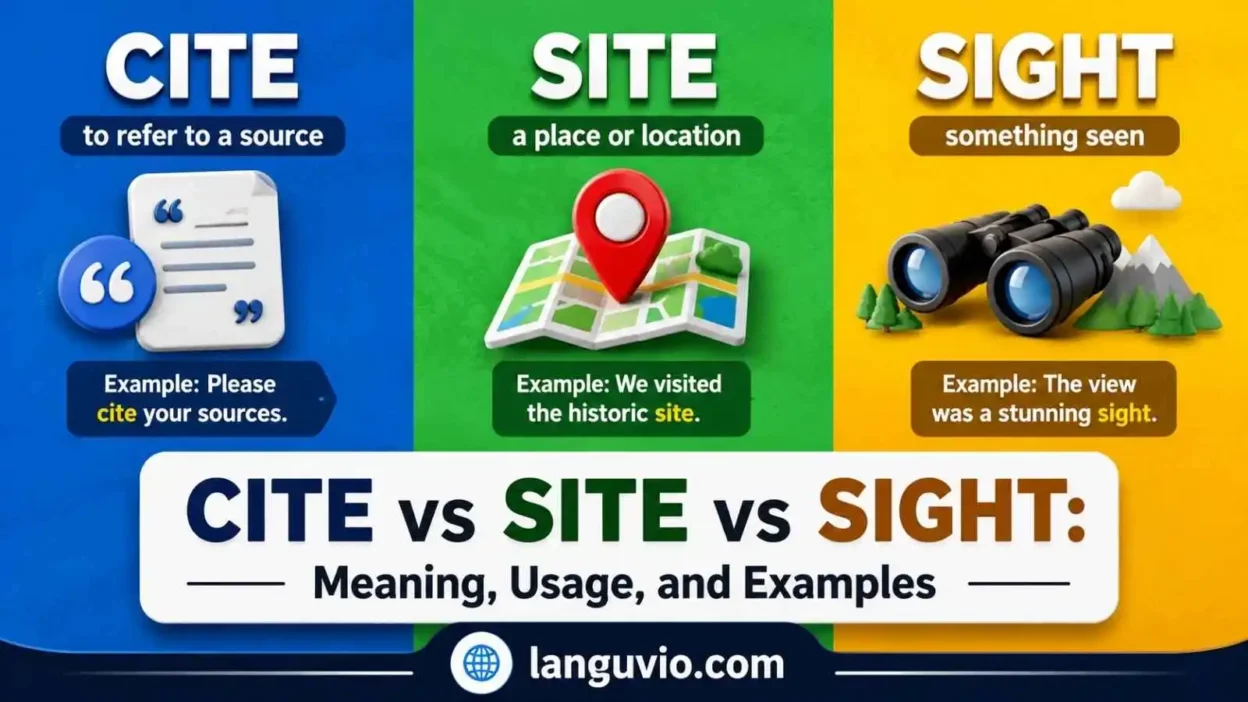
“Cite,” “site,” and “sight” sound exactly the same in standard American English. However, their meanings are completely different.
As a result, many people accidentally use the wrong spelling in essays, emails, text messages, and online writing. Even spellcheck may miss the error because all three words are correctly spelled.
To avoid confusion, it helps to connect each word to its most common use:
- “Cite” relates to references or quotations.
- “Site” refers to a place or location.
- “Sight” connects to vision or something seen.
Once you separate the meanings by context, choosing the right word becomes much easier.
Quick Answer
Generally, “cite” is the correct choice when talking about quoting, referencing, or mentioning a source formally.
Meanwhile, “site” refers to a physical place, property, area, or website.
In contrast, “sight” relates to vision, seeing, or something visible.
Examples:
- Please cite your sources at the end of the paper.
- The company selected a new building site.
- The waterfall was an incredible sight.
Why People Confuse Them
The main reason people confuse these words is pronunciation. In most US accents, “cite,” “site,” and “sight” are all pronounced the same way: “syt.”
Because they are homophones, listeners usually understand the meaning through context alone. In writing, however, the wrong spelling can quickly create confusion.
For example:
- “Please site your sources” is incorrect.
- “Please cite your sources” is correct.
Similarly:
- “The construction sight is closed” is incorrect.
- “The construction site is closed” is correct.
Since the words sound identical, writers often rely on memory instead of meaning. That is where mistakes happen.
Key Differences At A Glance
| Context | Best Choice | Why |
| Academic references | cite | Means to quote or reference a source |
| Legal references | cite | Means formally mention evidence or authority |
| A website | site | Refers to an online location |
| A physical location | site | Means a place or area |
| Vision or eyesight | sight | Relates to seeing |
| A beautiful view | sight | Means something visually noticeable |
Quick Comparison
| Feature | cite | site | sight |
| Main meaning | Reference something | Place or location | Vision or something seen |
| Common role | Verb | Usually a noun | Usually a noun |
| Common setting | Academic or legal writing | Locations and websites | Visual experiences |
| Pronunciation | Same as “site” | Same as “sight” | Same as “cite” |
Meaning and Usage Difference
In most situations, “cite” functions as a verb. It means to quote, mention, reference, or formally point to a source, rule, example, or authority.
Examples:
- The student cited three research studies.
- During the debate, she cited government data.
Additionally, “cite” often appears in academic, legal, and professional writing because those settings require evidence and references.
By comparison, “site” usually works as a noun. It refers to a place, area, property, or position. Today, it is also commonly used to mean a website.
Examples:
- Workers arrived early at the construction site.
- I found the recipe on a cooking site.
In more formal situations, “site” can also work as a verb meaning “to place in a particular location.”
Example:
- The city plans to site the new hospital near downtown.
Meanwhile, “sight” most often functions as a noun connected to vision or something visible.
Examples:
- The Grand Canyon is an unforgettable sight.
- She lost sight of her friend in the crowd.
Occasionally, “sight” can also act as a verb. In that case, it usually means to spot or see something suddenly.
Example:
- The hikers sighted a deer near the trail.
Tone, Context, and Formality
Typically, “cite” appears in formal settings. For instance, students, lawyers, journalists, and researchers regularly use the word when discussing evidence or sources.
Common examples include:
- cite evidence
- cite a report
- cite a legal case
On the other hand, “site” works comfortably in both formal and casual communication. Because people frequently discuss locations and websites, the word appears in everyday conversation as well as business writing.
Examples include:
- job site
- event site
- travel site
Likewise, “sight” is common in daily conversation and descriptive writing. It often carries a visual or emotional tone, especially when describing scenery or memorable moments.
Example:
- Watching the fireworks was an amazing sight.
Which One Should You Use?
First, choose “cite” when you mean:
- quote
- reference
- mention officially
Next, use “site” when referring to:
- a place
- a location
- a website
Finally, pick “sight” when talking about:
- vision
- seeing
- something visible
A quick memory trick can also help:
- “Cite” connects to “citation.”
- “Site” often relates to locations or websites.
- “Sight” connects to eyesight.
When One Choice Sounds Wrong
Even though these words sound alike, the wrong spelling often looks strange immediately in writing.
Incorrect:
- I need to sight my sources.
Correct:
- I need to cite my sources.
Incorrect:
- The new office sight is downtown.
Correct:
- The new office site is downtown.
Incorrect:
- The mountain site at sunrise was beautiful.
Correct:
- The mountain sight at sunrise was beautiful.
Therefore, checking the meaning instead of the pronunciation is the safest approach.
Common Mistakes (and Quick Fixes)
Mistake:
- “Can you site the article?”
Fix:
- “Can you cite the article?”
Why:
“Cite” is used for references, quotations, and formal mentions.
Mistake:
- “The new cite is under construction.”
Fix:
- “The new site is under construction.”
Why:
“Site” refers to a place or physical location.
Mistake:
- “The skyline was an incredible site.”
Fix:
- “The skyline was an incredible sight.”
Why:
“Sight” refers to something seen visually.
Mistake:
- “Please sight your references.”
Fix:
- “Please cite your references.”
Why:
Academic references require the verb “cite,” not “sight.”
Everyday Examples
Cite
- Please cite every source in your final report.
- The lawyer cited an earlier court decision.
- Journalists should cite reliable information whenever possible.
Site
- The company launched a redesigned shopping site.
- Crews are cleaning the construction site today.
- We visited the proposed site for the new stadium.
Sight
- Seeing the northern lights was a once-in-a-lifetime sight.
- He lost sight of the exit sign in the heavy rain.
- The parade was an exciting sight for tourists.
Dictionary-Style Word Details
Verb
cite:
Commonly used as a verb in standard US English. It means to quote, mention, reference, or officially recognize something.
Example:
- The article cited several expert opinions.
site:
Less common as a verb. It means to place or position something in a specific location.
Example:
- Officials decided to site the facility outside the city.
sight:
Sometimes used as a verb meaning to spot, see, or observe something.
Example:
- Sailors sighted land after several days at sea.
Noun
cite:
Not commonly used as a noun in modern standard US English.
site:
A very common noun meaning a location, property, area, or website.
Example:
- The booking site crashed during the sale.
sight:
A common noun referring to vision or something visible.
Example:
- The waterfall was a beautiful sight.
Synonyms
cite:
Closest plain alternatives:
- reference
- quote
- mention
Possible opposite in some contexts:
- ignore
site:
Closest plain alternatives:
- location
- place
- area
sight:
Closest plain alternatives:
- vision
- view
- scene
Possible opposite in some contexts:
- blindness
Example Sentences
cite:
- Students must cite their sources correctly.
- The author cited multiple studies in the article.
site:
- The concert site opens at noon.
- They selected a safer site for the building.
sight:
- The city skyline was an impressive sight.
- She lost sight of her suitcase at the airport.
Word History
cite:
The word comes from Latin roots connected to calling or summoning. Over time, it developed the modern meaning of referencing or formally mentioning something.
site:
This word comes from Latin roots related to position or location.
sight:
The word has older Germanic roots connected to vision and seeing.
Although their histories differ, the three words are now fully separate in modern English usage.
Phrases Containing
cite:
- cite a source
- cite evidence
- cited in court
site:
- construction site
- job site
- website site map
sight:
- line of sight
- out of sight
- a welcome sight
FAQs
Is it “cite your sources” or “site your sources”?
The correct phrase is “cite your sources” because “cite” means to reference information properly. In contrast, “site” refers to a location or place.
Correct:
- Please cite your sources in MLA format.
Incorrect:
- Please site your sources.
Are “cite,” “site,” and “sight” pronounced the same?
Yes. In standard American English, all three words are usually pronounced the same way. As a result, many writers confuse them in emails, essays, and online posts.
What does “site” mean?
Generally, “site” means a place, location, or website. Today, people commonly use it when talking about online platforms as well as physical areas.
Examples:
- construction site
- camping site
- shopping site
What does “sight” mean?
Unlike “site,” the word “sight” relates to vision or something visible. Therefore, it often appears in descriptions involving scenery or eyesight.
Examples:
- The waterfall was a beautiful sight.
- He lost sight of the road sign.
Can “site” be used as a verb?
Yes, although this use is less common in everyday conversation. As a verb, “site” means to place something in a particular location.
Example:
- The city decided to site the new hospital near downtown.
Is “cite” only used in academic writing?
No. Although “cite” is very common in school and research writing, it also appears in legal, professional, and news-related contexts.
Examples:
- The lawyer cited a previous case.
- The article cited government statistics.
Which word relates to websites?
When talking about websites, “site” is always the correct choice. For example, people often say “news site,” “shopping site,” or “travel site.”
Example:
- I found the recipe on a cooking site.
What is the easiest way to remember the difference?
A simple memory trick can make these words easier to remember:
- “Cite” → citation or reference
- “Site” → place or website
- “Sight” → eyesight or seeing
Because the words sound alike, connecting them to familiar meanings can help prevent mistakes.
Is “sight” ever used as a verb?
Yes, but this usage is fairly limited. Most often, “sight” as a verb means to spot or see something from a distance.
Example:
- The hikers sighted a deer near the trail.
Which word fits this sentence: “The view was an amazing ___”?
In this sentence, the correct word is “sight” because the sentence describes something visually impressive.
Correct sentence:
- The view was an amazing sight.
Conclusion
“Cite,” “site,” and “sight” may sound identical, but they are not interchangeable.
- Use “cite” for references and formal mentions.
- Use “site” for locations and websites.
- Use “sight” for vision and things you see.
The easiest way to choose correctly is to focus on context. If you are talking about sources, places, or vision, the right spelling becomes much clearer.