Meet vs meat is a common word-choice problem because the two words sound the same. In everyday American English, they are pronounced like meet, rhyming with seat.
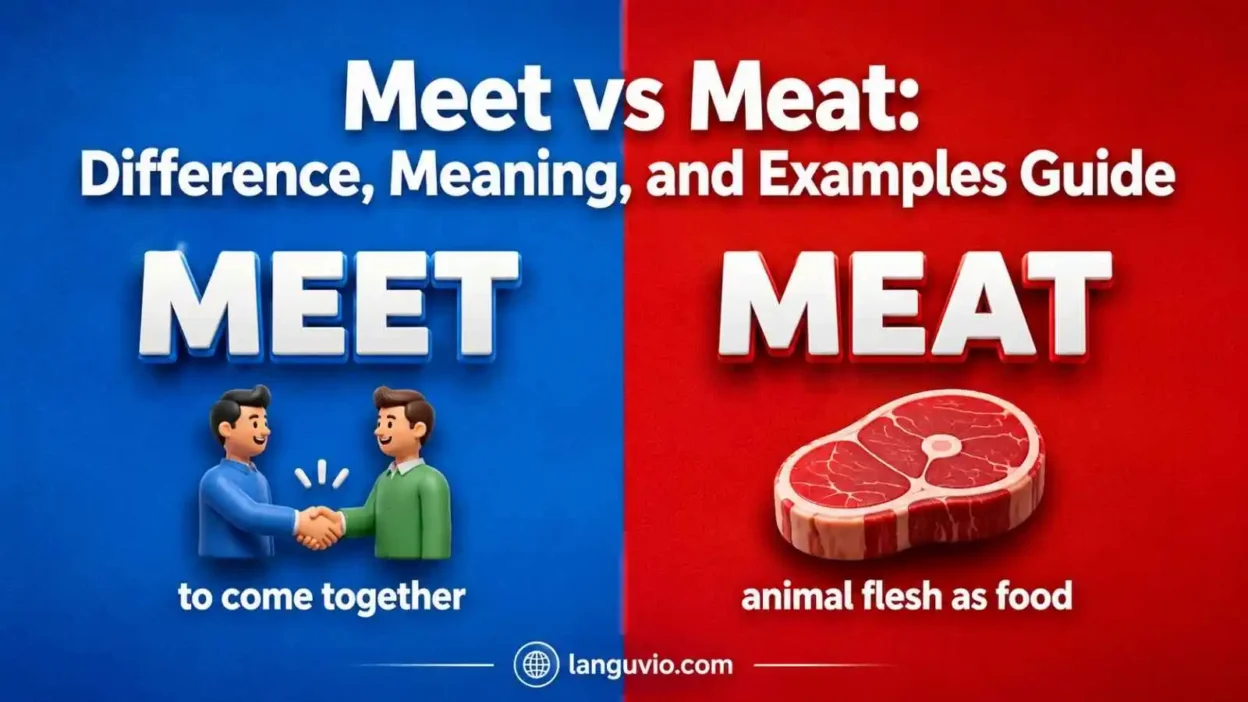
The difference is not in the sound. The difference is in the meaning and the job each word does in a sentence. Meet usually means to come together with someone, be introduced, or satisfy a need. Meat usually means animal flesh used as food, or the main substance of something.
Quick Answer
Use meet when you mean to see someone, come together, be introduced, satisfy a requirement, or take part in a sports event.
Use meat when you mean food from an animal, the edible inside part of something, or the main point of an idea.
Correct examples:
- I will meet you at the coffee shop.
- We need to meet the deadline.
- She does not eat meat.
- The meat of the argument comes in the final paragraph.
Why People Confuse Them
People confuse meet and meat because they are homophones. That means they have the same sound but different spellings and meanings.
When you hear the sentence out loud, context tells you which word is meant. When you write the sentence, spelling matters.
The sentence “Let’s meet for dinner” means two people will come together. The sentence “Let’s meat for dinner” is wrong because meat is not the action of seeing someone.
Key Differences At A Glance
- Meet: usually a verb; means to come together, be introduced, satisfy, or connect.
- Meat: usually a noun; means animal flesh used as food, the edible inner part, or the main substance.
- Same sound: both are pronounced like “meet.”
- Not interchangeable: one refers to an action or event, and the other refers to food or substance.
The easiest memory tip is this: meat contains eat, and meat is something people may eat.
Meaning and Usage Difference
Meet is most often a verb. It can mean to see someone for the first time, come together at a place, or satisfy a rule or need.
Examples:
- I’m excited to meet your family.
- Let’s meet at noon.
- The proposal does not meet the requirements.
Meat is a noun. It most often means animal flesh used as food. It can also mean the edible inner part of a nut or fruit, or the main part of an idea.
Examples:
- The soup has chicken meat in it.
- The coconut meat is sweet.
- Get to the meat of the issue.
Pronunciation matters here because both words sound alike. You cannot rely on sound when writing them. You must rely on meaning.
Tone, Context, and Formality
Meet is neutral and common in casual, school, business, and formal writing. You can meet a friend, meet a client, meet a goal, or meet a deadline.
Meat is also neutral in food contexts. It appears in everyday sentences about meals, shopping, recipes, and diet.
The figurative use of meat is more limited. Phrases like “the meat of the matter” or “the meat of the argument” mean the central point. This use is natural in conversation, essays, and workplace writing, but it should fit the context.
A sports use of meet is also important in American English. A track meet or swim meet is a sports competition. In that case, meet is a noun, not a verb.
Which One Should You Use?
| Context | Best Choice | Why |
| Seeing someone at a place | meet | It means to come together. |
| Being introduced to a person | meet | It means to make someone’s acquaintance. |
| Satisfying a rule or need | meet | It means to fulfill or match a requirement. |
| A sports competition | meet | It can be a noun in “track meet” or “swim meet.” |
| Food from an animal | meat | It means animal flesh used as food. |
| The edible inside of a nut or fruit | meat | It means the inner edible part. |
| The main point of an idea | meat | It means the substance or central part. |
When One Choice Sounds Wrong
Use meet only when the sentence involves coming together, being introduced, satisfying something, or naming a sports event.
Wrong: I bought fresh meet for dinner.
Correct: I bought fresh meat for dinner.
Use meat only when the sentence involves food, an edible inner part, or the substance of an idea.
Wrong: I will meat you after class.
Correct: I will meet you after class.
Wrong: This plan does not meat our needs.
Correct: This plan does not meet our needs.
Wrong: The meet of the essay is too short.
Correct: The meat of the essay is too short.
Common Mistakes (and Quick Fixes)
Mistake: Using meat for social plans.
Fix: Use meet when people come together.
- Wrong: Let’s meat at the mall.
- Correct: Let’s meet at the mall.
Mistake: Using meet for food.
Fix: Use meat when talking about food from an animal.
- Wrong: Do you eat meet?
- Correct: Do you eat meat?
Mistake: Forgetting that meet can mean “satisfy.”
Fix: Use meet with needs, standards, goals, and deadlines.
- Correct: The report must meet the company’s standards.
- Correct: We worked late to meet the deadline.
Mistake: Missing the figurative use of meat.
Fix: Use meat for the main substance of an idea.
- Correct: The introduction is short, but the meat of the article is useful.
Everyday Examples
Here are natural examples that show the difference clearly.
- I’ll meet you outside the theater.
- Did you meet the new manager yet?
- Our team needs to meet the sales goal.
- The two roads meet near the school.
- My brother has a swim meet on Saturday.
- She ordered pasta without meat.
- We bought ground meat for tacos.
- The recipe uses crab meat.
- The meat of the presentation starts on slide four.
- There is not much meat in that argument.
Dictionary-Style Word Details
Verb
- meet: Commonly used as a verb. It can mean to come together, be introduced, encounter someone, join, touch, satisfy, or fulfill.
- We will meet after work.
- The design must meet safety rules.
- meat: Not commonly used as a verb in standard US English. In normal writing, use meat as a noun.
Noun
- meet: Can be a noun, especially in American sports contexts.
- The school has a track meet tomorrow.
- She won two races at the swim meet.
- meat: A common noun. It means animal flesh used as food. It can also mean the edible inner part of something or the main substance of an idea.
- He grilled the meat.
- The meat of the walnut is inside the shell.
- The meat of the discussion came later.
Synonyms
- meet: Closest plain alternatives depend on meaning.
- For “come together”: gather, connect, come together.
- For “be introduced”: get to know, be introduced to.
- For “satisfy”: fulfill, satisfy, match.
- meat: Closest plain alternatives depend on meaning.
- For food: flesh, animal flesh, protein food.
- For the central part: core, substance, main point, heart.
Clear antonyms do not fit every meaning of either word. For meet meaning “satisfy,” a useful opposite is fail to meet. For meat as food, the opposite depends on diet or context, so it is better not to force one.
Example Sentences
- meet: Can we meet before lunch?
- meet: I finally got to meet my professor.
- meet: The app does not meet our needs.
- meet: My daughter has a gymnastics meet this weekend.
- meat: The grocery store sells fresh meat.
- meat: I ordered a sandwich with no meat.
- meat: The meat of the report is in the last section.
- meat: Crack the shell and remove the nut meat.
Word History
- meet: The word has long been connected with coming together, encountering, or joining. In modern use, its main role is still about connection, contact, or fulfillment.
- meat: The word comes from older English use connected with food. Over time, its main modern meaning became animal flesh used as food, while some broader uses remain in phrases about substance or the central part of something.
Phrases Containing
- meet:
- meet up
- meet with
- meet the deadline
- meet expectations
- meet someone halfway
- nice to meet you
- track meet
- swim meet
- meat:
- red meat
- white meat
- deli meat
- ground meat
- meat and potatoes
- meat of the matter
- mystery meat
- coconut meat
FAQs
Meet usually means to come together with someone, be introduced, or satisfy a need. Meat means animal flesh used as food, or the main substance of something.
Yes. In common American English, meet and meat sound the same. They both rhyme with seat, feet, and street.
Meet is most often a verb, as in “I will meet you later.” It can also be a noun in sports, as in “track meet” or “swim meet.”
Meat is normally a noun. It refers to food from an animal, the edible inner part of something, or the main part of an idea.
Meet you is correct. Use meet when you mean to see someone or come together with someone. “Meat you” is incorrect in standard English.
Eat meat is correct. Use meat when talking about food. Example: “She does not eat meat.”
Yes. Meet can mean to satisfy or fulfill something. For example, “The project must meet the deadline” means the project must be finished on time.
“The meat of the matter” means the main point or most important part of something. In this phrase, meat is used figuratively.
People confuse them because they are homophones. They sound the same but have different meanings and spellings.
Remember that meat contains eat, and meat is something people may eat. Use meet for people, plans, goals, deadlines, and sports events.
Conclusion
The difference between meet vs meat is simple once you check the meaning of the sentence.
Use meet for people coming together, introductions, requirements, goals, deadlines, joining, or sports events. Use meat for animal food, edible inner parts, or the main substance of an idea.
They sound the same, but they do very different jobs. When writing, ask yourself one quick question: “Am I talking about coming together or about food/substance?” That answer tells you which word to use.