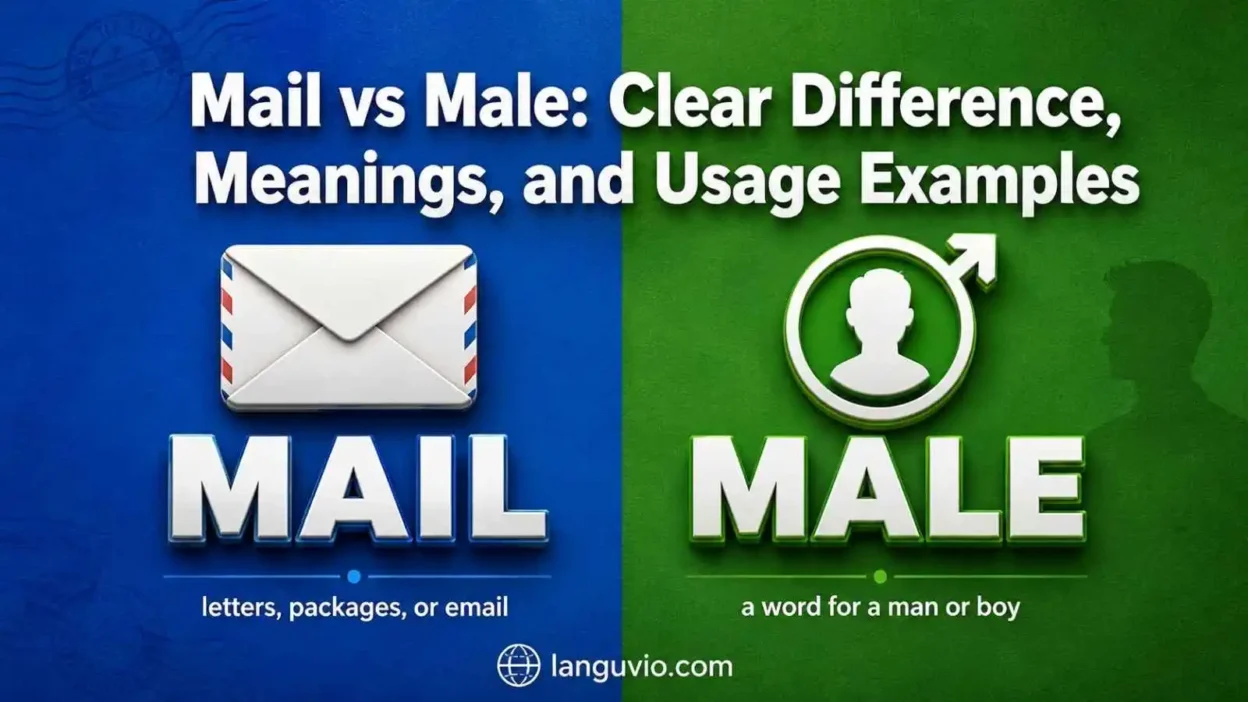
Mail vs male is a common English mix-up because the two words sound the same. The spelling is different, and the meanings are completely different.
Use mail when you mean letters, packages, postal delivery, or sometimes electronic messages. Use male when you mean a person, animal, plant, or group connected with the male sex or male gender.
The choice depends on meaning, not sound. In speech, listeners use context. In writing, the spelling must do the work.
Quick Answer
Mail means letters, packages, the postal system, or the act of sending something. It can be a noun or a verb.
Male describes or names someone or something connected with the male sex or gender. It is usually an adjective or a noun.
Correct: I need to mail the form today.
Correct: The clinic asked whether the patient was male or female.
Why People Confuse Them
People confuse mail and male because they are homophones. That means they have the same pronunciation but different spellings and meanings.
Both are pronounced like mayl. They rhyme with sale, trail, and fail.
That sound-alike problem creates errors in writing:
Wrong: I checked the male this morning.
Correct: I checked the mail this morning.
Wrong: The mail nurse entered the room.
Correct: The male nurse entered the room.
Key Differences At A Glance
Here is the simplest way to separate them:
- Mail = letters, packages, postal delivery, email, or sending something.
- Male = a man, boy, male animal, male plant, or male-related description.
- Mail can be a noun or verb.
- Male is usually an adjective or noun.
- They sound the same, so context matters in speech and spelling matters in writing.
Meaning and Usage Difference
Mail is about communication and delivery. It can mean physical items sent through the postal system, such as letters, bills, cards, and packages. In modern writing, it may also appear in words and phrases connected with electronic messages, such as email, voicemail, and mailing list.
Examples:
I put the rent check in the mail.
The package came in yesterday’s mail.
Please mail the signed copy before Friday.
Male is about sex, gender, or classification. It can describe people, animals, plants, teams, groups, voices, forms, or medical details.
Examples:
The male cat is larger than the female.
The survey asked for male, female, or another option.
The school hired a male coach for the boys’ team.
The key point is simple: mail is something you send or receive. Male describes or names a person, animal, plant, or category.
Tone, Context, and Formality
Mail is neutral in tone. It works in everyday, business, school, and official writing.
You can say:
I got your mail.
The office sends notices by mail.
We mailed the documents yesterday.
Male is also standard, but tone depends on context. As an adjective, it usually sounds normal: male student, male bird, male patient, male lead.
As a noun for a person, male can sound formal, medical, legal, or impersonal. In everyday writing, man or boy often sounds more natural when age and context are clear.
Natural: A man was waiting near the front desk.
More formal: An adult male was waiting near the front desk.
Natural: Two boys joined the class.
More formal: Two male students joined the class.
Use male when the category matters. Use man or boy when you simply mean a person in a normal everyday sentence.
Which One Should You Use?
Use the meaning of the sentence to choose the right word.
| Context | Best Choice | Why |
| Letters, cards, bills, or packages | It refers to items sent or received. | |
| Sending something through a postal service | It works as a verb meaning “send.” | |
| Email or message systems | It can appear in electronic-message contexts. | |
| A man, boy, or male person | male | It identifies sex or gender category. |
| Animals or plants | male | It describes biological classification. |
| Forms, records, or medical details | male | It is used as a category label. |
| A team or group made up of men or boys | male | It describes group membership. |
When One Choice Sounds Wrong
Mail sounds wrong when the sentence is about a person, animal, plant, or sex/gender category.
Wrong: The mail lion has a thick mane.
Correct: The male lion has a thick mane.
Wrong: The form says mail or female.
Correct: The form says male or female.
Male sounds wrong when the sentence is about letters, packages, delivery, or messages.
Wrong: Did you get my male?
Correct: Did you get my mail?
Wrong: I need to male this package.
Correct: I need to mail this package.
A good quick test is this: if you can put it in a mailbox, send it, receive it, or open it as a message, use mail. If it describes a person, animal, plant, or category, use male.
Common Mistakes (and Quick Fixes)
A common mistake is using male for messages.
Wrong: Check your male for the invite.
Correct: Check your mail for the invite.
In many modern contexts, email may be clearer than mail:
Clear: Check your email for the invite.
Another mistake is using mail for gender or sex.
Wrong: The mail students changed in the locker room.
Correct: The male students changed in the locker room.
A third mistake is using male as a noun when a warmer word would sound better.
Stiff: A male helped me carry the boxes.
Better: A man helped me carry the boxes.
Still correct in formal context: The report described the suspect as an adult male.
Everyday Examples
Here are natural examples that show the difference clearly.
I forgot to check the mail after work.
The mail carrier left a package on the porch.
Please mail the application before the deadline.
The company sent the notice by mail.
I found the invitation in my mail folder.
The male bird has brighter feathers.
The form asked whether the patient was male.
The male lead gave a strong performance.
Our dog is male.
The study included both male and female athletes.
Now compare both words in similar sentence patterns:
I need to mail the document.
The male employee signed the document.
The mail arrived late.
The male patient arrived late.
Did you send the mail?
Did you see the male cat?
Dictionary-Style Word Details
Verb
mail: Commonly used as a verb in standard US English. It means to send something through a postal service. It can also be used in electronic-message contexts.
Example: I will mail the package tomorrow.
male: Not commonly used as a verb in standard US English. Use make male, identify as male, or another clear phrase if that meaning is needed.
Example: The form identifies the animal as male.
Noun
mail: A noun meaning letters, packages, postal delivery, a postal system, or messages in some electronic contexts.
Example: The mail came before noon.
male: A noun meaning a male person, animal, or plant. For people, it can sound formal, clinical, or official depending on context.
Example: The smaller bird is the male.
Synonyms
mail: Closest plain alternatives include post, letters, packages, delivery, correspondence, and email when the message is electronic. These are not always exact matches, so choose by context.
male: Closest plain alternatives include man, boy, masculine, and male person. For animals, male animal may be clearer. Female is the clearest opposite in many sex-classification contexts.
Example Sentences
mail:
I left the outgoing mail on the counter.
Can you mail this birthday card today?
The school sent the notice by mail.
My inbox is full of unread mail.
male:
The male puppy has a blue collar.
The hospital recorded the patient as male.
A male teacher joined the staff this year.
The male flower produces pollen.
Word History
mail: The word has more than one historical line, including the familiar sense connected with postal items and another older sense referring to armor made of linked metal rings. For this comparison, the postal and message meaning is the useful one.
male: The word has long been used in English for sex-based classification and for people, animals, and plants. The exact historical details are less important for everyday word choice than the modern meaning.
Phrases Containing
mail:
mail carrier
mailbox
mailing address
mailing list
junk mail
direct mail
voice mail
email
male:
male student
male nurse
male athlete
male animal
male plant
male lead
male voice
male patient
FAQs
Use mail for letters, packages, postal delivery, or messages. Use male for a person, animal, plant, or category connected with the male sex or male gender.
Yes. Mail and male are pronounced the same: mayl. They are homophones, which means they sound alike but have different spellings and meanings.
Yes. Mail can be a verb meaning to send something through the postal system. Example: Please mail the form today.
Male can be both. As an adjective, it describes someone or something: male student. As a noun, it names a male person, animal, or plant: The smaller bird is the male.
Use mail if something is sent, received, delivered, or opened as a message. Use male if the sentence is about sex, gender, or a male person, animal, or plant.
Conclusion
Mail and male sound exactly alike, but they do not mean the same thing. Use mail for letters, packages, postal delivery, messages, or the act of sending something. Use male for a person, animal, plant, group, or category connected with the male sex or male gender. When you are unsure, look at the sentence meaning. If it is sent or received, choose mail. If it describes sex, gender, or a related category, choose male.