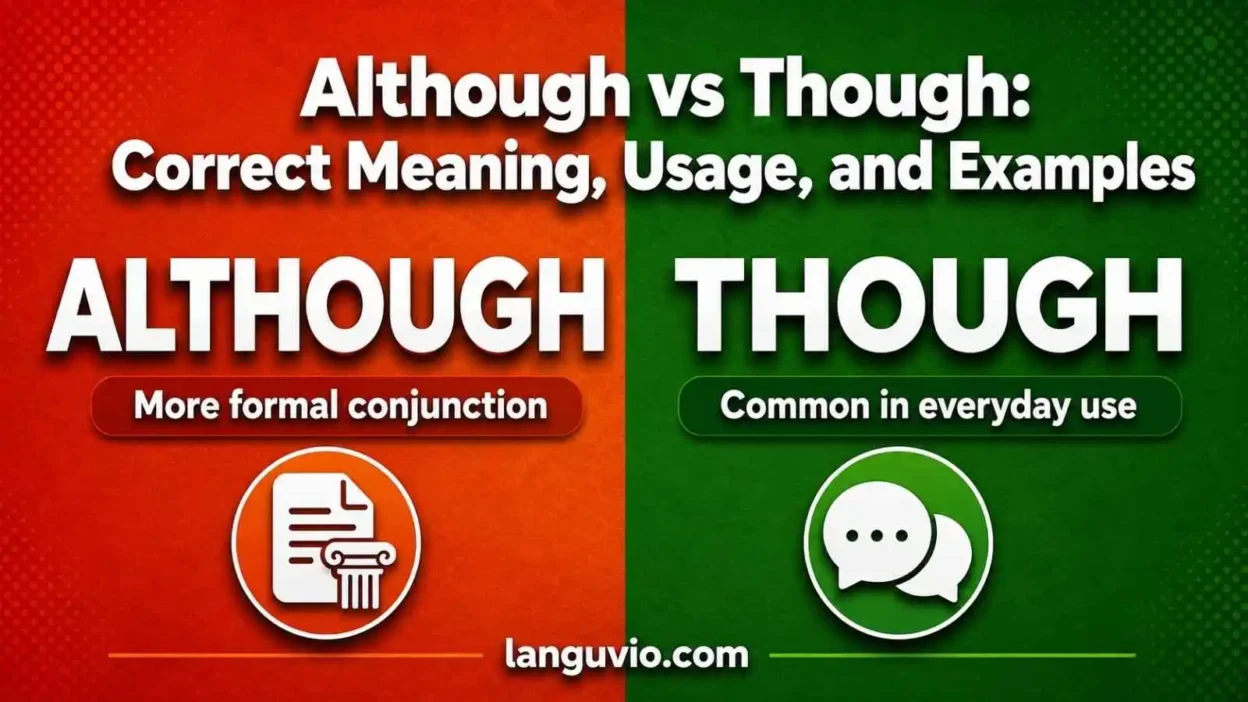
Although and though are both correct words, and they often mean the same thing. Both can introduce a contrast between two ideas, as in “Although it was late, we kept working” or “Though it was late, we kept working.”
The main difference is grammar and tone. Although is usually the safer choice for formal writing. Though is more conversational and more flexible because it can also appear at the end of a sentence to mean “however” or “nevertheless.”
Quick Answer
Use although when you want a clear, polished conjunction that introduces contrast. Use though when you want a more natural or conversational tone. Though can also come at the end of a sentence, as in “The plan is risky, though.” Although does not work naturally in that position.
Why People Confuse Them
People confuse although and though because both can introduce the same kind of contrast.
Correct: Although the store was busy, the line moved fast.
Correct: Though the store was busy, the line moved fast.
In those sentences, the meaning is almost the same. Each word connects a surprising or contrasting idea to the main statement.
The confusion starts when though moves to the end of a sentence. In that position, though is no longer working the same way as although. It means something closer to “however.”
Correct: The store was busy. The line moved fast, though.
Incorrect: The store was busy. The line moved fast, although.
Key Differences At A Glance
| Context | Best Choice | Why |
| Formal writing | Although | It sounds polished and standard. |
| Casual speech | Though | It sounds natural and conversational. |
| Beginning of a contrast clause | Both | Both can introduce contrast. |
| Middle of a sentence | Both | Both can connect a main clause and a contrast clause. |
| End of a sentence | Though | Though can mean “however” at the end. |
| Academic or business tone | Although | It usually sounds more careful. |
| Quick spoken contrast | Though | It fits everyday conversation well. |
Meaning and Usage Difference
Although means “in spite of the fact that.” It introduces a clause that contrasts with the main idea.
Correct: Although the app is expensive, many teams still use it.
Though can mean the same thing when it introduces a contrast clause.
Correct: Though the app is expensive, many teams still use it.
The important difference is that though has another common use. It can work as an adverb meaning “however” or “nevertheless.”
Correct: The app is expensive. Many teams still use it, though.
Although does not work that way.
Incorrect: The app is expensive. Many teams still use it, although.
So, although and though overlap as conjunctions, but they are not fully identical.
Tone, Context, and Formality
Although sounds more formal than though. It is a strong choice for school papers, business emails, reports, articles, and edited writing.
Example: Although the deadline changed, the team finished the project on time.
Though sounds lighter and more conversational. It is common in speech, texts, casual emails, and relaxed writing.
Example: The deadline changed. The team finished on time, though.
That does not mean though is wrong in formal writing. It can still be correct. However, if you want the safest polished choice, although is usually better.
| Feature | Although | Though |
| Main role | Conjunction | Conjunction and adverb |
| Tone | More formal | More conversational |
| End of sentence | Not natural | Natural |
| Best use | Clear written contrast | Flexible everyday contrast |
Which One Should You Use?
Use although when your sentence begins with a contrast clause.
Correct: Although I was tired, I finished the report.
Use though when you want the sentence to sound more natural in conversation.
Correct: Though I was tired, I finished the report.
Use though at the end when you want to add a small contrast after the main point.
Correct: I was tired. I finished the report, though.
For formal writing, although is often the cleaner choice. For everyday speech, though often sounds more natural.
When One Choice Sounds Wrong
Although sounds wrong when you place it at the end of a sentence as a separate contrast marker.
Incorrect: The movie was long. I liked it, although.
Correct: The movie was long. I liked it, though.
Though can sound too casual in very formal writing, especially when it appears at the end.
Casual: The proposal is expensive, though.
More formal: Although the proposal is expensive, it may save money later.
Though can start a sentence, so do not follow the false rule that it cannot.
Correct: Though the meeting ran late, everyone stayed focused.
Common Mistakes (and Quick Fixes)
Mistake: Using although at the end of a sentence.
Incorrect: It was cold. We went outside, although.
Correct: It was cold. We went outside, though.
Mistake: Treating though as wrong at the beginning.
Incorrect idea: Though cannot start a sentence.
Correct: Though traffic was heavy, we arrived on time.
Mistake: Using a sentence fragment after although.
Incorrect: Although the price was high.
Correct: Although the price was high, we bought it.
Mistake: Adding but after an although clause.
Incorrect: Although it was raining, but we played.
Correct: Although it was raining, we played.
Also correct: It was raining, but we played.
Mistake: Forgetting the comma after an opening contrast clause.
Correct: Although I called twice, no one answered.
Correct: Though I called twice, no one answered.
Everyday Examples
Correct Examples With Although And Though
Although I like the design, the price feels high.
Though I like the design, the price feels high.
The price feels high. I like the design, though.
Although she was nervous, she gave a strong presentation.
Though she was nervous, she gave a strong presentation.
The presentation was short. It covered the main points, though.
Although the restaurant was crowded, our food came quickly.
Though the restaurant was crowded, our food came quickly.
The restaurant was crowded. Our food came quickly, though.
Our food came quickly, though.
Correct: Although I disagree, I understand your point.
Correct: I disagree. I understand your point, though.
Dictionary-Style Word Details
Verb
• Although: Not used as a verb in standard US English. You cannot “although” something.
• Though: Not used as a verb in standard US English. You cannot “though” a sentence or action.
Noun
• Although: Not used as a noun in standard US English.
• Though: Not used as a noun in standard US English in normal modern use.
Synonyms
• Although: Closest plain alternatives include though, even though, while, and despite the fact that. These are not always exact replacements because grammar and tone can change.
• Though: As a conjunction, closest plain alternatives include although, even though, and while. As an end-position adverb, closest plain alternatives include however, nevertheless, still, and even so.
Clear antonyms do not work well for either word because both express contrast between ideas rather than a simple opposite meaning.
Example Sentences
Examples With Although And Though
Although the instructions were clear, several users missed the final step.
The trip was fun, although the drive home felt long.
Though the instructions were clear, several users missed the final step.
The drive home felt long, though.
The trip was fun, though.
Word History
• Although: Although developed from older forms connected to all and though. In modern US English, it is a standard conjunction for contrast.
• Though: Though is the older and more flexible word. In modern US English, it works as a conjunction and also as an adverb in sentences like “I liked it, though.”
Phrases Containing
• Although: Common patterns include although it was, although I agree, although not, and although some people.
• Though: Common patterns include even though, as though, even so though in casual speech, and sentence-final uses like “I think so, though.”
FAQs
Is although or though correct?
Both although and though are correct. Use although when you want a more formal or polished tone. Use though when you want a more casual or conversational tone. In many contrast sentences, both words can work.
What is the main difference between although and though?
The main difference is flexibility. Although mainly works as a conjunction that introduces contrast. Though can also work as a conjunction, but it can also appear at the end of a sentence to mean “however” or “nevertheless.”
Can I use though at the beginning of a sentence?
Yes. Though can start a sentence when it introduces a contrast clause. For example: “Though the meeting was long, it was useful.” This use is correct, but it sounds a little more conversational than although.
Can I use although at the end of a sentence?
No, not in normal standard English. Although does not naturally work at the end of a sentence. Write “The movie was slow. I enjoyed it, though,” not “I enjoyed it, although.”
Is although more formal than though?
Yes. Although usually sounds more formal than though. It is often better for school writing, business writing, reports, and careful explanations. Though is still correct, but it often sounds softer and more natural in everyday speech.
Do although and though need a comma?
When an although or though clause comes first, use a comma after it. Example: “Although I was tired, I finished the work.” When the contrast clause comes second, a comma is often optional, depending on sentence flow and emphasis.
Which should I use in American English?
In American English, use although for formal writing and though for casual speech or sentence-ending contrast. Both are standard, but the best choice depends on tone and sentence position.
Conclusion
Although and though are both correct, but they are not always interchangeable. Use although for a more formal contrast clause. Use though for a more conversational tone or when the word comes at the end of a sentence.
The easiest rule is this: if the word means “in spite of the fact that,” both may work. If it means “however” at the end of a sentence, use though.
Both although and though are correct. Use although when you want a more formal or polished tone. Use though when you want a more casual or conversational tone. In many contrast sentences, both words can work.
The main difference is flexibility. Although mainly works as a conjunction that introduces contrast. Though can also work as a conjunction, but it can also appear at the end of a sentence to mean “however” or “nevertheless.”
Yes. Though can start a sentence when it introduces a contrast clause. For example: “Though the meeting was long, it was useful.” This use is correct, but it sounds a little more conversational than although.
No, not in normal standard English. Although does not naturally work at the end of a sentence. Write “The movie was slow. I enjoyed it, though,” not “I enjoyed it, although.”
Yes. Although usually sounds more formal than though. It is often better for school writing, business writing, reports, and careful explanations. Though is still correct, but it often sounds softer and more natural in everyday speech.
When an although or though clause comes first, use a comma after it. Example: “Although I was tired, I finished the work.” When the contrast clause comes second, a comma is often optional, depending on sentence flow and emphasis.
In American English, use although for formal writing and though for casual speech or sentence-ending contrast. Both are standard, but the best choice depends on tone and sentence position.