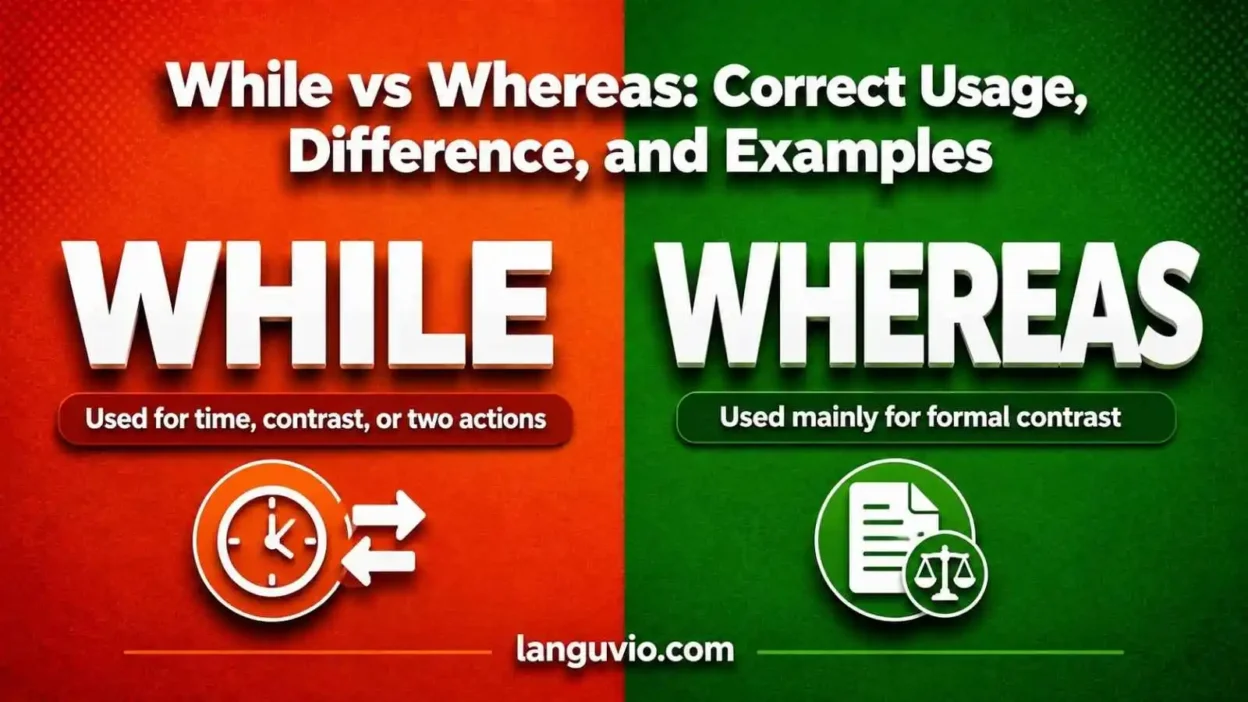
While and whereas are both correct words, but they do not always do the same job. The main difference is simple: while can refer to time or contrast, but whereas is mainly used to show contrast.
That means you can write, “I listened to music while I worked,” but not “I listened to music whereas I worked.” For direct comparison, both words may work: “She prefers coffee, while I prefer tea” or “She prefers coffee, whereas I prefer tea.”
Quick Answer
Use while when you mean “during the time that” or when you want a softer contrast. Use whereas when you want to compare two facts clearly. Whereas is usually more formal and more direct. While is more flexible, but it can be unclear if the sentence could mean either time or contrast.
Why People Confuse Them
People confuse while and whereas because both can connect two contrasting ideas.
For example:
“She likes remote work, while he prefers the office.”
“She likes remote work, whereas he prefers the office.”
Both sentences are correct. They compare two people and two preferences.
The confusion starts because while has another major use. It can mean “during the time that.” Whereas does not normally carry that time meaning.
Correct: “Text me while you are waiting at the airport.”
Wrong: “Text me whereas you are waiting at the airport.”
In that sentence, the meaning is time, so while is the right choice.
Key Differences At A Glance
| Context | Best Choice | Why |
| Two actions happen at the same time | while | It means “during the time that.” |
| Two facts are being compared | whereas | It makes the contrast clear and direct. |
| Casual contrast in everyday writing | while | It sounds natural and less formal. |
| Formal comparison in reports or essays | whereas | It sounds more precise and structured. |
| A sentence could mean time or contrast | whereas | It removes possible confusion. |
| Noun meaning “a period of time” | while | “A while” means a period of time. |
| Formal-document preamble language | whereas | It can introduce formal background statements. |
Meaning and Usage Difference
While has two common jobs.
First, it can show time:
“Please review the notes while I update the spreadsheet.”
Here, while means the two actions happen during the same period.
Second, while can show contrast:
“The first plan saves money, while the second plan saves time.”
Here, while compares two plans.
Whereas is narrower. It usually compares two facts, ideas, people, groups, or situations:
“The first plan saves money, whereas the second plan saves time.”
That sentence sounds more direct than the version with while. It tells the reader to notice the contrast.
A good rule is this: while can mean “during the time that,” but whereas usually means “in contrast.”
Tone, Context, and Formality
While sounds natural in everyday speech, emails, articles, and general writing. It is a good choice when the contrast is simple and the sentence cannot be misread.
Example:
“Some customers want faster shipping, while others care more about price.”
Whereas sounds more formal, more deliberate, and more comparison-focused. It fits reports, academic writing, policy language, business analysis, and careful explanations.
Example:
“Some customers prioritize delivery speed, whereas others prioritize total cost.”
The difference is not only formality. It is also clarity. If while could sound like a time word, whereas may be better.
Unclear:
“Jordan checked the files while Taylor called the client.”
This could mean Jordan checked the files at the same time Taylor called the client. It might also mean the sentence is comparing their tasks.
Clearer contrast:
“Jordan checked the files, whereas Taylor called the client.”
Which One Should You Use?
Use while when the meaning is time.
Correct:
“She answered emails while the report was printing.”
“Keep the line open while I check your account.”
“Listen carefully while the trainer explains the process.”
Use whereas when you want a clear contrast.
Correct:
“The old system required manual entry, whereas the new one updates automatically.”
“Alex likes detailed instructions, whereas Mia prefers a quick summary.”
“Our first option is cheaper, whereas the second option is faster.”
Use while for a softer contrast in natural writing.
Correct:
“The downtown store is open late, while the airport location closes at 6.”
That sentence is clear, natural, and easy to read.
When One Choice Sounds Wrong
Whereas sounds wrong when the meaning is time.
Wrong:
“She packed the order whereas I printed the label.”
Correct:
“She packed the order while I printed the label.”
The corrected sentence means the actions happened at the same time.
While can sound weak or unclear when the sentence needs a sharp comparison.
Less clear:
“The east entrance is open while the west entrance is closed.”
Better:
“The east entrance is open, whereas the west entrance is closed.”
The second sentence makes the contrast stronger.
Whereas can also sound too stiff in casual speech.
Too formal:
“I grabbed tacos, whereas my brother ordered pizza.”
More natural:
“I grabbed tacos, while my brother ordered pizza.”
Both are grammatical, but the second sounds more relaxed.
Common Mistakes (and Quick Fixes)
Mistake 1: Using whereas for time.
Wrong: “Call me whereas you are on break.”
Correct: “Call me while you are on break.”
Mistake 2: Forgetting the comma in a contrast sentence.
Wrong: “The app is simple while the old system is confusing.”
Correct: “The app is simple, while the old system is confusing.”
Also correct: “The app is simple, whereas the old system is confusing.”
Mistake 3: Using whereas without a real contrast.
Wrong: “The room was quiet, whereas the lights were on.”
Better: “The room was quiet, and the lights were on.”
There is no clear comparison between “quiet” and “lights were on.”
Mistake 4: Choosing while when readers may expect a time meaning.
Unclear: “The manager reviewed the budget while the assistant prepared the slides.”
Clear time meaning: “The manager reviewed the budget while the assistant prepared the slides at the same time.”
Clear contrast: “The manager reviewed the budget, whereas the assistant prepared the slides.”
Everyday Examples
Correct uses of while:
“I listened to a podcast while I cleaned the kitchen.”
“She took notes while the speaker answered questions.”
“The kids played outside while we made dinner.”
“Some people like early flights, while others prefer to travel at night.”
Correct uses of whereas:
“The basic plan includes email support, whereas the premium plan includes phone support.”
“Lena works best in the morning, whereas Chris is more focused after lunch.”
“The first draft was too short, whereas the final version gave enough detail.”
“Online classes offer flexibility, whereas in-person classes offer more face-to-face practice.”
Compact comparison:
| Feature | while | whereas |
| Main use | Time or contrast | Contrast |
| Tone | Natural and flexible | More formal and direct |
| Best for | Actions happening together; softer contrast | Clear comparison between two facts |
| Risk | Can be ambiguous | Can sound stiff in casual writing |
Dictionary-Style Word Details
Verb
• while: Can be used as a verb in the phrase while away, meaning to pass time pleasantly or casually. Example: “They whiled away the afternoon at the lake.”
• whereas: Not commonly used as a verb in standard US English.
Noun
• while: A noun meaning a period of time. Example: “I waited for a while.”
• whereas: Can be a noun in formal-document language, often referring to an introductory statement in a legal or official text. This use is uncommon in everyday writing.
Synonyms
• while: For time, closest plain alternatives include during the time that and when. For contrast, closest plain alternatives include although, whereas, and but.
• whereas: Closest plain alternatives include while, but, although, and in contrast. These are not always exact replacements because sentence structure and tone can change.
Clear antonyms are not very useful for either word because both are connectors, not simple descriptive words with direct opposites.
Example Sentences
Examples With While And Whereas
Please stay on the call while I check the order status.
The first design feels modern, while the second feels more traditional.
The first design feels modern, whereas the second feels more traditional.
The downtown office is closed on Fridays, whereas the suburban office stays open.
Word History
• while: Comes from older English forms connected with the idea of a period of time. Its time meaning is the older and central sense. Its contrast use developed because writers often compare what happens in one situation with what happens in another.
• whereas: Developed from where plus as. It has long been used to connect ideas, especially in contrast or formal introductory statements. In modern writing, its most useful everyday role is clear comparison.
Phrases Containing
• while: a while, for a while, once in a while, all the while, worthwhile, while away the time
• whereas: whereas clause, whereas statement, whereas in formal writing, whereas in contrast
FAQs
Is While Or Whereas Correct?
Both while and whereas are correct, but they are used differently. Use while when you mean “during the time that” or when you want a softer contrast. Use whereas when you want to compare two facts clearly. For example, “I cleaned the kitchen while dinner cooked” uses time. “I like tea, whereas she likes coffee” uses contrast.
What Is The Main Difference Between While And Whereas?
The main difference is that while can show time or contrast, but whereas mainly shows contrast. While is more flexible. Whereas is more direct and often more formal. If your sentence means two things happened at the same time, choose while. If your sentence compares two different facts, whereas may be clearer.
Can While And Whereas Be Used Interchangeably?
Sometimes, but not always. They can often both work in contrast sentences, such as “He likes working alone, while I prefer teams” and “He likes working alone, whereas I prefer teams.” However, they are not interchangeable when while means “during the time that.” You cannot replace that time meaning with whereas.
Is Whereas More Formal Than While?
Yes, whereas usually sounds more formal than while. It often fits reports, essays, comparisons, policy writing, and careful explanations. While sounds more natural in everyday speech and casual writing. However, while is still correct in formal writing when the meaning is clear.
Do You Need A Comma Before Whereas?
A comma is usually used before whereas when it connects two contrasting clauses. Example: “The old plan was cheaper, whereas the new plan is faster.” The comma helps show the contrast clearly.
Do You Need A Comma Before While?
Use a comma before while when it means “whereas” or “although.” Example: “The first option is cheaper, while the second is faster.” Do not usually use a comma when while means “during the time that.” Example: “She listened while he explained.”
Conclusion
While and whereas are both correct, but they are not equal in every sentence. Use while for time, as in “while I waited.” You can also use it for contrast when the meaning is clear.
Use whereas when you want a direct comparison between two facts. It is more formal and more precise. The safest choice is this: choose while for time and natural contrast, but choose whereas when contrast is the whole point.
Both while and whereas are correct, but they are used differently. Use while when you mean “during the time that” or when you want a softer contrast. Use whereas when you want to compare two facts clearly. For example, “I cleaned the kitchen while dinner cooked” uses time. “I like tea, whereas she likes coffee” uses contrast.
The main difference is that while can show time or contrast, but whereas mainly shows contrast. While is more flexible. Whereas is more direct and often more formal. If your sentence means two things happened at the same time, choose while. If your sentence compares two different facts, whereas may be clearer.
Sometimes, but not always. They can often both work in contrast sentences, such as “He likes working alone, while I prefer teams” and “He likes working alone, whereas I prefer teams.” However, they are not interchangeable when while means “during the time that.” You cannot replace that time meaning with whereas.
Yes, whereas usually sounds more formal than while. It often fits reports, essays, comparisons, policy writing, and careful explanations. While sounds more natural in everyday speech and casual writing. However, while is still correct in formal writing when the meaning is clear.
A comma is usually used before whereas when it connects two contrasting clauses. Example: “The old plan was cheaper, whereas the new plan is faster.” The comma helps show the contrast clearly.
Use a comma before while when it means “whereas” or “although.” Example: “The first option is cheaper, while the second is faster.” Do not usually use a comma when while means “during the time that.” Example: “She listened while he explained.”