The choice between who vs that looks simple at first. Many writers learn that who refers to people and that refers to things. That rule works well most of the time, especially in clear, polished US writing.
However, real English is a little more flexible. That can sometimes refer to people, especially in clauses that identify which person or type of person you mean. Even so, who usually sounds more natural, respectful, and expected when the noun is a person.
Quick Answer
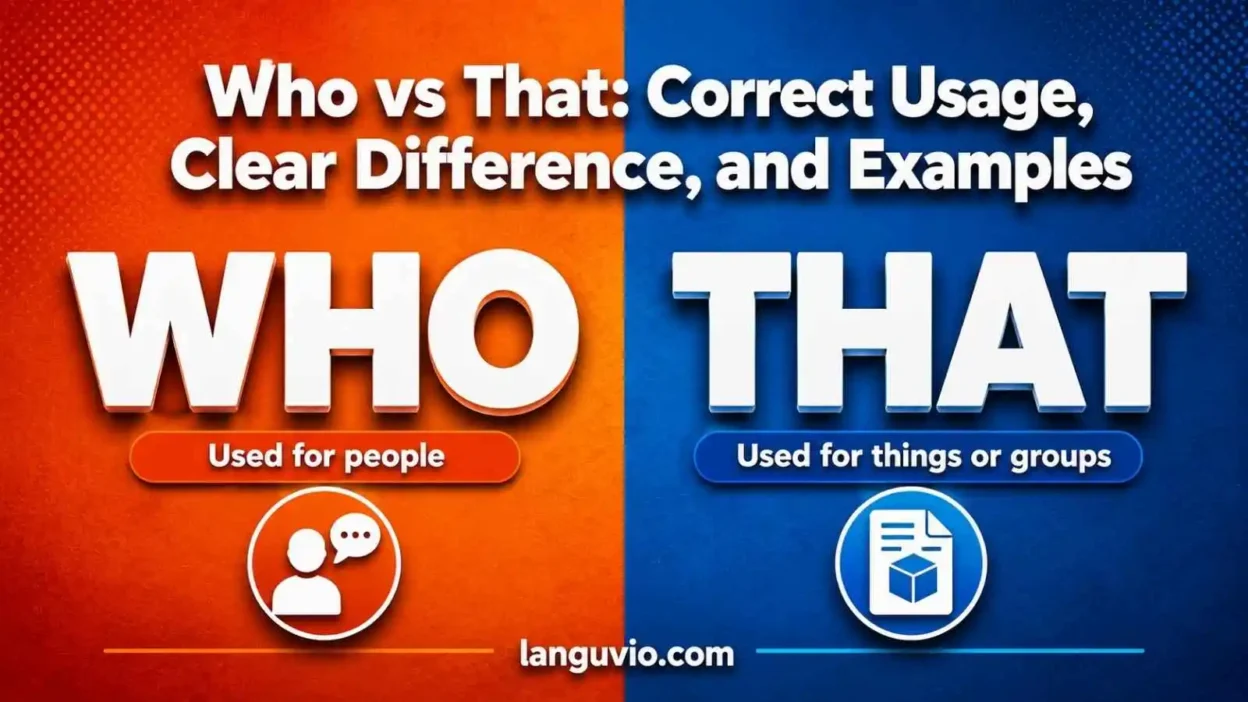
Use who when you refer to a person or people: “The teacher who helped me stayed late.” Use that when you refer to a thing, idea, object, or organization as a unit: “The app that crashed needs an update.” That can sometimes refer to people, but who is usually the better choice for people in careful writing.
Why People Confuse Them
People confuse who and that because both can introduce a clause that describes a noun.
In the sentence “The student who won the prize is here,” who won the prize tells us which student. In “The laptop that froze is on my desk,” that froze tells us which laptop.
The confusion grows because that is flexible. It can point to a person, thing, animal, idea, or group in some sentence patterns. As a result, sentences like “the person that called” are common.
Still, common does not always mean best. In school, business, and publication-style writing, the person who called usually sounds smoother and more human.
Key Differences At A Glance
| Context | Best Choice | Why |
| A specific person | who | It clearly refers to a human being. |
| People in general | who | It sounds natural and polished. |
| A physical object | that | It refers to a thing, not a person. |
| An idea or event | that | It points to something nonhuman. |
| A company as one entity | that | The noun names an organization, not individual people. |
| Employees or team members | who | The noun names people. |
| A nonessential clause after commas | who | “That” does not work in this comma-based structure. |
| Casual speech about a type of person | who or that | “That” can appear, but “who” is safer. |
Meaning and Usage Difference
Who is a pronoun that refers to people. In this comparison, it usually works as a relative pronoun, which means it introduces extra information about a person or people.
Example: “The nurse who checked me in was kind.”
Here, who checked me in tells us which nurse.
That is also used as a relative pronoun in this comparison. It can introduce information about things, ideas, animals, groups, and sometimes people.
Example: “The form that you submitted is missing a signature.”
Here, that you submitted tells us which form.
The most important difference is not that that can never refer to people. It can. The better rule is this: use who when the noun is clearly human, and use that when the noun is not human or when you mean a group as a single unit.
Tone, Context, and Formality
Who sounds more personal. It fits people, names, roles, students, workers, customers, friends, and family members.
Example: “The customer who left the review contacted us again.”
That sounds more neutral. It fits objects, systems, policies, documents, organizations, and abstract ideas.
Example: “The policy that changed last month affects new hires.”
In formal writing, who is usually the cleaner choice for people. In casual speech, some people use that for people without sounding unusual.
| Feature | who | that |
| Main use | People | Things, ideas, groups, and sometimes people |
| Tone | More personal | More neutral |
| Best fit | Human nouns | Nonhuman nouns |
| Clause type | Restrictive or nonrestrictive | Restrictive only |
| Safest in polished writing | For people | For things and entities |
Which One Should You Use?
Use who when the noun is a person.
Correct: “The manager who approved the request is out today.”
Less polished: “The manager that approved the request is out today.”
Use that when the noun is a thing.
Correct: “The request that she approved is in the folder.”
Wrong: “The request who she approved is in the folder.”
Use that when you mean an organization as a single unit.
Correct: “The company that hired him is based in Austin.”
Awkward: “The company who hired him is based in Austin.”
However, switch to who when you mean the people inside the organization.
Correct: “The employees who hired him were impressed.”
Wrong: “The employees that hired him were impressed.”
The second sentence is not always impossible, but who is much better because employees are people.
When One Choice Sounds Wrong
Who sounds wrong when it refers to an object, idea, rule, file, product, or place.
Wrong: “The report who explained the issue was helpful.”
Correct: “The report that explained the issue was helpful.”
That sounds wrong in a nonessential clause set off by commas.
Wrong: “Maria, that works in payroll, fixed the form.”
Correct: “Maria, who works in payroll, fixed the form.”
This happens because that does not work well in that comma-based, extra-information structure. When you add nonessential information about a person, use who.
That can also sound cold when the noun is a specific person.
Cold: “My neighbor that helped us brought a ladder.”
Better: “My neighbor who helped us brought a ladder.”
Common Mistakes (and Quick Fixes)
Mistake 1: Using who for things
Wrong: “The phone who rang is mine.”
Correct: “The phone that rang is mine.”
Mistake 2: Using that after commas
Wrong: “My sister, that lives in Denver, is visiting.”
Correct: “My sister, who lives in Denver, is visiting.”
Mistake 3: Treating all group nouns the same
Awkward: “The company who sent the invoice called again.”
Better: “The company that sent the invoice called again.”
Mistake 4: Forgetting the human noun
Awkward: “The team that stayed late deserve credit.”
Better: “The team members who stayed late deserve credit.”
Mistake 5: Thinking “that” for people is always ungrammatical
Too strict: “The person that called” is always wrong.
Better: “The person that called” can occur, but “the person who called” is usually stronger in edited writing.
Everyday Examples
“The doctor who treated my son explained every step.”
“The receipt that came by email has the order number.”
“The student who asked the best question stayed after class.”
“The chair that broke is still in the garage.”
“The company that owns the building changed the parking rules.”
“The people who live upstairs are moving next week.”
“The friend who sent the playlist knows my taste.”
“The message that popped up looked suspicious.”
“The server who helped our table was excellent.”
“The rule that changed this year confused several applicants.”
Dictionary-Style Word Details
Verb
• who: Not commonly used as a verb in standard US English. In this comparison, who works as a pronoun.
• that: Not commonly used as a verb in standard US English. In this comparison, that works mainly as a relative pronoun.
Noun
• who: Not commonly used as a normal noun. It can be discussed as a word, as in “the word who,” but its usual role is pronoun.
• that: Not commonly used as a normal noun in this comparison. It can be discussed as a word, but its usual roles include pronoun, determiner, conjunction, and adverb in other sentence types.
Synonyms
• who: No exact synonym fits every use. Closest plain alternatives include “the person who” or “the people who” when rewriting a sentence.
• that: No exact synonym fits every use. Closest plain alternatives include “the thing that,” “the one that,” or a sentence rewrite.
Clear antonyms do not apply to who or that because they are function words, not descriptive words with direct opposites.
Example Sentences
Examples With Who
The coach who trained us in high school still sends advice.
Anyone who wants a refund should bring the receipt.
My cousin, who lives in Phoenix, is flying in Friday.
Examples With That
The jacket that I ordered arrived this morning.
The issue that delayed the project has been fixed.
The company that built the app released an update.
Word History
• who: Who is a long-standing English pronoun used for people in questions and clauses. Its history does not change the modern rule: use it for people.
• that: That is a long-standing English function word with several roles. In modern usage, it can introduce clauses about things, ideas, groups, and sometimes people.
The practical choice today depends more on sentence structure and reader expectation than on word origin.
Phrases Containing
• who: “people who,” “someone who,” “anyone who,” “the person who,” “who knows,” “who cares.”
• that: “the one that,” “the thing that,” “now that,” “that said,” “that is,” “all that.”
In the who vs that choice, the most useful phrases are “people who,” “someone who,” “the thing that,” and “the one that.”
FAQs
Is it “people who” or “people that”?
Use people who in most polished US writing. Since people refers to human beings, who sounds clearer and more natural. “People that” can appear in casual speech, but “people who” is usually the better choice for school, work, and published writing.
Can “that” refer to a person?
Yes, that can sometimes refer to a person, especially in a restrictive clause: “The person that called left a message.” However, who usually sounds better: “The person who called left a message.” So, that is not always wrong, but who is safer for people.
Is “the person that” grammatically wrong?
No, the person that is not automatically wrong. It can work when the clause identifies which person you mean. Still, many readers prefer the person who because it sounds more personal and polished. For formal writing, choose who.
Should I use “who” or “that” for a company?
Use that when you mean the company as one organization: “The company that made the software is hiring.” Use who only when you clearly mean the people inside the company: “The employees who built the software won an award.”
Can I use “that” after a comma?
No, avoid that after a comma in a nonessential clause. Write “My brother, who lives in Dallas, is visiting,” not “My brother, that lives in Dallas, is visiting.” After commas, who works for people.
What is the easiest rule to remember?
Use who for people and that for things, ideas, and organizations. The rule has some flexibility, but it will keep most sentences correct, natural, and easy to read.
Conclusion
The safest rule is simple: use who for people and that for things, ideas, and organizations treated as single units. This rule will make most sentences clear and natural.
Still, do not call every use of that for a person wrong. English allows it in some restrictive clauses, especially in casual or general statements. For polished US writing, though, who usually sounds better when you mean a real person, while that works best for nonhuman nouns.
Use people who in most polished US writing. Since people refers to human beings, who sounds clearer and more natural. “People that” can appear in casual speech, but “people who” is usually the better choice for school, work, and published writing.
Yes, that can sometimes refer to a person, especially in a restrictive clause: “The person that called left a message.” However, who usually sounds better: “The person who called left a message.” So, that is not always wrong, but who is safer for people.
No, the person that is not automatically wrong. It can work when the clause identifies which person you mean. Still, many readers prefer the person who because it sounds more personal and polished. For formal writing, choose who.
Use that when you mean the company as one organization: “The company that made the software is hiring.” Use who only when you clearly mean the people inside the company: “The employees who built the software won an award.”
No, avoid that after a comma in a nonessential clause. Write “My brother, who lives in Dallas, is visiting,” not “My brother, that lives in Dallas, is visiting.” After commas, who works for people.
Use who for people and that for things, ideas, and organizations. The rule has some flexibility, but it will keep most sentences correct, natural, and easy to read.