

“Next Friday” and “this Friday” are both common phrases in American English, but they can create confusion because their meaning depends on the speaker’s current time and context.
In most situations, “this Friday” means the Friday that is coming up in the current week, while “next Friday” usually means the Friday after the upcoming Friday. However, some speakers use “next Friday” to mean the immediately upcoming Friday, which can cause misunderstandings.
The safest choice depends on the situation. When clarity matters, especially for meetings, appointments, travel plans, or deadlines, adding the exact date is the best way to avoid confusion.
Quick Answer
“This Friday” usually refers to the upcoming Friday in the current week. “Next Friday” usually refers to the following Friday after that.
Example:
- If today is Monday, August 24:
- “I’ll call you this Friday” usually means August 28.
- “I’ll call you next Friday” usually means September 4.
Because people sometimes use “next Friday” differently, saying the actual date is often the clearest option.
Why People Confuse Them

People confuse “next Friday” and “this Friday” because both phrases describe a future Friday, and the word “next” does not always feel equally clear to every speaker.
The confusion often happens when someone speaks early in the week. For example, if it is Monday, one person may understand “next Friday” as the Friday coming at the end of that week. Another person may understand it as the Friday of the following week.
“This Friday” feels more connected to the current week because “this” points to something near the speaker’s present situation. “Next Friday” points forward, but the exact distance depends on how the speaker organizes time.
In casual conversations, people often understand the meaning from context. In professional situations, however, relying only on these phrases can create scheduling mistakes.
English has many confusing word pairs where a small difference can change the meaning. Similar to perspective and prospective, Friday expressions can also create confusion when people do not consider the context.
Key Differences At A Glance
| Feature | This Friday | Next Friday |
| Main meaning | The upcoming Friday in the current week | Usually the Friday after the upcoming Friday |
| Time reference | Closer to the present | Further in the future |
| Common use | Casual plans and immediate events | Future plans beyond the current week |
| Possible confusion | Lower | Higher because meanings vary |
| Context | Best Choice | Why |
| Meeting happening at the end of this week | This Friday | It clearly points to the current week |
| Planning an event for the following week | Next Friday | It usually refers to the later Friday |
| Important appointment | Exact date | Removes possible confusion |
Meaning and Usage Difference
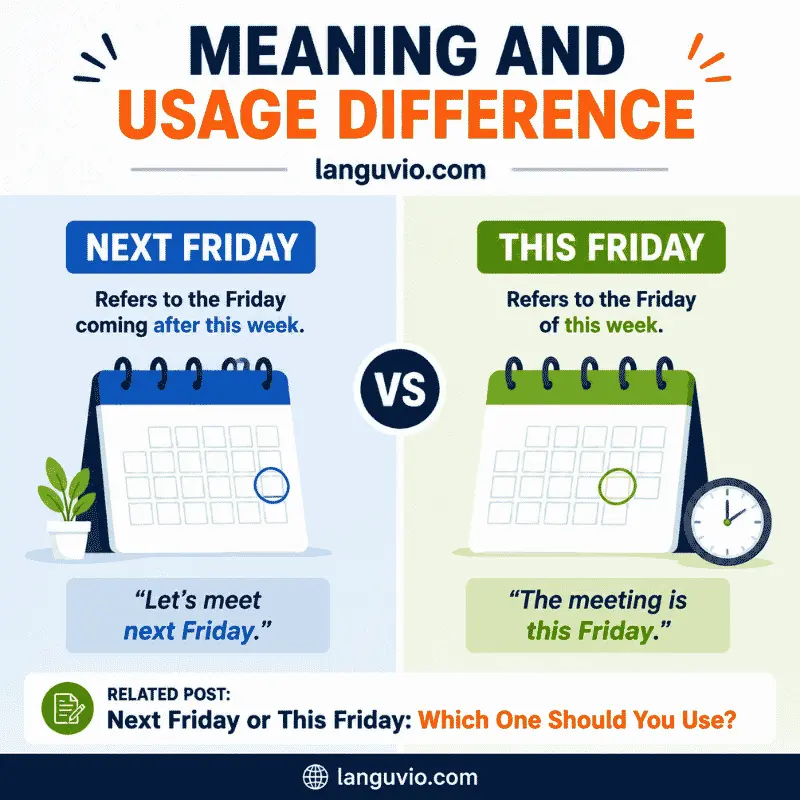
This Friday
“This Friday” refers to the Friday associated with the current week or the nearest upcoming Friday.
Examples:
- “The project meeting is this Friday.”
- “I’m leaving this Friday morning.”
The phrase uses “this” as a pointing word. It connects the Friday to the current situation or time period.
Next Friday
“Next Friday” usually refers to the Friday that comes after the current upcoming Friday.
Examples:
- “The interview is next Friday.”
- “We will review the results next Friday.”
However, everyday usage is not completely consistent. Some people use “next Friday” for the immediately upcoming Friday, especially when speaking early in the week. This is why confirming the date can be helpful.
If you want to understand how date expressions are used in everyday English, you can also check Merriam-Webster’s English usage resources for clear definitions and examples.
Tone, Context, and Formality
Both phrases are normal in American English and work in casual and professional conversations.
“This Friday” often sounds more immediate because it suggests something happening soon.
Examples:
- “Can you send me the report this Friday?”
- “Let’s meet this Friday after work.”
“Next Friday” sounds slightly more distant because it usually places the event one week later.
Examples:
- “The conference starts next Friday.”
- “I’ll check back with you next Friday.”
Neither phrase is more formal than the other. The difference is mainly about time reference and clarity.
Which One Should You Use?
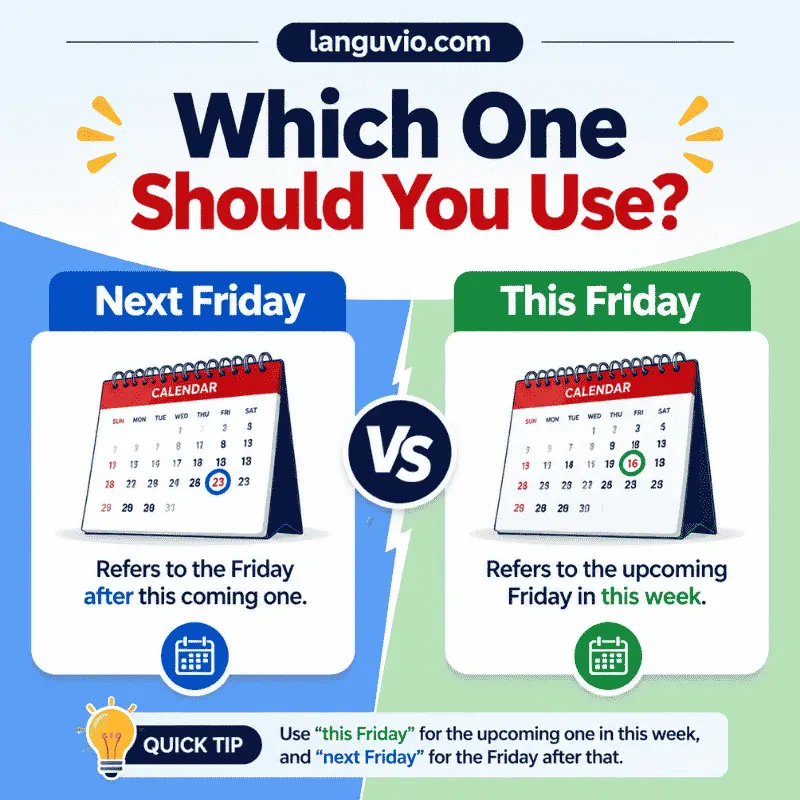
Choose “this Friday” when you mean the Friday coming up in the current week.
Use “next Friday” when you mean the following Friday after that.
For important communication, avoid relying only on either phrase.
Better:
- “Let’s meet Friday, September 4.”
- “The appointment is this Friday, August 28.”
A specific date removes all uncertainty.
When One Choice Sounds Wrong
“This Friday” can sound incorrect if the speaker clearly means a Friday beyond the current week.
Example:
Incorrect for a later event:
- “The concert is this Friday” when the concert is actually two weeks away.
“Next Friday” can sound confusing when the listener expects the upcoming Friday.
Example:
- Person A: “Can we meet next Friday?”
- Person B: “Do you mean this coming Friday or the Friday after?”
The phrase is not grammatically wrong, but it may not communicate the intended date clearly.
Common Mistakes (and Quick Fixes)
Mistake 1: Assuming everyone understands “next Friday” the same way
Fix:
Use the date when the timing matters.
Mistake 2: Using “this Friday” for a distant Friday
Fix:
Use “next Friday” or say the exact date.
Mistake 3: Forgetting the current day changes the meaning
Fix:
Always consider when the conversation happens.
Mistake 4: Using both phrases without clarification
Fix:
Confirm the actual day if plans involve other people.
Everyday Examples
Example 1:
“I have a dentist appointment this Friday.”
Meaning:
The appointment is on the upcoming Friday.
Example 2:
“The company will announce the results next Friday.”
Meaning:
The announcement will usually happen the following Friday.
Example 3:
“Are we meeting this Friday or next Friday?”
Meaning:
The speaker wants clarification because both options may create confusion.
Example 4:
“Send me the final version by this Friday.”
Meaning:
The deadline is the upcoming Friday.
Example 5:
“We will discuss the budget next Friday.”
Meaning:
The discussion is likely planned for the Friday after the upcoming one.
Learning the difference between similar expressions takes practice. For example, understanding whichever and whatever helps English learners make clearer choices in everyday conversations.
Dictionary-Style Word Details
Verb
- This Friday: Not a verb. It functions as a time phrase.
- Next Friday: Not a verb. It functions as a time phrase.
Neither phrase describes an action. Both provide information about when something happens.
Noun
- This Friday: “Friday” is the noun referring to a specific day.
- Next Friday: “Friday” is also the noun referring to a future day.
The words “this” and “next” modify the noun “Friday” by adding time information.
Synonyms
- This Friday: Closest plain alternatives: “the upcoming Friday,” “the coming Friday.”
- Next Friday: Closest plain alternatives: “the following Friday,” “the Friday after this one.”
These alternatives may not always match every speaker’s intended meaning, so context still matters.
Example Sentences
- This Friday: “My flight leaves this Friday.”
- Next Friday: “The team meeting is scheduled for next Friday.”
Both sentences describe future events, but they point to different Fridays.
Word History
“Friday” comes from the name of the day in the traditional seven-day week. The words “this” and “next” have long been used in English to identify time and position. The exact interpretation of “next” in phrases like “next Friday” depends on everyday usage and context.
Phrases Containing
- This Friday: “available this Friday,” “meeting this Friday,” “due this Friday.”
- Next Friday: “coming next Friday,” “scheduled next Friday,” “starting next Friday.”
Both phrases are widely used in modern American English.
FAQs
No, “this Friday” and “next Friday” usually refer to different Fridays. “This Friday” normally means the upcoming Friday, while “next Friday” usually means the Friday after the upcoming one. However, some speakers use “next Friday” differently.
“This Friday” is often clearer for immediate plans, but the exact date is best for important scheduling. Meetings, appointments, and deadlines can become confusing if people interpret “next Friday” differently.
Yes, “next Friday” can sometimes mean the coming Friday, especially in casual speech. Because usage varies among speakers, listeners may need extra context to understand the intended date.
Yes, using dates is the clearest option when timing matters. Saying “Friday, September 4” removes uncertainty and prevents different interpretations of “this Friday” or “next Friday.”
No, neither phrase is more formal. Both are standard expressions in American English. The difference comes from their time reference, not their level of formality.
You can avoid confusion by adding the exact date or explaining the timing. For example, saying “this Friday, August 28” or “next Friday, September 4” makes your meaning immediately clear.
Conclusion
“Next Friday” and “this Friday” are both correct phrases, but they do not always communicate the same time. In most American English usage, “this Friday” means the upcoming Friday, while “next Friday” usually means the Friday after it.
Because people sometimes interpret “next Friday” differently, the best choice depends on the situation. Casual conversations often provide enough context, but professional plans benefit from using a specific date.
When clarity matters, avoid assumptions. A simple date can make your message easier to understand and prevent scheduling mistakes.


