
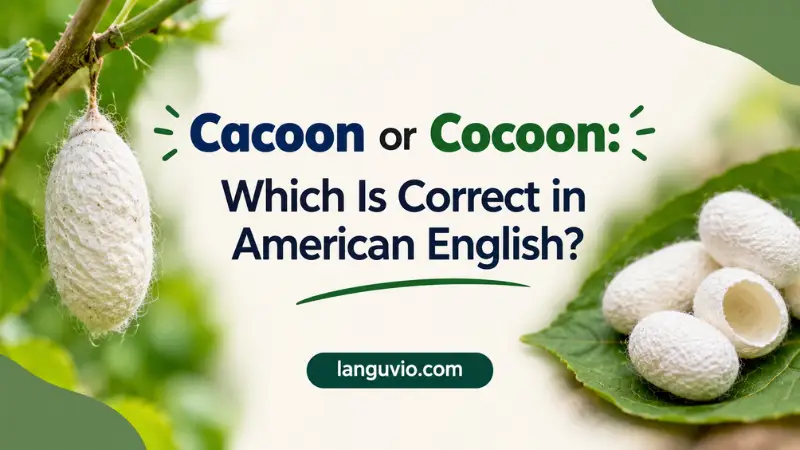
If you are writing about an insect’s protective covering, cocoon is the word you normally want. It is the standard US-English noun for the covering made by certain insects as they develop. It also has figurative uses for a safe or protected place.
Cacoon is different. It is a real but uncommon noun with a specialized botanical meaning. It refers to a large bean associated with certain tropical climbing plants. It is not an alternative spelling for an insect’s cocoon.
That small distinction matters because treating cacoon as nothing more than a misspelling misses its actual dictionary meaning.
Quick Answer
Use cocoon when you mean the protective covering associated with an insect, or when you use the word figuratively for a protected or comfortable environment.
Use cacoon only in the rare specialized botanical context involving the bean of certain tropical vines.
So, in ordinary American English, cocoon is the correct choice for sentences about insects, comfort, protection, or isolation.
For example:
The moth emerged from its cocoon.
But cacoon can be correct when the subject is the botanical object:
The guide described the cacoon bean found on the tropical vine.
Why People Confuse Them
The words look almost identical and share the same basic pronunciation pattern. That makes it easy to substitute the first vowel when writing.
The confusion becomes stronger when someone has heard the word many times but has rarely seen it written. The unusual spelling of cocoon can then feel less familiar than it actually is.
There is another reason for confusion: cacoon is not simply a meaningless spelling error. Dictionaries record it as a specialized noun. That means a blanket statement such as “cacoon is never a word” is too broad.
Key Differences At A Glance
| Context | Best Choice | Why |
|---|---|---|
| Insect protective covering | cocoon | This is the standard word for the structure |
| Figurative safe or protected place | cocoon | The figurative sense comes from the protective idea |
| Verb meaning to wrap or protect | cocoon | Cocoon functions as a verb |
| Specialized botanical noun | cacoon | It has a separate, uncommon botanical meaning |
| Ordinary US-English writing | cocoon | It is the familiar everyday choice |
The key point is simple: cocoon and cacoon do not represent two spellings of the same ordinary word.
| Feature | Cacoon | Cocoon |
|---|---|---|
| Common in everyday US English | No | Yes |
| Insect-related meaning | No | Yes |
| Figurative protective meaning | No | Yes |
| Verb use | No | Yes |
| Specialized botanical meaning | Yes | No |
Meaning and Usage Difference
Cocoon has several connected uses. As a noun, it can mean a protective covering made by certain insects. It can also describe a similar protective enclosure or, figuratively, a comfortable and protected environment.
For example:
The caterpillar disappeared inside its cocoon.
You can also use cocoon as a verb. It can describe wrapping or surrounding someone or something protectively.
The thick blankets cocooned the child on the cold night.
Cacoon, by contrast, has a narrow botanical meaning. Collins defines it as the large bean of a tropical climber, while other dictionary records associate the term with a tropical vine and its seed. It is therefore not the normal choice for an insect covering.
Tone, Context, and Formality
There is no meaningful formal-versus-informal difference between the two words in ordinary US English.
The important difference is context.
Cocoon is familiar in everyday writing, schoolwork, science discussions, and figurative descriptions of comfort or protection. Its figurative use can describe a person, home, environment, or other protective setting.
Cacoon is much more specialized. A general reader may assume it is a misspelling of cocoon unless the surrounding sentence makes the botanical meaning clear.
Because of that, writers should not substitute cacoon merely to vary their wording.
Which One Should You Use?
Choose cocoon when you are talking about:
- an insect’s protective covering
- a protective enclosure
- a comfortable or sheltered environment
- the act of wrapping or surrounding protectively
Choose cacoon only when your subject specifically requires the specialized botanical noun.
If you are writing a normal sentence about a caterpillar, moth, insect, or protected space, cocoon is almost certainly the word you need.
When One Choice Sounds Wrong
Using cacoon for an insect structure sounds wrong because that meaning belongs to cocoon.
Incorrect for the intended insect meaning:
The butterfly developed inside a cacoon.
Correct:
The insect developed inside a cocoon.
However, saying that cacoon is always wrong would also be inaccurate. If a specialized botanical text is discussing the bean called a cacoon, the word can be appropriate.
The safest approach is to let the subject determine the choice rather than treating the two words as interchangeable spellings.
Common Mistakes (and Quick Fixes)
Mistake: Writing cacoon when you mean an insect’s protective covering.
Fix: Write cocoon.
Mistake: Assuming every occurrence of cacoon is a spelling error.
Fix: Check the context. A specialized botanical use of cacoon is legitimate.
Mistake: Using cacoon as a verb.
Fix: Use cocoon when you mean to wrap, surround, or protect.
Mistake: Treating the two words as synonyms.
Fix: Remember that their meanings are different and their normal contexts do not overlap.
Everyday Examples
Here are natural examples of cocoon in modern US English:
- The moth remained inside its cocoon until it was ready to emerge.
- We found an empty cocoon attached to the branch.
- The thick blanket made a warm cocoon around the baby.
- After a busy week, Maya likes to cocoon herself at home with a book.
- The quiet bedroom became his cocoon during the storm.
Examples of the specialized cacoon use are much less common:
- The botanical reference described the cacoon as a large bean.
- The museum displayed a specimen identified as a cacoon.
- The field guide included information about the plant that produces the cacoon.
In ordinary conversation, cocoon will be far more familiar to American readers.
Dictionary-Style Word Details
Verb
Cacoon: Not commonly used as a verb in standard US English.
Cocoon: A verb meaning to wrap, enclose, surround, or protect as if in a cocoon.
Example: The soft blankets cocooned him from the cold.
Noun
Cacoon: A rare, specialized noun for a large bean associated with certain tropical climbing plants.
Cocoon: A noun for the protective covering made by certain insects. It can also refer figuratively to a protected or comfortable enclosure.
Synonyms
Cacoon: Because its meaning is specialized, it has no widely useful everyday synonym. Depending on the botanical context, bean or seed may serve as a closest plain alternative, but neither is necessarily an exact substitute.
Cocoon: Depending on context, closest plain alternatives include covering, case, enclosure, or shelter. These are context-based alternatives rather than exact replacements in every sentence.
Example Sentences
Cacoon: The researcher recorded the unusual cacoon specimen.
Cocoon: The caterpillar built a cocoon before its next stage of development.
Cocoon: She created a quiet cocoon where she could read and relax.
Word History
Cocoon entered English from French cocon, ultimately connected with words meaning a shell or protective covering. Historical sources place its English noun use in the late 17th century. The verb developed later from the noun.
Cacoon has a different history and a specialized botanical sense. Collins gives its origin as uncertain and dates the word to the 19th century.
Phrases Containing
Cacoon: Because the word is specialized, common fixed phrases are uncommon. It is more likely to appear in botanical descriptions involving the cacoon bean or the plant associated with it.
Cocoon: Common constructions include cocoon of protection, cocoon of comfort, cocoon oneself, and cocooned from something. These can be literal or figurative depending on context.
FAQs
Is “cacoon” ever correct in English?
Yes, cacoon can be correct in a specialized botanical context. It names a particular bean associated with tropical climbing plants. However, it is not the word to use for an insect’s protective covering, so most everyday writers should choose cocoon.
Should I use “cocoon” when writing about insects?
Yes, use cocoon when referring to the protective covering made by certain insects. This is the standard word in American English. For example, “The moth emerged from its cocoon” uses the correct noun and meaning.
Are “cacoon” and “cocoon” interchangeable?
No, cacoon and cocoon are not interchangeable. Cocoon covers the familiar insect and figurative meanings, while cacoon has a specialized botanical meaning. Replacing one with the other can change the meaning or make a sentence incorrect.
Can “cocoon” be used as a verb?
Yes, cocoon can function as a verb. It can describe wrapping, enclosing, or protecting someone or something. It can also describe withdrawing into a comfortable or protected environment, depending on the sentence and context.
Why do people write “cacoon” instead of “cocoon”?
People may write cacoon because the two forms look and sound similar enough to create uncertainty during writing. The unusual spelling of cocoon can also make the first vowel easy to remember incorrectly.
Is “cacoon” appropriate in everyday US English?
Usually, no. Cocoon is the natural everyday choice for insects, protective coverings, and figurative descriptions of comfort or isolation. Cacoon is appropriate mainly when discussing its specialized botanical meaning, where the unusual word is specifically intended.
Conclusion
For ordinary American English, choose cocoon when you mean an insect’s protective covering, a protective enclosure, or a figurative place of comfort and safety.
Cacoon is not simply an incorrect spelling, though. It is a rare specialized noun with a botanical meaning. The two words therefore should not be treated as interchangeable.
When your sentence is about a caterpillar, moth, protection, or a cozy retreat, cocoon is the clear choice.


