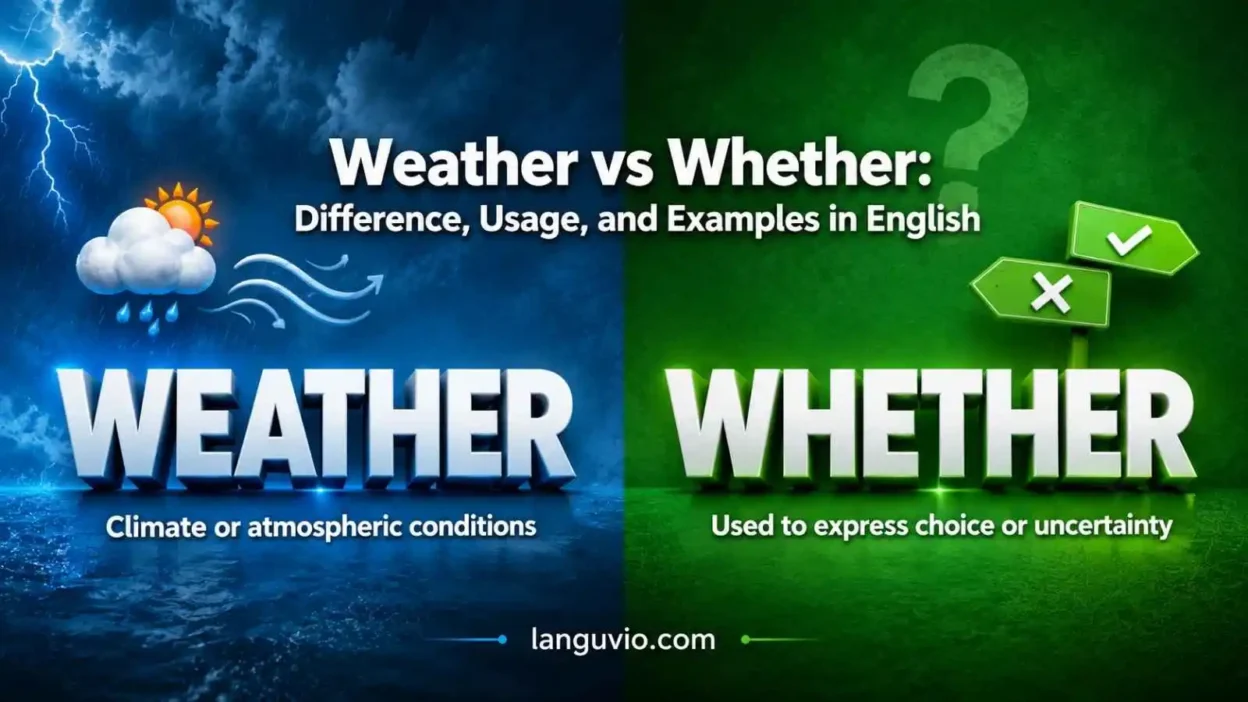
Weather and whether are both correct words, but they do not mean the same thing.
Use weather when you mean the conditions outside, such as rain, heat, snow, wind, or storms. You can also use weather as a verb meaning to survive or get through something difficult.
Use whether when you are talking about a choice, doubt, question, or possibility.
The simplest answer is this: weather is about conditions; whether is about options.
Quick Answer
Weather is usually a noun. It means the state of the air outside.
Example: The weather looks perfect for a picnic.
Weather can also be a verb.
Example: The small business weathered a tough year.
Whether is a conjunction. It connects an idea to a question, doubt, or choice.
Example: I’m not sure whether I should bring a jacket.
These words are not interchangeable. “Check the whether” is wrong. “I don’t know weather I can go” is also wrong.
Why People Confuse Them
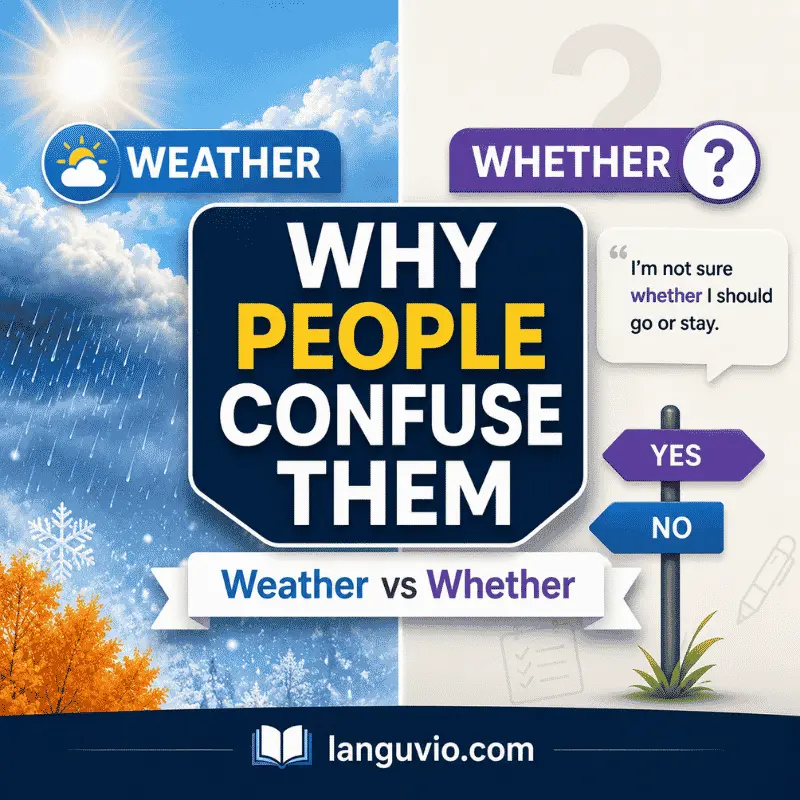
People confuse weather and whether because they sound the same in most everyday US speech. Some speakers give whether a light “hw” sound at the beginning, but many do not.
That means the difference is mostly visible in writing, not hearing.
The spelling also looks similar. Both words start with “we” or “whe,” both end in “ther,” and both are common enough that readers notice mistakes quickly.
Context is the best clue. If the sentence is about rain, heat, wind, or forecasts, use weather. If the sentence is about a choice or question, use whether.
Key Differences At A Glance
- Meaning: weather = air conditions; whether = choice, doubt, or possibility.
- Main grammar role: weather = noun or verb; whether = conjunction.
- Common context: weather forecast, cold weather, stormy weather; whether to go, whether or not, ask whether.
- Sound: usually the same in US English.
- Correct test: replace weather with “conditions outside” or whether with “if.” If the sentence still makes sense, you likely found the right word.
Meaning and Usage Difference
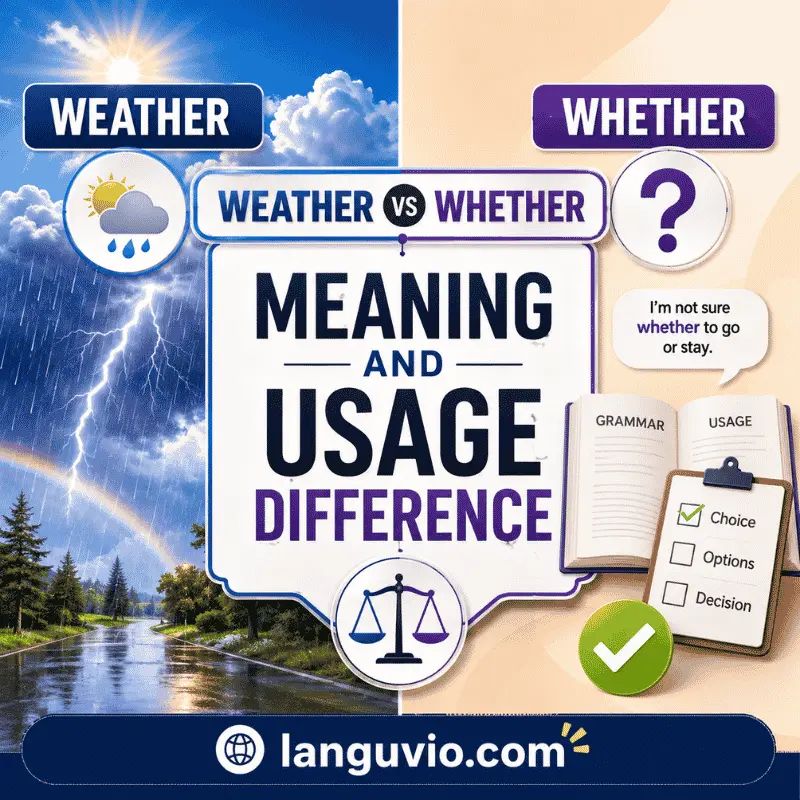
Weather names what is happening in the air around us. It can be sunny, cold, humid, windy, snowy, rainy, or stormy.
Example: The weather changed fast after lunch.
As a verb, weather means to be affected by exposure or to get through a hard situation.
Example: The deck has weathered after years of sun and rain.
Example: They weathered the delay and finished the project.
Whether introduces a choice, doubt, or indirect yes-or-no question.
Example: She asked whether the store was still open.
Example: We need to decide whether to drive or take the train.
The two words do not overlap in meaning. Weather names conditions or describes enduring something. Whether helps frame uncertainty or alternatives.
Tone, Context, and Formality
Weather is neutral. It fits casual talk, school writing, news, business writing, and daily plans.
Example: Bad weather delayed the flight.
The verb weather can sound a little more polished or figurative, especially in phrases like weather a crisis or weather the storm.
Whether is also neutral. It often sounds more careful than if in sentences about choices, formal questions, or written instructions.
Example: Please confirm whether you can attend.
That does not mean whether is fancy. It is normal in everyday English. It simply has a clear job: it points to doubt, a question, or possible outcomes.
Which One Should You Use?
| Context | Best Choice | Why |
| Talking about rain, sun, heat, snow, or wind | weather | It means outside air conditions. |
| Talking about a forecast | weather | Forecasts report outside conditions. |
| Saying someone survived a hard time | weather | As a verb, it can mean “get through.” |
| Talking about a choice | whether | It introduces alternatives. |
| Reporting a yes-or-no question | whether | It introduces indirect questions. |
| Using “or not” | whether | “Whether or not” is the standard phrase. |
Use weather for the world outside or for getting through something hard. Use whether when the sentence has a question, choice, or doubt.
When One Choice Sounds Wrong
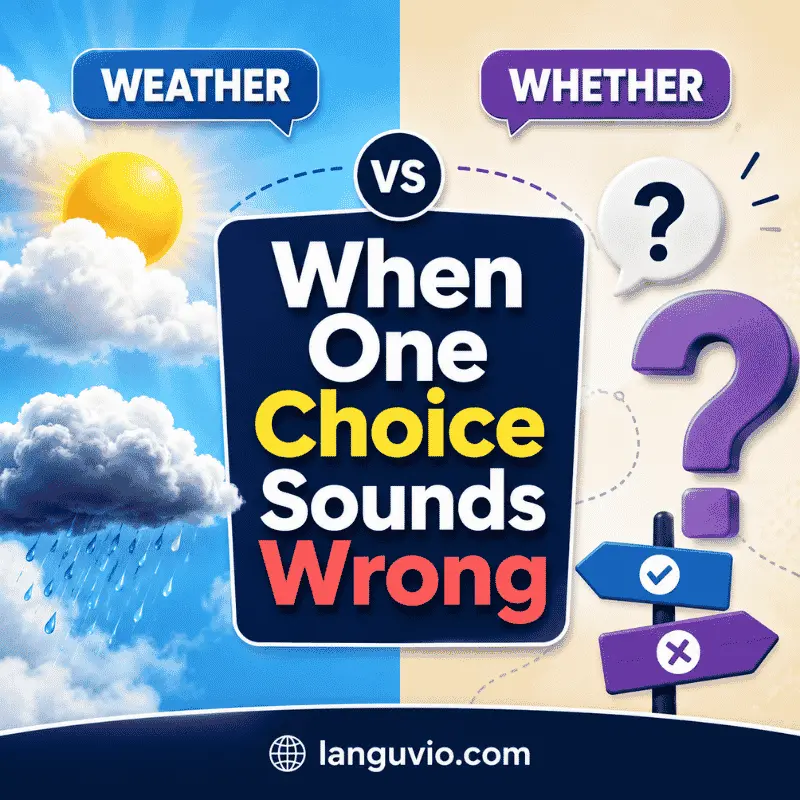
Weather sounds wrong when the sentence needs a choice word.
Wrong: I’m deciding weather to apply.
Correct: I’m deciding whether to apply.
The sentence is not about rain or temperature. It is about a decision.
Whether sounds wrong when the sentence needs a condition word.
Wrong: The whether is cold today.
Correct: The weather is cold today.
The sentence is about outside conditions, so weather is the only correct choice.
One more clue: if the word comes before “to” and means a decision, use whether.
Correct: I don’t know whether to call now or wait.
Common Mistakes (and Quick Fixes)
A common mistake is using weather before a verb phrase about a choice.
Wrong: Tell me weather you want pizza or tacos.
Correct: Tell me whether you want pizza or tacos.
Another mistake is using whether in weather-report phrases.
Wrong: Check the whether before we leave.
Correct: Check the weather before we leave.
Writers also sometimes forget that weather can be a verb.
Correct: The team managed to weather the setback.
That sentence does not mean the team became rainy or windy. It means the team got through a difficult moment.
Everyday Examples
I checked the weather before leaving for work.
The weather in Denver can change quickly.
Our patio furniture has weathered after several hot summers.
The school will decide whether to cancel the game.
I’m not sure whether the package arrived.
We’re going hiking whether it rains or not.
Ask whether the meeting moved to Zoom.
The company hopes to weather the slow season.
Dictionary-Style Word Details
Verb
weather: Commonly used as a verb. It can mean to change because of exposure to sun, wind, rain, or time. It can also mean to survive or get through something difficult.
Example: The fence weathered over the years.
Example: They weathered the crisis.
whether: Not used as a verb in standard US English.
Noun
weather: Commonly used as a noun. It means the condition of the air at a certain time and place.
Example: The weather was clear all weekend.
whether: Not commonly used as a noun in standard US English. In modern use, it works as a conjunction.
Synonyms
weather: Closest plain alternatives include conditions outside, atmospheric conditions, or forecast when you mean a report about the weather. As a verb, close alternatives include endure, withstand, or get through.
whether: No exact one-word synonym fits every use. If can work in some indirect questions, but not in every structure. Closest plain alternatives depend on the sentence, such as if, whether or not, or in either case.
Clear antonyms do not fit either word in a simple, useful way.
Example Sentences
weather: The weather should be mild on Saturday.
weather: The old barn has weathered years of storms.
weather: We can still weather this delay if we adjust the schedule.
whether: I don’t know whether I saved the receipt.
whether: She asked whether the office was open.
whether: We’ll finish the job whether it is easy or not.
Word History
weather: The word goes back to Old English forms tied to air, wind, sky, and outdoor conditions. Its modern meaning still centers on outside conditions.
whether: The word also goes back to Old English, but its older sense was tied to choosing between alternatives. That history matches its modern use in questions, doubt, and choice.
These words sound alike today, but their meanings developed along different paths.
Phrases Containing
weather: Common phrases include weather forecast, cold weather, severe weather, under the weather, and weather the storm.
whether: Common phrases include whether or not, whether to, and whether…or.
Example: I’m feeling under the weather today.
Example: I’m deciding whether to stay home.
FAQs
Is “weather vs whether” about spelling or meaning?
It is mainly about meaning and usage. Weather means outside conditions, like rain, heat, snow, or wind. Whether introduces a choice, doubt, or question.
Are weather and whether pronounced the same?
Yes, in most everyday US English, weather and whether sound the same. That is why people often mix them up in writing.
Is it “weather or not” or “whether or not”?
The correct phrase is whether or not.
Correct: I’ll go whether or not it rains.
Wrong: I’ll go weather or not it rains.
Is it “check the weather” or “check the whether”?
The correct phrase is check the weather.
Correct: Check the weather before you leave.
Wrong: Check the whether before you leave.
Can weather be a verb?
Yes. Weather can be a verb meaning to survive, endure, or get through something difficult.
Example: The company managed to weather the slowdown.
Can whether be a noun or verb?
No, not in standard modern US English. Whether is normally a conjunction. It connects a sentence to a choice, doubt, or indirect question.
Example: I don’t know whether she is coming.
Can I use “if” instead of “whether”?
Sometimes, yes.
Example: I don’t know whether he called.
Example: I don’t know if he called.
But whether is often better when there are clear alternatives.
Example: We need to decide whether to drive or fly.
What is the easiest way to remember weather vs whether?
Use weather for outside conditions. Use whether for choices.
Quick check:
Weather = rain, sun, wind, snow
Whether = if, choice, doubt, or question
Conclusion
The difference between weather and whether is clear once you check the job the word is doing.
Use weather for outside conditions or for the verb meaning “to get through.” Use whether for choices, doubts, indirect questions, and possible outcomes.
A quick memory trick: weather has eat hidden inside it, and weather can affect what you eat, wear, and do outside. Whether often points to a choice: whether this or that.
When in doubt, ask this question: “Am I talking about conditions or options?” Conditions need weather. Options need whether.