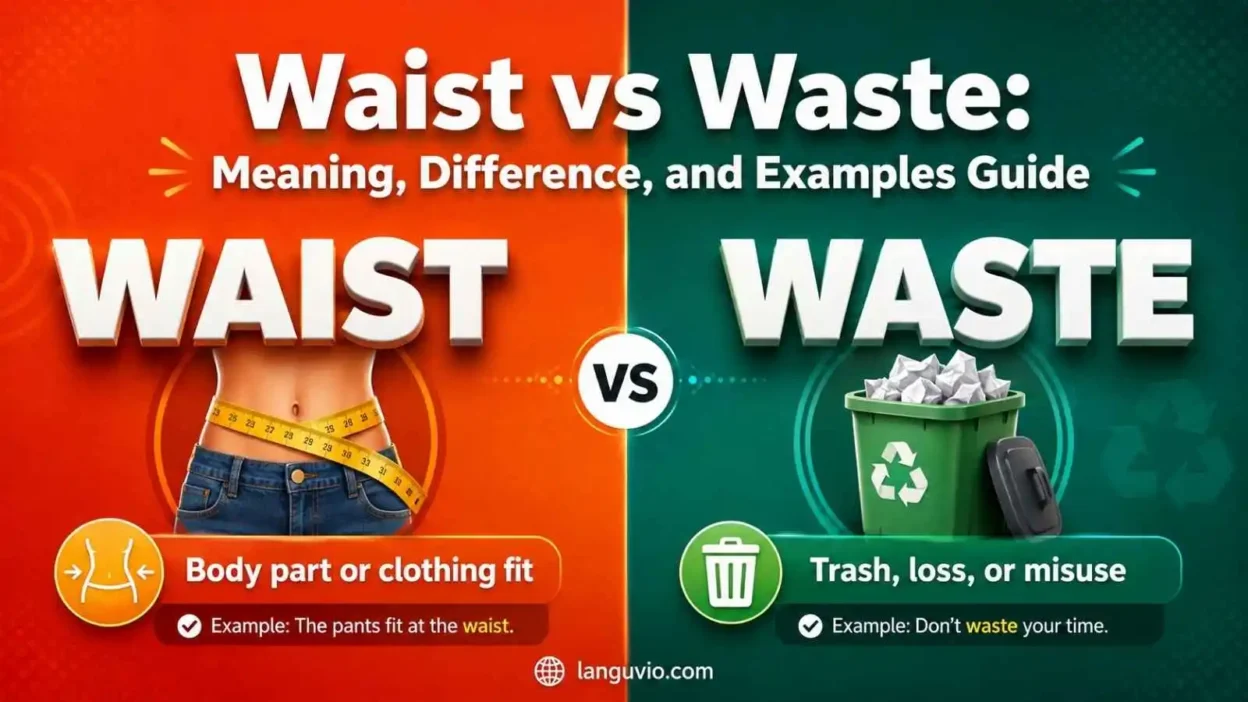
Waist and waste are easy to confuse because they sound the same. However, they do not mean the same thing.
Waist refers to the middle part of the body or the part of clothing that fits there. Waste, on the other hand, refers to trash, leftover material, careless use, or using something without a good purpose.
Because these words are homophones, the mistake usually happens in writing, not speech. Once you connect each word to its meaning, the choice becomes simple.
Quick Answer
Use waist when you mean the body area between the ribs and hips. It also works for clothing that fits around that area, such as jeans, skirts, belts, or dresses.
Use waste when you mean garbage, leftover material, or careless use of something valuable. For example, you can waste time, waste money, waste food, or create waste.
Here is the simple rule:
| Feature | Waist | Waste |
| Main meaning | Middle body area or clothing fit | Trash, misuse, leftover material, or careless use |
| Common role | Noun | Noun, verb, and adjective |
| Example | The pants are tight at the waist. | Do not waste water. |
Why People Confuse Them
People confuse waist and waste because both words are pronounced like wayst. As a result, they sound identical in normal conversation.
In writing, though, spelling changes the meaning completely. A sentence may sound correct when spoken, yet look wrong when written.
For example, “a waste of time” sounds exactly like “a waist of time.” Still, only waste of time is correct because the phrase means time used badly.
Key Differences At A Glance
| Context | Best Choice | Why |
| Body measurement | Waist | It names the middle body area. |
| Pants, jeans, skirts, or dresses | Waist | It refers to where clothing fits. |
| Trash or discarded material | Waste | It means unwanted material. |
| Using time badly | Waste | It means using something carelessly. |
| Leftover food | Waste | It can mean unused or thrown-away material. |
| Environmental cleanup | Waste | It refers to garbage, byproducts, or pollutants. |
| “From the ___ down” | Waist | It refers to the body below the waist. |
| “A ___ of money” | Waste | It means poor or useless use. |
Meaning and Usage Difference
Waist is mainly a noun. It names a physical area of the body. In everyday use, it often appears in sentences about clothing, body size, belts, dresses, pants, or measurements.
For example:
The tailor measured my waist.
These shorts are loose at the waist.
She tied the sweatshirt around her waist.
Waste has more grammar uses. As a noun, it can mean trash, leftover material, or a poor use of something. As a verb, it means to use something carelessly. In addition, it can work as an adjective in phrases such as waste material or waste paper.
For example:
Food waste is a big problem in many homes.
Please do not waste paper.
The crew removed waste material from the site.
Since both words sound the same, pronunciation will not help you choose. Instead, focus on the meaning of the sentence.
Tone, Context, and Formality
Neither word is more formal by itself. Instead, the context decides how each word sounds.
Waist often appears in clothing, fitness, health, sports, and body-description contexts. For instance, you might read about waist size, waist measurement, a fitted waist, or high-waist jeans.
Waste appears in many more situations. You may see it in school, work, home life, money, food, energy, and environmental topics. For example, people talk about food waste, plastic waste, wasted money, or wasted time.
In formal writing, waste management sounds official. Meanwhile, What a waste! sounds casual. Similarly, waist measurement may sound medical or practical, while high-waist jeans sounds fashion-related.
Which One Should You Use?
Choose waist if the sentence is about the body, clothing fit, or a measurement around the middle of a person.
Choose waste if the sentence is about trash, leftovers, careless use, loss, or using something badly.
A quick test can help. If you can point to the middle of a person’s body or the part of clothing around that area, waist is correct. However, if the sentence involves time, money, food, energy, materials, or resources being lost or misused, waste is the right choice.
A belt goes around your waist.
I do not want to waste the afternoon.
The factory reduced its waste last year.
An elastic waist makes the skirt more comfortable.
When One Choice Sounds Wrong
The wrong word often makes the sentence confusing or unintentionally funny. Therefore, it helps to check the meaning before choosing the spelling.
Incorrect: This meeting was a waist of time.
Correct: This meeting was a waste of time.
A meeting does not have a body part. For that reason, waist does not work here.
Incorrect: The jeans fit well at the waste.
Correct: The jeans fit well at the waist.
Jeans fit around the body, so waist is the correct word.
Incorrect: Please do not waist food.
Correct: Please do not waste food.
Food can be thrown away or used carelessly. Therefore, waste is the right choice.
Incorrect: Her waste measurement changed.
Correct: Her waist measurement changed.
A body measurement needs waist, not waste.
Common Mistakes (and Quick Fixes)
One common mistake is writing waist of time. The correct phrase is waste of time because it means time used badly.
Another mistake is writing waste size when talking about clothing. The correct phrase is waist size.
Also, watch the word waistband. It is one word, and it uses waist because it means the band of clothing around the waist.
Correct: The waistband is too tight.
Incorrect: The wasteband is too tight.
Here is an easy memory tip: waist has an i, and a person has a waist. If the sentence is not about the body or clothing, waste is probably the word you need.
Everyday Examples
My jeans are too tight around the waist.
She wrapped the flannel shirt around her waist.
During the stretch, bend at the waist.
He ordered pants with a 34-inch waist.
Do not waste your money on an app you will never use.
We used the leftovers so the food would not go to waste.
The office is trying to cut paper waste.
After two hours, the meeting felt like a complete waste.
The city added more bins for household waste.
She did not want to waste a good opportunity.
Dictionary-Style Word Details
Verb
Waist: Not commonly used as a verb in standard US English. In normal writing, use waist as a noun.
Waste: Commonly used as a verb. It means to use something carelessly, use it with no good result, or let it be lost.
Examples:
Do not waste water.
She wasted an hour looking for the file.
They wasted a chance to win the game.
Noun
Waist: A noun meaning the part of the body between the ribs and hips. It can also mean the part of clothing that fits around that area.
Examples:
The belt sits at the waist.
The dress has a fitted waist.
Waste: A noun meaning unwanted material, garbage, leftover matter, or the poor use of something valuable.
Examples:
The crew picked up waste along the road.
That was a waste of money.
Synonyms
Waist: Closest plain alternatives include waistline, middle, midsection, and midriff. However, these words are not always exact. For example, midriff often refers to the front area of the body, especially when clothing reveals it.
Waste: For the noun meaning unwanted material, close alternatives include trash, garbage, refuse, and scraps. For the verb, close alternatives include squander, misuse, and throw away.
Clear antonyms depend on the meaning. For waste as a verb, useful opposites include save, use wisely, conserve, and preserve. In contrast, waist does not have a clear everyday opposite.
Example Sentences
Waist:
The apron ties at the waist.
He felt sore from the waist down after the workout.
The tailor adjusted the waist of the pants.
Waste:
Do not waste your lunch break scrolling on your phone.
The restaurant donates extra meals to reduce food waste.
Leaving the lights on all night wastes electricity.
Word History
Waist: The word comes from older English forms connected with the body’s shape or form. Today, it mainly refers to the middle part of the body and the clothing area around it.
Waste: The word has older roots tied to ideas such as emptiness, loss, damage, or uselessness. Today, it can describe unwanted material, careless use, or something used with little value.
Although the two words sound the same now, their meanings are separate.
Phrases Containing
Waist:
around the waist
from the waist down
waist-high
waist size
waist measurement
high-waist jeans
elastic waist
Waste:
waste of time
go to waste
Waist: Common phrases include around the waist, from the waist down, waist-high, waist size, and elastic waist.
Waste: Common phrases include waste of time, go to waste, waste money, waste food, waste away, and waste disposal.
hazardous waste
waste no time
FAQs
The correct phrase is waste of time.
Use waste because the phrase means time was used badly or had little value.
Correct: That meeting was a waste of time.
Incorrect: That meeting was a waist of time.
Waist means the middle part of the body between the ribs and hips, or the part of clothing that fits there.
Waste means trash, leftover material, or the careless use of time, money, food, energy, or resources.
Example: The pants fit my waist.
Example: Do not waste water.
Yes. Waist and waste sound the same. Both are pronounced like wayst.
They are homophones, so the difference matters in spelling and meaning, not pronunciation.
Waste can be both.
As a noun, it can mean trash or poor use of something.
Example: Food waste is a serious problem.
As a verb, it means to use something carelessly.
Example: Do not waste your money.
In normal modern US English, waist is not commonly used as a verb. It is usually a noun.
Example: The belt fits around my waist.
The correct phrase is waist size.
Use waist because the phrase refers to a body measurement or clothing measurement.
Correct: What is your waist size?
Incorrect: What is your waste size?
The correct word is waistband.
A waistband is the part of pants, shorts, a skirt, or underwear that fits around the waist.
Correct: The waistband is too tight.
Incorrect: The wasteband is too tight.
Conclusion
The choice between waist and waste is simple once you focus on meaning.
Use waist for the middle part of the body or the clothing area around it. Use waste for trash, leftovers, misuse, or using something carelessly.
They sound the same, but they are not interchangeable. If the sentence is about a body or clothing fit, choose waist. If it is about losing, misusing, or throwing something away, choose waste.