
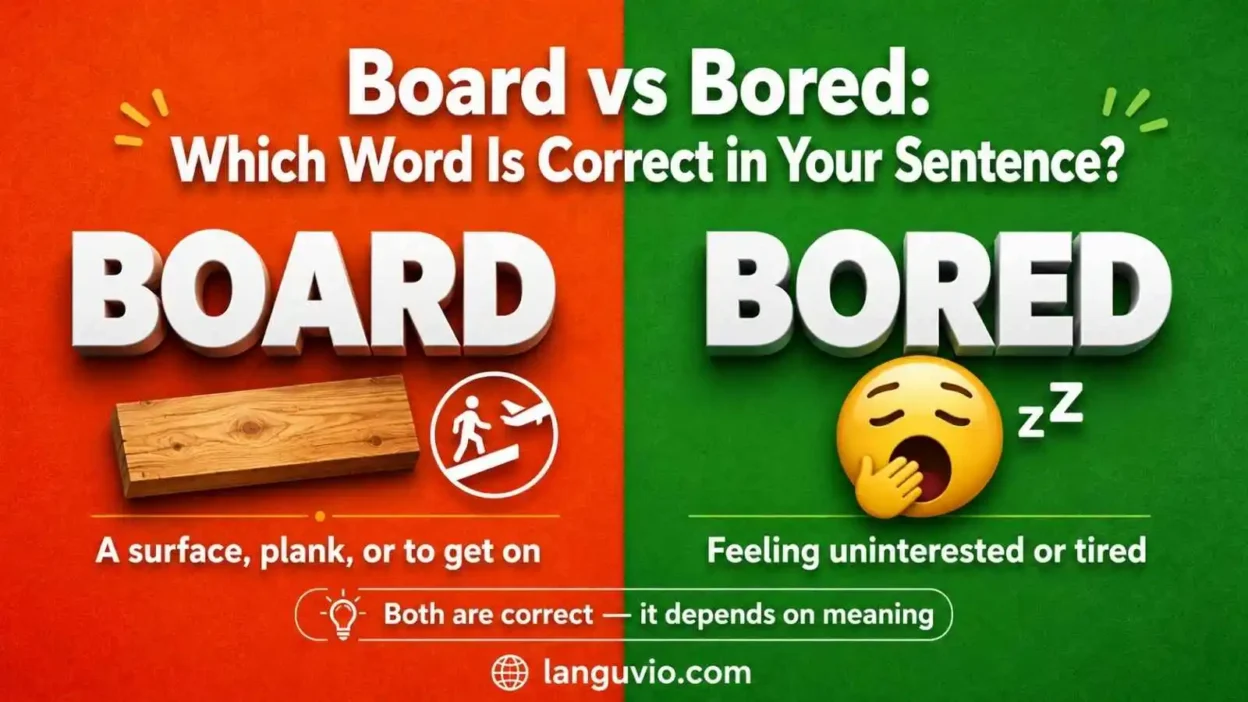
Board vs bored is a common word-choice mistake because the two words sound the same in everyday American English. Their spelling is close too, so many writers choose the wrong one when typing quickly.
The meanings are completely different.
Use board when you mean a flat piece of material, a writing surface, a group of decision-makers, or the action of getting on a plane, train, bus, or ship. Choose bored when someone feels uninterested, tired of an activity, or mentally unstimulated.
One letter changes the whole meaning. A teacher writes on the board, but a student may feel bored during a slow lesson. Passengers board a plane, yet a long delay can make them feel bored at the gate.
Quick Answer
Board and bored are both correct words, but they are not interchangeable.
Use board for a thing, group, surface, or travel action.
Choose bored for the feeling of being uninterested or tired of something dull.
Correct: I wrote the answer on the board.
Correct: I was bored during the long meeting.
Why People Confuse Them
People confuse board and bored because they are homophones. That means they sound alike but have different spellings and meanings.
In most American speech, both words sound like “bord.” Sound alone will not help you choose the right spelling. The sentence meaning has to guide your choice.
This mistake also happens because both words appear in daily life. Schools have boards. Companies have boards. Airports tell passengers to board. At the same time, people often say they feel bored at school, work, home, or during a slow event.
A simple test can help. When the sentence talks about a thing, a group, or getting onto transportation, board is usually right. When the sentence talks about a feeling, bored is the correct choice.
Key Differences At A Glance
Here is the simple difference:
- Board is usually a noun or verb.
- Bored is usually an adjective, but it can also be the past-tense form of bore.
- Board can mean a plank, classroom surface, game surface, committee, or travel action.
- Bored means uninterested, tired of something, or not mentally engaged.
- Board fits objects, groups, travel, and set phrases.
- Bored fits feelings, moods, and reactions.
Meaning and Usage Difference
The main difference between board and bored is meaning.
As a noun, board can mean a flat piece of wood or another material. It can also mean a surface used for writing or display, such as a whiteboard or bulletin board. In business, school, and government contexts, board can refer to a group of people who make decisions.
Examples:
The carpenter cut the board.
Our school board meets tonight.
Please write your name on the board.
As a verb, board often means to get on a plane, train, bus, or ship.
Example:
We board the train at 8:15.
The word bored describes how someone feels. It means a person has lost interest, has nothing engaging to do, or feels tired because something is dull.
Examples:
The kids were bored during the delay.
She looked bored halfway through the presentation.
Think of it this way: board usually points to something outside you. Bored points to a feeling inside you.
Tone, Context, and Formality
Both words are standard in American English, but they belong in different contexts.
In school, board is ordinary and simple: write on the board. In business, it can sound more formal: the board approved the budget. During travel, it is practical and common: passengers may now board.
The word bored usually feels more personal because it describes an emotion or reaction. You can use it in casual speech, school writing, work messages, reviews, and everyday conversation. It also works in formal writing when someone’s lack of interest matters.
There is no useful US vs UK rule for the basic difference here. Meaning decides the spelling, not the country.
Pronunciation is worth noting only because the words sound alike. Since both usually sound like “bord,” you should not choose by sound. Look at the sentence instead.
Which One Should You Use?
Use this table when you are not sure which word fits.
| Context | Best Choice | Why |
| A flat piece of wood or material | board | It names a physical object. |
| A classroom writing surface | board | It refers to a writing or display surface. |
| A group that makes decisions | board | It names a committee or governing group. |
| Getting on a plane, train, bus, or ship | board | It is a verb meaning to get on. |
| Feeling uninterested | bored | It describes a feeling. |
| A dull meeting or class | bored | It shows how someone feels during it. |
| Past tense of “bore” meaning drill a hole | bored | It is the past-tense verb form. |
| Past tense of “bore” meaning made someone uninterested | bored | It is also the past-tense verb form. |
When One Choice Sounds Wrong
Use bored when the sentence is about emotion.
Wrong: I am board at home.
Correct: I am bored at home.
The word board does not mean “uninterested,” so it sounds wrong in that sentence.
Choose board when the sentence is about a thing, group, surface, or travel action.
Wrong: The teacher wrote on the bored.
Correct: The teacher wrote on the board.
Another common travel mistake looks like this:
Wrong: We will bored the plane soon.
Correct: We will board the plane soon.
Here, bored does not work because it does not mean “get on.” The sentence needs the verb board.
A quick replacement test can help. If you can replace the word with uninterested, use bored. If that replacement makes no sense, board is probably the better choice.
Common Mistakes and Quick Fixes
One common mistake is using board for a feeling.
Wrong: The movie made me board.
Correct: The movie made me bored.
Another mistake is using bored for a classroom surface.
Wrong: Put the answer on the bored.
Correct: Put the answer on the board.
Travel sentences create problems too.
Wrong: We bored the bus downtown.
Correct: We boarded the bus downtown.
Writers should also remember that bored can be a past-tense verb.
Correct: The worker bored a hole through the wall.
In that sentence, bored does not mean uninterested. It is the past tense of bore, meaning to make a hole.
Do not mix up bored and boring either.
Correct: I am bored.
Correct: The movie is boring.
A person feels bored. A dull thing is boring.
Everyday Examples
I left my notes on the board after class.
The board of directors met on Friday morning.
Passengers can board through Gate 12.
My little brother got bored during the long car ride.
The new hire looked bored during the safety video.
After dinner, we played a board game.
The city board approved the new park plan.
Please erase the board before the next class starts.
She was bored with the same lunch every day.
The contractor boarded up the broken window.
A mechanic bored a small hole through the metal part.
I felt bored, so I went for a walk.
Dictionary-Style Word Details
Verb
Board works as a verb. It can mean to get on a plane, train, bus, or ship. In another use, it can mean to cover something with boards or to provide meals and lodging.
Examples:
We board the plane at noon.
They boarded up the windows before the storm.
Bored is the past tense and past participle of bore. It can mean made someone feel uninterested, or it can mean made a hole with a tool.
Examples:
The lecture bored the audience.
The worker bored a hole in the board.
Noun
Board is commonly used as a noun. It can mean a flat piece of material, a writing surface, a game surface, a group of officials, or meals and lodging in set phrases.
Examples:
The board cracked under pressure.
The board approved the plan.
Room and board are included.
Bored is not commonly used as a noun in standard American English. The noun form for the state of being bored is boredom.
Correct: Her boredom was obvious.
Not natural: Her bored was obvious.
Synonyms
For board, no single synonym fits every meaning. The closest plain alternatives depend on context.
A wooden board can be a plank.
A school board can be a committee or council.
To board a plane can mean to get on a plane.
For bored, close alternatives include uninterested, weary, restless, not engaged, and tired of it.
Clear opposites for bored include interested, engaged, excited, and entertained.
A clear opposite for board does not work well because the word has several different meanings.
Example Sentences
Here are clear examples of board:
The teacher wrote the homework on the board.
The company board will review the proposal.
We need one more board to finish the shelf.
Families began to board the train early.
The shop owner boarded up the front window.
Now compare those with bored:
I was bored after waiting for two hours.
The students looked bored during the lecture.
She gets bored when the work is too easy.
The speaker bored the crowd with too many details.
The technician bored a hole through the panel.
Word History
Board has long been connected with flat pieces of wood or material. Over time, it also became connected with tables, writing surfaces, official groups, meals and lodging, and travel.
The word bored comes from bore. In everyday writing, it most often describes the feeling of having no interest. It can also be the past-tense form of bore, either meaning to make someone uninterested or to drill into something.
For most writers, the history is less important than the sentence meaning. If the sentence is about a surface, group, object, or travel action, use board. When the sentence is about lack of interest, use bored.
Phrases Containing
Common phrases with board include:
- board game
- bulletin board
- school board
- board of directors
- boarding pass
- room and board
- above board
- on board
- board up
- across the board
Common phrases with bored include:
- bored with
- bored of
- bored by
- bored at work
- bored in class
- bored to tears
- bored stiff
- bored to death
- bored out of your mind
FAQs
Both words are correct, but they mean different things. Board can mean a flat surface, a group of people, or the action of getting on transportation. Bored means uninterested or tired of something dull.
Board is usually a noun or verb. It can refer to a wooden piece, classroom surface, committee, or the act of getting on a plane or bus. Bored is usually an adjective that describes how someone feels.
No. The correct sentence is “I am bored.” Use bored when you mean someone feels uninterested, tired, or not engaged.
No. The correct sentence is “write it on the board.” A classroom writing surface is a board, not bored.
Yes. Board can be a verb meaning to get on a plane, train, bus, or ship. Example: We will board the plane soon.
Yes, but only as the past tense of bore. Example: The lecture bored the audience. It can also mean drilled a hole, as in The worker bored a hole in the wood.
People mix them up because they sound the same in everyday American English. Since pronunciation does not show the spelling, you have to choose based on meaning.
Use board for the classroom surface. Example: The teacher wrote the answer on the board. Use bored only if someone feels uninterested in class.
Think of board as a thing or action. Think of bored as a feeling. A board can be touched, used, or joined. A bored person feels uninterested.
Both are common, but bored with is often the safer choice in standard writing. Example: She was bored with the same routine.
Conclusion
The difference between board and bored becomes clear when you check the sentence meaning. Use board for a flat object, classroom surface, decision-making group, room and meals, or the action of getting onto transportation. Pick bored when someone feels uninterested, tired of something, or mentally unstimulated.