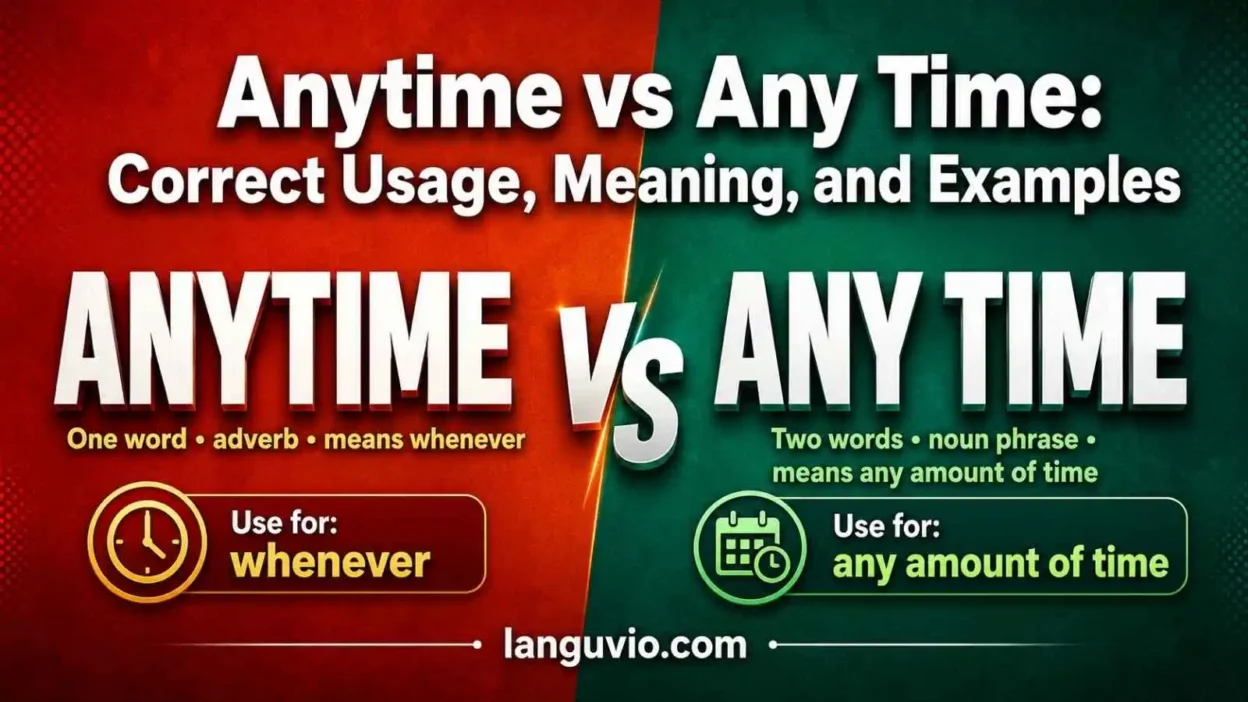
Anytime and any time are both correct, but they do not always fit the same sentence. The one-word form usually means “whenever.” The two-word form keeps time as a noun, especially when you mean an amount of time or use the phrase at any time.
This difference matters in emails, school writing, work messages, and website copy. A small space can change the grammar of the sentence, even when the meaning feels close.
Quick Answer
Use anytime as an adverb when you mean “whenever” or “at any time.” Use any time when time is a noun, when you mean “any amount of time,” or after at. So, Call me anytime is correct, but Call me at any time needs two words.
Why People Confuse Them
People confuse these forms because they sound exactly the same. The space is visible only in writing.
Another reason is that both can point to flexible time. Call me anytime and Call me at any time have almost the same message. The grammar, however, is different.
Anytime works like one adverb. Any time works as two separate words: any modifies the noun time.
Key Differences At A Glance
| Context | Best Choice | Why |
| “Call me ___.” | anytime | It means “whenever.” |
| “Call me at ___.” | any time | The phrase after at is any time. |
| “I don’t have ___ today.” | any time | It means an amount of time. |
| “Stop by ___ after lunch.” | anytime | It works as an adverb meaning “whenever.” |
| “You may cancel at ___.” | any time | At any time is the standard phrase. |
| “___ you need help, text me.” | Anytime | It means “whenever” at the start of a time clause. |
Meaning and Usage Difference
Anytime means “whenever” or “at any time.” It usually describes when something can happen.
Examples:
• You can call me anytime.
• The package should arrive anytime now.
• Anytime you need help, send me a message.
Any time means “any amount of time” or “any particular time.” It is often used when time is still clearly a noun.
Examples:
• I don’t have any time this morning.
• Do you have any time before the meeting?
• You can cancel at any time.
A useful test is to add a word between any and time. If that works, use two words.
Correct: Do you have any extra time today?
Correct: I don’t have any free time this week.
You cannot write anyextra time or anyfree time, so the two-word form is needed.
Tone, Context, and Formality
Anytime is natural in modern US English. It works well in everyday writing, business emails, customer messages, and casual instructions.
Any time can sound slightly more formal in some sentences. It is also the safer choice when you are unsure, because it works in more structures.
Use any time in formal lines like:
• You may request a refund at any time.
• Employees may ask questions at any time during training.
Use anytime in simple, direct lines like:
• Email me anytime.
• Drop by anytime after 3 p.m.
There is no strong need to treat this as a US-versus-UK choice for normal American writing. The real issue is grammar and sentence structure.
Which One Should You Use?
Choose anytime when you can replace it with whenever.
Correct: Text me anytime.
Test: Text me whenever.
Correct: Anytime you visit Chicago, try this pizza place.
Test: Whenever you visit Chicago, try this pizza place.
Choose any time when you mean available time, an amount of time, or a time slot.
Correct: I don’t have any time to talk right now.
Correct: Do we have any time before the movie starts?
Also choose any time after at.
Correct: You can leave at any time.
Incorrect: You can leave at anytime.
When One Choice Sounds Wrong
Anytime sounds wrong when the sentence needs a noun phrase.
Incorrect: I don’t have anytime today.
Correct: I don’t have any time today.
Incorrect: Do you have anytime for a quick call?
Correct: Do you have any time for a quick call?
Any time can sound stiff when a short adverb would be smoother, but it is often still acceptable.
Natural: Come over anytime.
Also correct: Come over any time.
The main hard mistake is at anytime. In standard edited US English, write at any time.
Common Mistakes (and Quick Fixes)
Mistake 1: Using “at anytime”
Incorrect: You may update your profile at anytime.
Correct: You may update your profile at any time.
Mistake 2: Using “anytime” for an amount of time
Incorrect: I barely had anytime to eat lunch.
Correct: I barely had any time to eat lunch.
Mistake 3: Making every use two words
Acceptable but less direct: You can call me any time.
Smoother: You can call me anytime.
Mistake 4: Thinking one form is always wrong
Both forms are correct. The right choice depends on the sentence.
Everyday Examples
• I’m free anytime after 4 p.m.
• I don’t have any time before work.
• You can ask questions at any time.
• Stop by anytime this weekend.
• We can reschedule any time that works for you.
• The bus should arrive anytime now.
• She does not have any time for another project.
• Anytime you need a ride, let me know.
• Customers may cancel at any time.
• I can help anytime, but I need any time you can spare tomorrow.
| Feature | Anytime | Any time |
| Basic role | One-word adverb | Two-word noun phrase |
| Main meaning | Whenever | Any amount or point of time |
| Best test | Replace with “whenever” | Add a word before “time” |
| Common phrase | Call me anytime | At any time |
| Wrong use | I have anytime | At anytime |
Dictionary-Style Word Details
Verb
• Anytime: Not used as a verb in standard US English.
• Any time: Not used as a verb. In this form, time can be a noun, but the full phrase any time is not a verb.
Noun
• Anytime: Not commonly used as a noun in standard US English. It usually works as an adverb.
• Any time: A noun phrase. Any modifies the noun time.
Example: I don’t have any time today.
Synonyms
• Anytime: Closest plain alternatives include whenever, at any time, and whenever convenient.
• Any time: Closest plain alternatives include any amount of time, some time, available time, or a time that works.
Possible opposites depend on the sentence. For anytime, never may be the opposite in a direct contrast. For any time, no time can be the opposite when the meaning is “no available time.”
Example Sentences
• Anytime: You can message me anytime.
• Anytime: Anytime you are in Dallas, we should grab coffee.
• Anytime: The results could post anytime now.
• Any time: I don’t have any time this afternoon.
• Any time: You may return the item at any time within 30 days.
• Any time: Is there any time left before the deadline?
Word History
• Anytime: English often turns common word groups into closed compounds when they become frequent in one role. Anytime is now established as a one-word adverb.
• Any time: The older open form remains important because it still works as a normal noun phrase: any + time.
Exact first-use claims are not needed here. The safe point is that both forms exist today, but they serve different grammatical roles.
Phrases Containing
• Anytime: anytime soon, anytime now, anytime you need help, call anytime.
• Any time: at any time, any time of day, any time before noon, do not have any time, any time that works.
After someone says “thank you,” casual replies such as Anytime! are common. The spaced form Any time! can also make sense if you mean “I’d help whenever you need it.”
FAQs
Is it anytime or any time?
Both anytime and any time are correct, but they fit different grammar roles. Use anytime when you mean “whenever.” Use any time when you mean an amount of time, available time, or the phrase at any time.
Is “call me anytime” correct?
Yes. Call me anytime is correct because anytime works as an adverb meaning “whenever.” It sounds natural in casual and professional US English. You can also write call me any time, but the one-word form is smoother here.
Is “at anytime” correct?
No. The standard form is at any time. After the preposition at, use two words because time is acting as a noun. For example: You can cancel at any time is correct.
When should I use any time as two words?
Use any time when you mean “any amount of time” or “available time.” For example: I don’t have any time today and Do you have any time before lunch? Both need two words because time is a noun.
Is anytime formal or informal?
Anytime is standard and natural, but any time can sound a little more formal in some sentences. In legal, policy, academic, or very formal writing, at any time is often the safer choice.
What is the easiest way to remember the difference?
Replace the word with whenever. If whenever fits, anytime usually works. Example: Text me anytime means Text me whenever. If you mean “any amount of time,” use any time.
Can I say “anytime soon”?
Yes. Anytime soon is a common phrase meaning “in the near future.” Example: I don’t think the store will reopen anytime soon.
Conclusion
Use anytime when the word means whenever and works like an adverb. Use any time when time is a noun, when you mean an amount of time, or when the phrase follows at.
The easiest rule is this: Call me anytime, but call me at any time. For formal writing, any time is often the safer option, but anytime is correct when the sentence needs a simple adverb.
Both anytime and any time are correct, but they fit different grammar roles. Use anytime when you mean “whenever.” Use any time when you mean an amount of time, available time, or the phrase at any time.
Yes. Call me anytime is correct because anytime works as an adverb meaning “whenever.” It sounds natural in casual and professional US English. You can also write call me any time, but the one-word form is smoother here.
No. The standard form is at any time. After the preposition at, use two words because time is acting as a noun. For example: You can cancel at any time is correct.
Use any time when you mean “any amount of time” or “available time.” For example: I don’t have any time today and Do you have any time before lunch? Both need two words because time is a noun.
Anytime is standard and natural, but any time can sound a little more formal in some sentences. In legal, policy, academic, or very formal writing, at any time is often the safer choice.
Replace the word with whenever. If whenever fits, anytime usually works. Example: Text me anytime means Text me whenever. If you mean “any amount of time,” use any time.
Yes. Anytime soon is a common phrase meaning “in the near future.” Example: I don’t think the store will reopen anytime soon.