Into vs in to confuses many writers because the words look almost the same and often sound the same in speech. Still, they are not the same choice in writing.
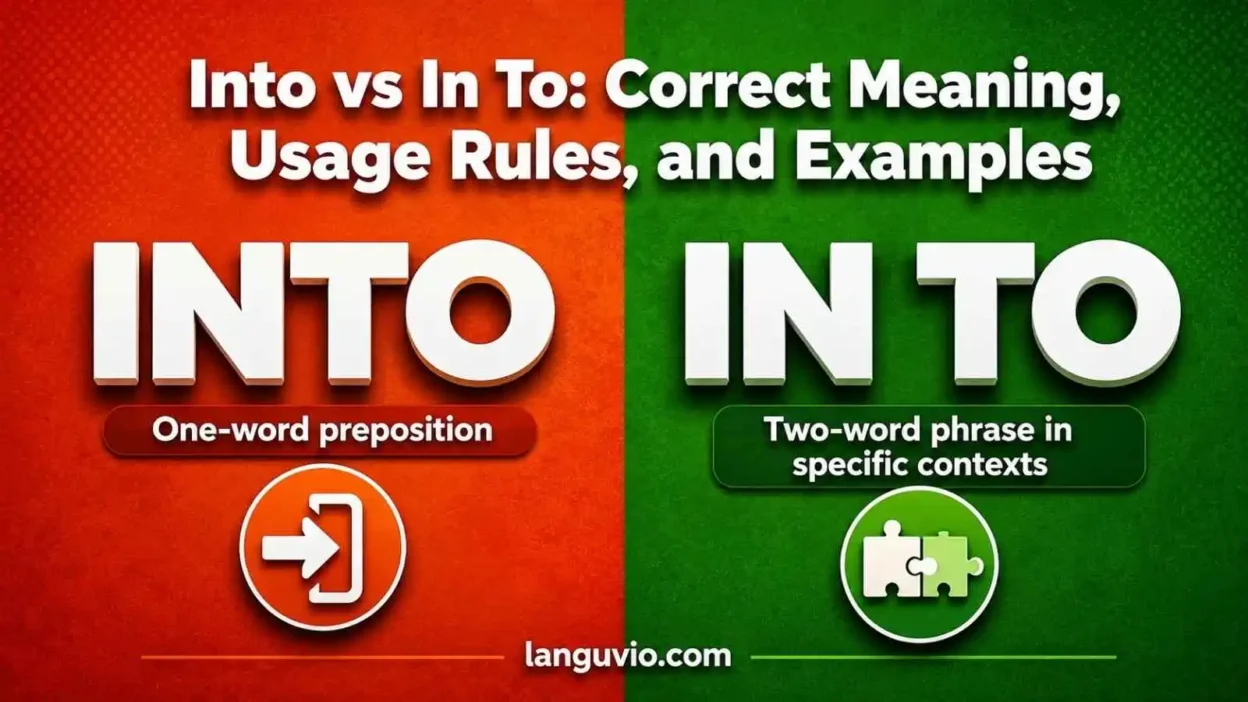
Use into when you need one preposition. Use in to when in and to belong to separate parts of the sentence. The difference is usually about sentence structure, not style.
Quick Answer
Use into as one word when something enters, moves toward the inside, changes form, hits something, or becomes involved in something. Use in to as two words when in is part of a verb phrase and to starts the next phrase.
Correct: “She walked into the office.”
Correct: “She walked in to ask a question.”
Why People Confuse Them
People confuse into and in to because they often sound alike. In fast speech, you may not hear the space between in and to.
The confusion gets worse with verbs like log in, sign in, check in, turn in, and break in. In these phrases, in often belongs to the verb before it. Then to begins the next part of the sentence.
Compare these:
“She broke into the garage.”
“She broke in to rescue the dog.”
The first sentence means she entered the garage by force. The second means she broke in for a purpose: to rescue the dog.
Key Differences At A Glance
| Context | Best Choice | Why |
| Movement toward the inside | into | “Into” shows entry or direction. |
| Change or transformation | into | “Into” can show becoming something else. |
| Interest or involvement | into | “Into” can mean interested in something. |
| Collision or contact | into | “Into” can mean against. |
| Division in math | into | “Into” can show how one number divides another. |
| A phrasal verb plus a purpose phrase | in to | “In” stays with the verb, and “to” starts the next phrase. |
| Login, sign-in, or check-in actions | in to | The verb phrase is usually “log in,” “sign in,” or “check in.” |
Meaning and Usage Difference
Into is one word. It is a preposition. It usually shows movement toward the inside of a place, thing, or situation.
Examples:
“She dropped the keys into her bag.”
“The kids ran into the backyard.”
“The company turned the old warehouse into apartments.”
Into can also show contact, interest, or involvement.
Examples:
“He bumped into the table.”
“My brother is really into soccer.”
“She went into marketing after college.”
In to is not one fixed word. It is two separate words that happen to stand next to each other. Often, in is part of a verb phrase, and to begins an infinitive or a prepositional phrase.
Examples:
“Please log in to update your profile.”
“She stopped in to say hello.”
“He turned the form in to the office.”
The sound is not the best guide. The grammar of the sentence gives the answer.
| Feature | into | in to |
| Form | One word | Two words |
| Main job | Preposition | Separate words in a sentence |
| Common use | Entry, change, contact, interest | Verb phrase plus “to” phrase |
| Example | “Walk into the room.” | “Walk in to ask for help.” |
Tone, Context, and Formality
Into is normal in both casual and formal writing. It does not sound too relaxed or too stiff. You can use it in school writing, business writing, fiction, emails, and everyday messages.
In to is also normal when the sentence needs two separate words. It is not less formal. In fact, it is often the cleaner choice in edited writing when the verb is log in, sign in, check in, or tune in.
For example, “log in to your account” is clearer than “log into your account” because the action is log in. The word to then points to the account.
Still, many people write “log into” in casual settings. For polished writing, keep the verb phrase clear.
Which One Should You Use?
Use into when the sentence shows movement, change, interest, or entry into a place, state, subject, or situation.
“She walked into the store.”
“The rain changed into snow.”
“He got into trouble.”
Use in to when in completes the first part of the sentence and to starts the purpose or next action.
“I stopped in to pick up the receipt.”
“She came in to talk.”
“He logged in to check his account.”
A simple test can help: if to means “in order to,” use in to as two words.
Correct: “I stopped in to pick up the receipt.”
Meaning: “I stopped in in order to pick up the receipt.”
Here, in belongs to stopped in, and to belongs to to pick up. That is why in to stays as two words.
When One Choice Sounds Wrong
The wrong choice can make the sentence unclear or change the meaning.
Wrong: “Please log into reset your password.”
Correct: “Please log in to reset your password.”
Here, to reset tells the purpose. The verb is log in.
Wrong: “She walked in to the conference room.”
Better: “She walked into the conference room.”
Here, the sentence shows movement toward the inside of a room.
Sometimes both forms are grammatical, but the meaning changes.
“She turned into the driveway.”
This means she moved her car toward and inside the driveway.
“She turned in to the driveway.”
This sounds as if she turned something in to the driveway, which does not make sense in normal writing.
“She turned him in to the police.”
This means she reported him to the police.
Common Mistakes (and Quick Fixes)
Mistake: “I logged into check my messages.”
Fix: “I logged in to check my messages.”
Mistake: “He came into help with dinner.”
Fix: “He came in to help with dinner.”
Mistake: “The teacher turned the grades in to a chart.”
Fix: “The teacher turned the grades into a chart.”
Mistake: “She is in to hiking.”
Fix: “She is into hiking.”
Mistake: “Drop into say hi.”
Fix: “Drop in to say hi.”
Mistake: “The puppy jumped in to the box.”
Fix: “The puppy jumped into the box.”
Everyday Examples
Into: “Put the groceries into the fridge.”
“She turned her hobby into a small business.”
“I ran into my neighbor at the coffee shop.”
“He is into old movies and vinyl records.”
“The meeting went into the lunch hour.”
In to: “Please sign in to join the class.”
“I stopped in to grab my jacket.”
“She checked in to see how her mom was feeling.”
“He turned the keys in to the front desk.”
“They came in to finish the project before noon.”
Dictionary-Style Word Details
Verb
Into: Not used as a verb in standard US English. It is a preposition.
In to: Not a verb by itself. However, in can be part of verb phrases such as log in, sign in, drop in, check in, and turn in.
Noun
Into: Not commonly used as a noun in standard US English.
In to: Not a noun. It is a two-word sequence, not a single noun form.
Synonyms
Into: The best plain meaning depends on the sentence.Use into when something moves inside, goes toward a place, or enters a space. You can also use into when something changes into a new form, state, or role.
In to: No exact synonym fits the whole two-word sequence. In some purpose sentences, to can mean “in order to.”
Examples:
“I stopped in to help.”
“I stopped in in order to help.”
Example Sentences
Into: “She poured the batter into the pan.”
“The quiet street turned into a busy market.”
“I am not really into horror movies.”
In to: “Please log in to view your schedule.”
“He came in to ask about the job.”
“She turned the report in to her manager.”
Word History
Into: The word has old roots from forms meaning in plus to. Today, it works as one standard preposition.
In to: This is not a single historical word. It is the modern result of two separate words landing next to each other in a sentence.
Phrases Containing
Into: get into, run into, turn into, look into, go into, break into, bump into.
In to: log in to, sign in to, tune in to, drop in to, check in to, turn in to.
Use the full sentence to decide whether the words should stay together or apart.
FAQs
Is it into or in to?
Both can be correct. Use into when you mean movement, entry, change, contact, or interest. Example: “She walked into the room.” Use in to when in and to belong to separate parts of the sentence. Example: “She came in to ask a question.”
What is the main difference between into and in to?
Into is one preposition. It shows that something moves inside, changes into something else, or becomes involved in something. In to is two separate words. Usually, in belongs to a verb phrase, and to starts the next phrase.
Is “log into” or “log in to” correct?
In careful writing, log in to is usually clearer because the verb phrase is log in. Example: “Please log in to your account.” However, many people use “log into” casually, especially online.
When should I use into?
Use into when something goes inside a place, thing, or situation. Examples: “Put the file into the folder.” “The rain turned into snow.” “She is really into photography.”
When should I use in to?
Use in to when to means “in order to” or begins the next phrase. Example: “He stopped in to say hello.” This means he stopped in for the purpose of saying hello.
Can one sentence change meaning with into and in to?
Yes. “She broke into the house” means she entered by force. “She broke in to rescue the dog” means she entered for a purpose. The space changes the structure and meaning.
What is the easiest rule to remember?
Use into for entry, movement, change, or interest. Use in to when in completes the verb and to begins the reason, action, or destination that follows.
Conclusion
The difference between into and in to is simple once you look at the sentence structure. Use into when you need one preposition for entry, movement, change, contact, interest, or division.
Use in to when in belongs to the verb before it and to begins the next phrase. When you are unsure, test the verb first. If the verb is log in, sign in, drop in, check in, or turn in, you will often need in to.
Both can be correct. Use into when you mean movement, entry, change, contact, or interest. Example: “She walked into the room.” Use in to when in and to belong to separate parts of the sentence. Example: “She came in to ask a question.”
Into is one preposition. It shows that something moves inside, changes into something else, or becomes involved in something. In to is two separate words. Usually, in belongs to a verb phrase, and to starts the next phrase.
In careful writing, log in to is usually clearer because the verb phrase is log in. Example: “Please log in to your account.” However, many people use “log into” casually, especially online.
Use into when something goes inside a place, thing, or situation. Examples: “Put the file into the folder.” “The rain turned into snow.” “She is really into photography.”
Yes. “She broke into the house” means she entered by force. “She broke in to rescue the dog” means she entered for a purpose. The space changes the structure and meaning.
Use into for entry, movement, change, or interest. Use in to when in completes the verb and to begins the reason, action, or destination that follows.