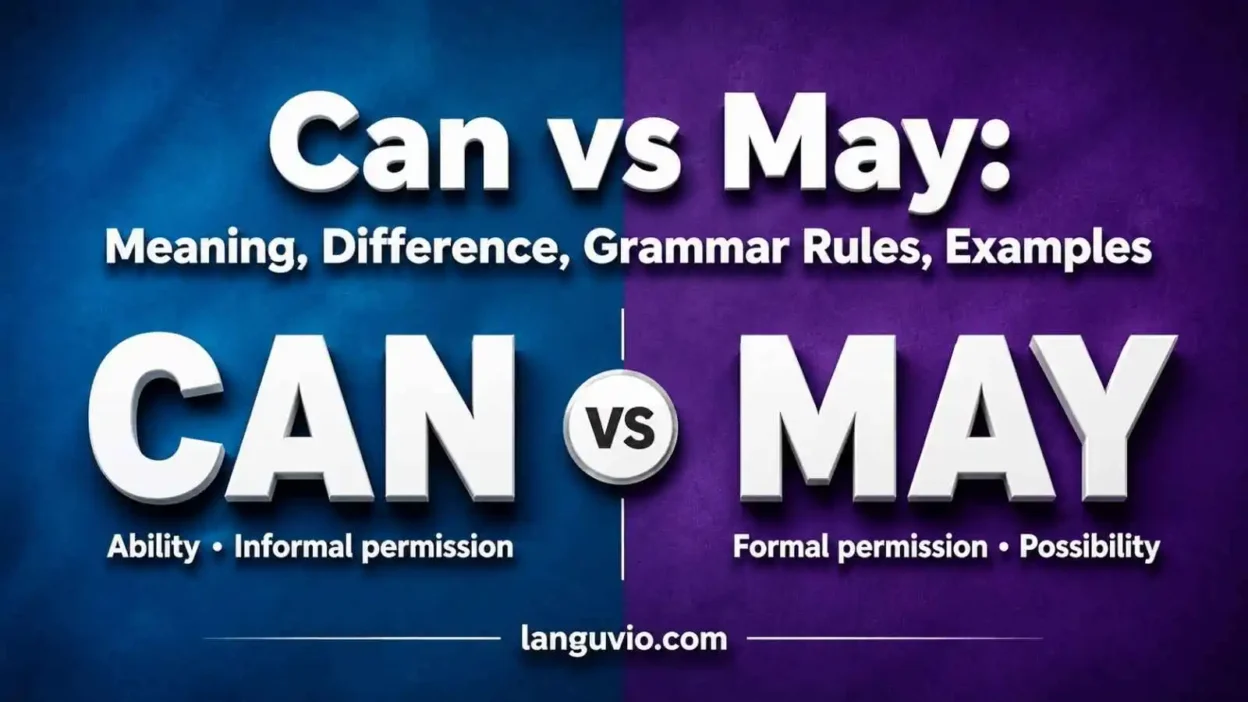
Can vs may is confusing because both words can ask or give permission. Many people learned the old classroom correction: “Can I go?” asks about ability, while “May I go?” asks for permission.
However, that rule is too simple for modern US English. Can is common and acceptable for everyday permission, while may sounds more formal, polite, official, or careful. Therefore, the best choice depends on meaning, tone, and context.
Quick Answer
Use can when you mean be able to or when you are asking permission in normal everyday English. Use may when you want to ask or give permission more formally, or when you mean possibly. For example, “Can you drive?” asks about ability. In contrast, “May I leave early?” asks permission in a polite way.
Why People Confuse Them
People confuse can and may because the words overlap in real use. In school, many students hear that can means ability and may means permission.
That rule helps in simple sentences:
Ability: Can you swim?
Permission: May I use your phone?
Still, everyday English is more flexible. A person who says “Can I use your phone?” is usually asking for permission, not asking whether they have the physical ability to use a phone.
In addition, both words can express possibility:
General possibility: Traffic can get heavy after 5 p.m.
Uncertain possibility: It may rain later tonight.
As a result, the better rule is not “one is correct and one is wrong.” Instead, remember this: can is more direct and common, while may is more formal, polite, or uncertain.
Key Differences At A Glance
| Context | Best Choice | Why |
| Physical or mental ability | can | It means someone is able to do something. |
| Everyday permission | can | It sounds natural in normal conversation. |
| Formal permission | may | It sounds more polite, official, or careful. |
| Written rules or policies | may | It fits formal notices and instructions. |
| General possibility | can | It shows something is possible or sometimes happens. |
| Uncertain possibility | may | It shows something might happen. |
| Requesting someone to do something | can | “Can you help me?” is natural. |
| Polite service language | may | “How may I help you?” sounds formal and professional. |
Meaning and Usage Difference
Can is a modal verb. It usually comes before the base form of another verb.
For ability, use sentences like these:
I can drive.
My sister can speak Spanish.
This laptop can run the program.
Besides ability, can also works for permission, requests, offers, and possibility.
Everyday permission: Can I sit here?
Request: Can you send the file today?
Possibility: Summers can be very hot in Phoenix.
Offer: Can I help you with that?
May is also a modal verb, and it also comes before the base form of another verb. However, its tone is usually more formal or careful.
Polite permission: May I ask a question?
Formal permission: You may begin the test.
Possibility: The package may arrive tomorrow.
When may shows possibility, it often means something is possible but not certain.
The meeting may run late.
She may join us after work.
Your order may arrive tomorrow.
In short, can often points to ability or everyday permission. May, on the other hand, often points to formal permission or uncertain possibility.
| Feature | can | may |
| Main everyday use | ability or informal permission | formal permission or possibility |
| Tone | direct, common, conversational | polite, formal, careful |
| Best question form | Can I borrow this? | May I borrow this? |
| Ability use | Yes: I can lift it. | No: I may lift it does not mean ability. |
| Possibility use | Things can change. | Things may change. |
Tone, Context, and Formality
Can sounds natural in everyday US English. Therefore, it works well with friends, family, coworkers, classmates, and customers.
A friend might say, “Can I call you after lunch?”
At work, someone may ask, “Can we use the conference room?”
In a normal request, you might say, “Can you check this report?”
May sounds more formal. It can also sound more polite when you are speaking to a teacher, manager, customer, guest, or someone you do not know well.
For example, a receptionist might say, “May I ask who is calling?”
At a hotel, a guest could ask, “May we leave our bags at the front desk?”
In a workplace policy, a sign might read, “Employees may use the side entrance after 6 p.m.”
However, may can sound stiff in casual settings. A person talking to a close friend would probably say, “Can I sit on your couch?” rather than “May I sit on your couch?”
That does not make may wrong. It simply means the tone is more formal than most casual conversations need.
Which One Should You Use?
Use can when the sentence is about ability.
I can finish the project by Friday.
Can your laptop run the program?
She can explain the rule clearly.
Also, use can for normal everyday permission.
Can I use your charger?
Can we leave early today?
You can take the last slice.
In formal writing, use may when the sentence gives or asks for permission in a polite or official way.
May I speak with the manager?
Guests may enter through the main lobby.
Students may submit the form online.
Meanwhile, use may when you mean something is possible but not certain.
The store may close early because of the storm.
Your order may arrive tomorrow.
He may need more time.
For most daily conversations, can will sound normal. However, for formal permission, official writing, or extra politeness, may is often the better choice.
When One Choice Sounds Wrong
May sounds wrong when the sentence clearly asks about ability. In that case, can is the right word.
Wrong: May you lift this box?
Better: Can you lift this box?
Wrong: May she code in Python?
Better: Can she code in Python?
Wrong: May your phone connect to Wi-Fi?
Better: Can your phone connect to Wi-Fi?
These questions are about skill, power, or capacity. Therefore, can is the natural choice.
On the other hand, can may sound too casual in formal notices or official permission statements.
Casual: You can enter after showing your ID.
More formal: You may enter after showing your ID.
Casual: Members can use the pool until 9 p.m.
More formal: Members may use the pool until 9 p.m.
Both versions are understandable. Still, may fits better when the writing needs an official tone.
Common Mistakes (and Quick Fixes)
A common mistake is treating “Can I?” as always wrong. In reality, “Can I?” is normal for everyday permission.
Everyday: Can I borrow your pen?
More formal: May I borrow your pen?
Another mistake is using may for ability. When you mean “be able to,” use can instead.
Wrong: I may speak three languages.
Correct: I can speak three languages.
Sometimes, writers use can when a formal rule needs a more official tone. In that situation, may usually sounds better.
Casual: Visitors can park in Lot B.
Formal: Visitors may park in Lot B.
A different mistake happens when someone uses may to ask another person to do something. For normal requests, can is usually better.
Awkward: May you send me the invoice?
Natural: Can you send me the invoice?
Finally, do not assume may always means permission. It can also mean possibility.
Example: She may call after dinner.
Meaning: It is possible that she will call.
Everyday Examples
In everyday speech, both words can appear in permission questions, but the tone changes.
Casual permission: Can I open the window?
Polite permission: May I open the window?
A work-from-home sentence can also change tone.
Everyday style: He can work from home on Fridays.
Formal rule: He may work from home on Fridays.
For possibility, the difference is slightly different.
General possibility: The roads can flood during heavy rain.
Specific uncertainty: The roads may flood tonight.
A guest question shows the same contrast.
Everyday question: Can I bring a guest?
More formal question: May I bring a guest?
Ability is different because may usually does not fit.
Right: Can she finish the design today?
Wrong for ability: May she finish the design today?
However, may works if the sentence asks about permission.
Permission: May she finish the design at home today?
Dictionary-Style Word Details
Verb
Can: In this comparison, can is mainly a modal auxiliary verb. It helps another verb express ability, permission, request, offer, or possibility. For example, “I can help” means I am able to help. The word can can also be a regular verb meaning to preserve food in a can or to dismiss someone from a job, but those meanings are separate from this comparison.
May: May is mainly a modal auxiliary verb. It helps another verb express permission, possibility, a polite suggestion, or a wish. For example, “You may leave now” gives permission. Unlike can, it is not commonly used as a regular action verb in standard US English.
Noun
Can: Can can be a noun meaning a metal container. For example, “She opened a can of soup.” However, that noun meaning is not part of the permission and ability difference.
May: May can be a capitalized noun meaning the fifth month of the year. For example, “The event is in May.” Still, that noun meaning is separate from the modal verb may.
Synonyms
Can: Closest plain alternatives include be able to, know how to, be allowed to, and be possible to, depending on the sentence. For the negative, cannot or can’t is the usual opposite.
May: Closest plain alternatives include be permitted to, be allowed to, might, and possibly, depending on the sentence. For permission, may not means not permitted. For possibility, may not means possibly not.
Example Sentences
Can:
I can meet you at 3 p.m.
Please ask if you can send the address.
You can use my laptop for the call.
A small typo can change the meaning.
May:
May I ask one more question?
Guests may check in after 3 p.m.
The client may request another revision.
May your new job bring you success.
Word History
Can: The modal use of can goes back to older English forms linked with knowing how to do something and being able to do something. Because of that history, ability remains one of its strongest meanings.
May: The modal use of may also goes back to older English forms connected with power or ability. Over time, modern use became strongly tied to permission, possibility, and formal tone.
The histories overlap more than the old classroom rule suggests. As a result, can and may share some modern uses, especially when people ask for permission.
Phrases Containing
Can:
can do
can’t wait
as best I can
more than I can handle
can hardly believe it
kick the can down the road
May:
may I ask
may as well
come what may
be that as it may
if I may say so
may the best person win
FAQs
Is “can I” grammatically correct?
Yes, “Can I” is grammatically correct in modern US English. People use it every day to ask permission, especially in casual or normal situations. For example, “Can I use your charger?” sounds natural. However, in very formal settings, “May I” may sound more polite.
Is “may I” more polite than “can I”?
Yes, “May I” usually sounds more polite and formal than “Can I.” For example, “May I speak with the manager?” sounds more careful than “Can I speak with the manager?” Both can be correct, but the tone is different.
Should I say “Can I go?” or “May I go?”
Both can be correct. “Can I go?” sounds natural in everyday speech. “May I go?” sounds more formal or polite. In school, a teacher may prefer “May I go?” because it clearly asks for permission.
What is the main difference between can and may?
The main difference is meaning and tone. Can often means ability or everyday permission. May often means formal permission or possibility. For example, “I can drive” means I am able to drive. “I may drive later” means it is possible that I will drive later.
Can may mean possibility?
Yes, may can mean possibility. For example, “It may rain tonight” means rain is possible, but not certain. In this use, may is close to might.
Can can mean permission?
Yes, can can mean permission in everyday English. For example, “You can leave early today” means you are allowed to leave early. Still, in formal writing, may often sounds better.
Which is better in formal writing, can or may?
In formal writing, may is often better for permission. For example, “Visitors may enter through the front door” sounds more official than “Visitors can enter through the front door.”
Conclusion
Can and may are both correct, but they do not always fit the same tone or meaning. Use can for ability and for normal everyday permission. Use may for formal permission, polite questions, official rules, and uncertain possibility.
In short, the old rule is too strict. “Can I leave?” is normal in everyday English. “May I leave?” is more formal and polite. Therefore, the best choice depends on what you mean and how formal you want to sound.
Yes, “Can I” is grammatically correct in modern US English. People use it every day to ask permission, especially in casual or normal situations. For example, “Can I use your charger?” sounds natural. However, in very formal settings, “May I” may sound more polite.
Yes, “May I” usually sounds more polite and formal than “Can I.” For example, “May I speak with the manager?” sounds more careful than “Can I speak with the manager?” Both can be correct, but the tone is different.
Both can be correct. “Can I go?” sounds natural in everyday speech. “May I go?” sounds more formal or polite. In school, a teacher may prefer “May I go?” because it clearly asks for permission.
The main difference is meaning and tone. Can often means ability or everyday permission. May often means formal permission or possibility. For example, “I can drive” means I am able to drive. “I may drive later” means it is possible that I will drive later.
Yes, may can mean possibility. For example, “It may rain tonight” means rain is possible, but not certain. In this use, may is close to might.
Yes, can can mean permission in everyday English. For example, “You can leave early today” means you are allowed to leave early. Still, in formal writing, may often sounds better.
In formal writing, may is often better for permission. For example, “Visitors may enter through the front door” sounds more official than “Visitors can enter through the front door.”