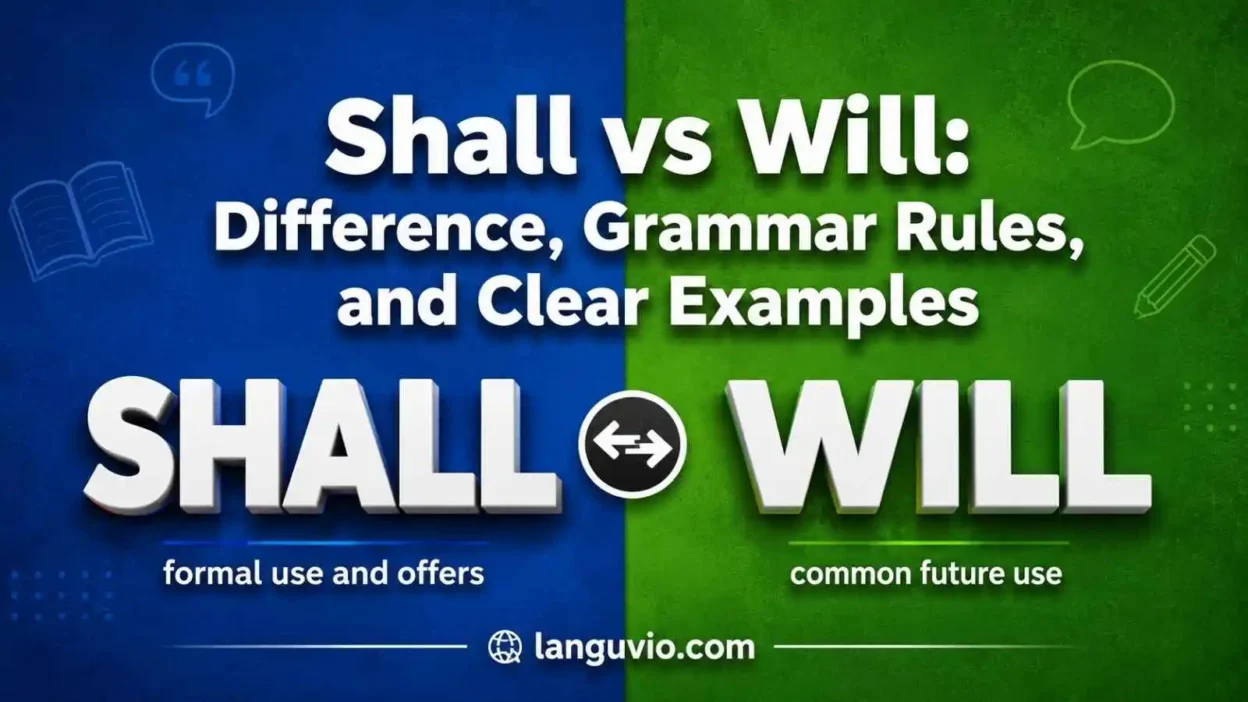
Shall vs will can confuse writers because both words can point to the future. You may see “I shall call you tomorrow” and “I will call you tomorrow,” and both can be grammatically correct.
The real difference is usage. In modern American English, will is the normal choice for most future statements. Shall sounds more formal, old-fashioned, or legal-style, except in polite questions like “Shall I help?” or “Shall we start?”
Quick Answer
Use will for most everyday future statements in American English. Use shall mainly with I or we in formal writing, polite offers, or suggestions. Both words can be correct, but will usually sounds more natural in modern US speech and writing.
Correct: I will send the report today.
Also correct, but formal: I shall send the report today.
Why People Confuse Them
People confuse shall and will because older grammar lessons often taught a strict rule: use shall with I and we, and use will with other subjects.
That rule still appears in some grammar books, but most Americans do not follow it in daily speech. Today, I will and we will sound normal.
The confusion also comes from formal writing. Legal documents, policies, and old-fashioned statements may use shall where everyday English would use will or must.
Key Differences At A Glance
| Feature | Shall | Will |
| Main role | Formal future, offers, suggestions, obligation-style wording | Normal future, promises, decisions, requests, predictions |
| Common in US English? | Limited | Very common |
| Best with | I, we, formal rules, “Shall I/we…” questions | All subjects |
| Tone | Formal, old-fashioned, serious, legal-style | Natural, modern, neutral |
| Example | Shall we begin? | We will begin at 9. |
Meaning and Usage Difference
Will is the standard future marker in modern American English. It works with all subjects.
Examples:
Correct: I will call you after lunch.
Example: She will join the meeting online.
Also correct: They will announce the winner Friday.
Shall can also point to the future, but it is much less common in everyday US English. It usually appears with I or we, especially in formal statements or polite questions.
Examples:
Formal: We shall review your request.
Polite offer: Shall I open the window?
Suggestion: Shall we meet at noon?
The pronunciation difference is small and usually not the source of confusion. Shall sounds like “shal” or a softer “shuhl.” Will sounds like “wil.” In speech, both often become ’ll after pronouns: I’ll, we’ll, they’ll.
Tone, Context, and Formality
Will is neutral. It fits emails, school writing, business messages, everyday speech, instructions, predictions, and plans.
Examples:
I will check the schedule.
The store will close at 8 p.m.
We will send an update tomorrow.
Shall has a more formal tone. In American English, it may sound old-fashioned in a simple future sentence.
Formal: I shall return after the meeting.
Natural: I will return after the meeting.
However, shall still sounds natural in some polite questions:
Shall I take your coat?
Shall we begin?
In rules or contracts, shall can mean that something is required. Still, in clear modern writing, must is often a better choice when you mean “required.”
Formal rule-style: Employees shall wear ID badges.
Clearer: Employees must wear ID badges.
Which One Should You Use?
| Context | Best Choice | Why |
| Everyday future statement | Will | It sounds natural in modern American English. |
| Promise | Will | It clearly shows intent or commitment. |
| Quick decision | Will | It fits decisions made while speaking. |
| Prediction | Will | It is the normal future choice. |
| Polite offer with I | Shall | “Shall I…?” sounds polite and traditional. |
| Suggestion with we | Shall | “Shall we…?” is common in formal or polite speech. |
| Legal-style requirement | Shall or must | “Shall” appears in formal rules, but “must” is clearer. |
| Casual conversation | Will | “Shall” may sound stiff or old-fashioned. |
For most US writing, choose will unless you have a clear reason to use shall.
Use shall when the sentence is a polite offer, a suggestion, or a deliberately formal statement.
When One Choice Sounds Wrong
Shall can sound wrong when it appears in casual American speech.
Stiff: I shall text you when I get home.
Natural: I will text you when I get home.
Stiff: They shall arrive around six.
Natural: They will arrive around six.
Will can sound less natural when the sentence is a polite offer with I or a suggestion with we.
Less polished: Will I open the window for you?
Better: Shall I open the window for you?
Less polished: Will we start now?
Better as a suggestion: Shall we start now?
However, context matters. “Will we start now?” can be correct if you are asking about the future. “Shall we start now?” suggests that you are inviting the other person to begin.
Common Mistakes (and Quick Fixes)
Mistake: I shall be there in five minutes.
Better for everyday US English: I will be there in five minutes.
Mistake: She shall call you tomorrow.
Better: She will call you tomorrow.
Mistake: Shall you attend the event?
Better: Will you attend the event?
Mistake: The tenant will pay rent by the first day of each month.
Clearer if it is a requirement: The tenant must pay rent by the first day of each month.
Mistake: Shall I receive a confirmation email?
Better if asking about the future: Will I receive a confirmation email?
Mistake: Will we order lunch?
Better if making a suggestion: Shall we order lunch?
Everyday Examples
I will finish the assignment tonight.
We will meet outside the theater.
She will send the invoice this afternoon.
They will move into the new apartment next week.
I will not forget your advice.
Will you help me carry this box?
Will the office be open tomorrow?
Shall I save you a seat?
Shall we take a short break?
We shall overcome this challenge.
The board shall review all appeals within 30 days.
The winner will be announced after the final round.
Dictionary-Style Word Details
Verb
Shall: Shall is a modal auxiliary verb. It is used with the base form of another verb, as in “shall go,” “shall see,” or “shall begin.” In modern US English, it is limited mainly to formal first-person future use, offers, suggestions, and rule-style wording.
Will: Will is also a modal auxiliary verb when it forms the future, as in “will go” or “will call.” It can also be a main verb meaning to choose, intend, cause by determination, or leave property through a legal document.
Noun
Shall: Not commonly used as a noun in standard modern English.
Will: Will can be a noun. It can mean determination, desire, a person’s choice, or a legal document that states what should happen to someone’s property after death.
Examples:
She has a strong will.
He updated his will last year.
Synonyms
Shall: Closest plain alternatives depend on context. Use will to talk about the future. Choose must when something is required. For suggestions, use softer phrases such as should we or do you want to.
Will: For future meaning, the closest plain alternative is often be going to. For determination as a noun, possible alternatives include resolve, determination, or willpower. For a legal document, last will and testament is a fuller term.
Clear antonyms do not fit shall as a future modal. For will as determination, a loose opposite may be lack of resolve, but it is not a direct word-for-word opposite in every context.
Example Sentences
Shall:
Shall I call the front desk?
Shall we review the final draft?
We shall keep your information confidential.
All applicants shall submit the form by Friday.
Will:
I will call the front desk.
We will review the final draft.
The package will arrive tomorrow.
Will you join the meeting at 3 p.m.?
Word History
Shall: The word has older roots connected with duty, expectation, and obligation. That background helps explain why shall can still sound serious or rule-like today.
Will: The word has older roots connected with wanting, choosing, and intending. That background helps explain why will can express future action, willingness, determination, and personal choice.
The practical point is simple: modern American English has moved strongly toward will for normal future meaning.
Phrases Containing
Shall:
Shall I?
Shall we?
We shall see.
Never the twain shall meet.
You shall not pass.
Will:
I will.
We will.
Will do.
Free will.
At will.
Where there’s a will, there’s a way.
Only time will tell.
FAQs
Is “shall” still correct in American English?
Yes, shall is still correct, but it is not very common in everyday American English. Most people use will for normal future statements. For example, “I will call you tomorrow” sounds more natural than “I shall call you tomorrow.” However, shall still works in formal writing, polite offers, and phrases like “Shall we begin?”
What is the main difference between shall and will?
The main difference is tone and usage. Will is the normal modern choice for future actions, promises, predictions, and decisions. Shall sounds more formal, old-fashioned, or rule-like. In US English, use will most of the time. Use shall mainly in polite questions with I or we, such as “Shall I help?” or “Shall we go?”
Is “I shall” correct?
Yes, I shall is grammatically correct. It means “I will,” but it sounds more formal or old-fashioned in modern American English. In casual writing or speech, I will is usually better. Example: “I will send the file today” sounds more natural than “I shall send the file today.”
When should I use “shall we”?
Use shall we when making a polite suggestion. For example, “Shall we start the meeting?” means “Do you want to start the meeting?” It sounds polite, slightly formal, and natural in many contexts.
Can I use “will” instead of “shall”?
Usually, will is better in modern US English.
Example: We will review your request.
But in polite offers, shall can sound more natural: Shall I help you?
Is “shall” used in legal writing?
Yes, shall can show obligation in legal or rule-style writing. However, must is usually clearer.
Example: Employees must wear ID badges.
Conclusion
Shall and will are both correct words, but they do not feel the same in modern American English. Will is the best choice for most future statements, promises, predictions, and requests.
Use shall when you want a formal tone, a polite offer, or a suggestion with I or we. For requirements, consider must if your goal is clear, direct writing.
Yes, shall is still correct, but it is not very common in everyday American English. Most people use will for normal future statements. For example, “I will call you tomorrow” sounds more natural than “I shall call you tomorrow.” However, shall still works in formal writing, polite offers, and phrases like “Shall we begin?”
The main difference is tone and usage. Will is the normal modern choice for future actions, promises, predictions, and decisions. Shall sounds more formal, old-fashioned, or rule-like. In US English, use will most of the time. Use shall mainly in polite questions with I or we, such as “Shall I help?” or “Shall we go?”
Yes, I shall is grammatically correct. It means “I will,” but it sounds more formal or old-fashioned in modern American English. In casual writing or speech, I will is usually better. Example: “I will send the file today” sounds more natural than “I shall send the file today.”
Use shall we when making a polite suggestion. For example, “Shall we start the meeting?” means “Do you want to start the meeting?” It sounds polite, slightly formal, and natural in many contexts.
Usually, will is better in modern US English.
Example: We will review your request.
But in polite offers, shall can sound more natural: Shall I help you?
Yes, shall can show obligation in legal or rule-style writing. However, must is usually clearer.
Example: Employees must wear ID badges.