May vs might can be tricky because both words often talk about possibility. You can say, “It may rain later” or “It might rain later,” and both sentences can sound correct.
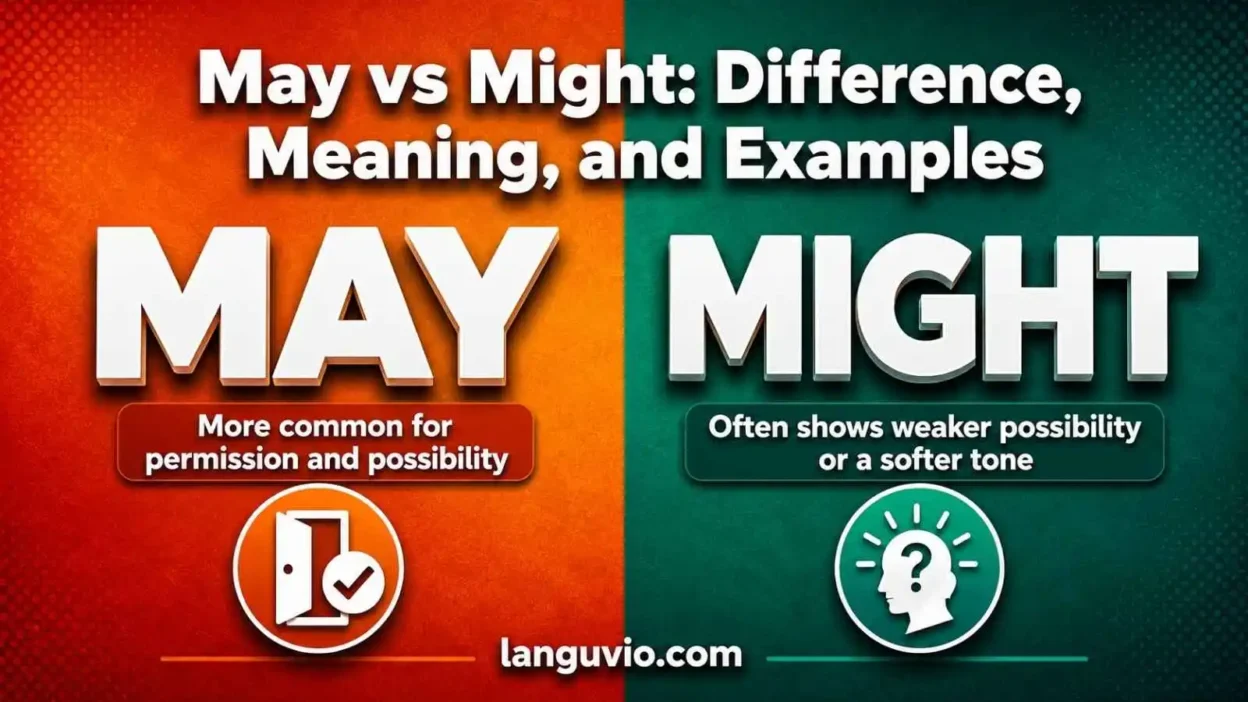
The difference depends on meaning, tone, and context. May often works better for permission and neutral possibility. Might often works better for weaker possibility, uncertainty, or imagined situations. Once you know those patterns, the choice becomes much easier.
Quick Answer
Use may when you mean permission or a possible result that sounds fairly open or neutral. Use might when the possibility feels weaker, less certain, more tentative, or hypothetical. In many possibility sentences, both words are acceptable, but they do not always create the same tone.
Why People Confuse Them
People confuse may and might because both are modal auxiliary verbs. That means they help another verb.
They usually come before the base form of a verb:
• may go
• may be
• might leave
• might work
Both words can point to something possible:
• The store may close early.
• The store might close early.
Those sentences are close. However, may can sound more direct or more likely. Might can sound more uncertain.
The confusion grows because might also developed as the past form of may, but modern English does not follow that pattern in every sentence. That is why a simple “present vs past” rule is not enough.
Key Differences At A Glance
| Context | Best Choice | Why |
| Asking formal permission | may | “May I…” is the standard polite form. |
| Giving permission | may | “You may…” clearly means someone is allowed to do something. |
| General possibility | may or might | Both can work when something is possible. |
| Slightly stronger possibility | may | It can sound more likely or more direct. |
| Weaker or more uncertain possibility | might | It often sounds more tentative. |
| Hypothetical situation | might | It fits imagined or less realistic situations well. |
| Past possibility | may have or might have | Both can work, but “might have” often sounds more tentative or remote. |
| Avoiding “may not” confusion | might not | “May not” can mean “not allowed” or “possibly not.” |
Meaning and Usage Difference
May is used for possibility, permission, polite requests, and wishes.
Examples:
• It may snow tonight.
• May I ask a question?
• You may leave after the test.
• May your new job bring you joy.
In everyday writing, may is especially useful when permission is involved. “May I use your charger?” sounds polite and clear. “You may start now” means someone has permission to begin.
Might is used for possibility, especially when the speaker feels less sure.
Examples:
• It might snow tonight.
• I might stop by after work.
• She might not see the message until morning.
• If I had more time, I might join the class.
In many sentences, might makes the idea feel more uncertain. “I might go” sounds less definite than “I may go.”
For possibility, the difference is often a matter of shade, not a hard grammar wall. For permission, the difference is much clearer: may is the normal choice.
Tone, Context, and Formality
May often sounds more formal, careful, or official.
Examples:
• Employees may request remote work on Fridays.
• Students may use calculators for this section.
• May I speak with the manager?
These sentences sound natural in rules, policies, school notices, workplace writing, and polite requests.
Might often sounds softer or more tentative.
Examples:
• I might work from home Friday.
• We might need more time.
• That might be a better option.
These sentences sound natural in conversation, emails, planning, and cautious suggestions.
Both words are standard in American English. The better choice depends on what you want to say. Use may when the sentence needs permission, official tone, or a more open possibility. Use might when the sentence needs uncertainty, softness, or distance.
Which One Should You Use?
Choose may when you are asking for permission.
Correct:
• May I sit here?
• May we reschedule the meeting?
Choose may when you are giving permission.
Correct:
• You may park in this spot.
• Guests may enter through the side door.
Choose might when the idea feels doubtful or tentative.
Correct:
• I might be late if traffic gets worse.
• The package might arrive tomorrow, but I am not sure.
Choose might for many imagined situations.
Correct:
• If I had a free weekend, I might drive to the beach.
• If the price dropped, we might buy it.
For past possibility, both may have and might have can be correct when you are unsure now about something in the past.
Correct:
• She may have missed the email.
• She might have missed the email.
However, might have often sounds more tentative or more tied to a possible but uncertain past situation.
When One Choice Sounds Wrong
Might can sound wrong when you need clear permission.
Awkward:
• Might I leave early today?
Better in modern American English:
• May I leave early today?
May can confuse readers when it appears in a negative sentence.
Unclear:
• We may not attend the event.
This could mean two things:
• We might not attend the event.
• We are not allowed to attend the event.
Clearer for possibility:
• We might not attend the event.
Clearer for permission:
• We may not attend the event because the policy does not allow it.
May can also sound too formal in casual speech.
Formal:
• You may want to text him first.
More casual:
• You might want to text him first.
Both can be correct, but the second sounds softer and more natural in many everyday conversations.
Common Mistakes (and Quick Fixes)
Mistake 1: Using might for normal permission.
Weak:
• Might I use your phone?
Better:
• May I use your phone?
Mistake 2: Treating may and might as always interchangeable.
Weak:
• You might submit the form by Friday.
Better if giving permission:
• You may submit the form by Friday.
Better if showing uncertainty:
• You might submit the form by Friday, but you have not decided yet.
Mistake 3: Using may not when the meaning is only possibility.
Unclear:
• The bus may not arrive on time.
Clearer:
• The bus might not arrive on time.
Mistake 4: Making the likelihood difference too strict.
Too rigid:
• Always use may for likely events and might for unlikely events.
Better:
• Use may for a more direct or neutral possibility. Use might when you want a more uncertain or tentative tone.
Mistake 5: Forgetting that both words need a base verb.
Wrong:
• She may goes home early.
• He might leaves soon.
Correct:
• She may go home early.
• He might leave soon.
Everyday Examples
Here are natural examples for American English.
• I may take Friday off if my manager approves it.
• I might take Friday off, but I have not decided yet.
• May I borrow your laptop for ten minutes?
• You may bring one guest to the event.
• We might order pizza after the game.
• The meeting may run longer than expected.
• The meeting might run longer, so keep your afternoon open.
• She may have sent the file already.
• She might have sent it to the wrong address.
• We may not enter that room without a badge.
• We might not enter the building until the rain slows down.
Extra comparison:
| Feature | may | might |
| Main use | Permission or possibility | Uncertain possibility |
| Tone | More formal or direct | Softer or more tentative |
| Permission | Natural | Usually not natural in modern US use |
| Negative form | Can mean “not allowed” or “possibly not” | Usually means “possibly not” |
| Best example | May I come in? | I might come later. |
Dictionary-Style Word Details
Verb
• may: Commonly used as a modal auxiliary verb. It helps another verb show permission, possibility, polite request, or wish.
Example: You may begin now.
• might: Commonly used as a modal auxiliary verb. It helps another verb show possibility, uncertainty, or a hypothetical idea.
Example: We might leave after lunch.
Neither word takes -s, -ed, or -ing in normal modal use.
Correct:
• She may call.
• He might call.
Incorrect:
• She mays call.
• He mights call.
Noun
• may: Lowercase may is rarely used as a noun in standard everyday English. It can refer to hawthorn or its blossoms in older or literary use. Capitalized May is the name of a month, but that is a different use from the modal verb may.
• might: Might is also a noun meaning strength, power, or force.
Example: The team fought with all its might.
This noun use does not mean the same thing as the modal verb might.
Synonyms
• may: Closest plain alternatives include can, is allowed to, is permitted to, could possibly, and perhaps will. These are not always exact matches. For permission, is allowed to is closest. For possibility, could possibly is closer.
• might: Closest plain alternatives include could, could possibly, may possibly, and perhaps will. These are not exact matches in every sentence because might often carries a softer or more uncertain tone.
Clear antonyms do not fit neatly for either word because both are modal verbs. For permission, the opposite of may can be may not, cannot, or is not allowed to, depending on the sentence.
Example Sentences
Examples of May and Might
Use may when something is possible or when you want to ask or give permission politely.
May I ask one quick question?
You may use the conference room after 2 p.m.
The new policy may affect part-time workers.
A larger table may be needed for the meeting.
Use might when something is possible but less certain, hypothetical, or dependent on the situation.
I might join you after work.
That might be the best answer.
She might have left her keys in the car.
Dinner may run late because we might not finish before then.
Word History
• may: The word comes from older English forms connected with ability, power, permission, and possibility. In modern use, it mainly works as a modal verb for permission and possibility.
• might: Might developed as a past form related to may, but modern usage is broader. Today it often works as its own modal for uncertainty, weaker possibility, and hypothetical meaning. It also has a separate noun use meaning strength or power.
For everyday writing, the history matters less than the sentence meaning.
Phrases Containing
Common Phrases With May
May be means something is possible.
She may be at home now.
May have refers to a possible past action or situation.
He may have left his phone in the car.
May not means something is possibly not true or not allowed.
You may not enter without permission.
May well suggests that something is very possible or likely.
This decision may well change the final result.
May I…? is a polite way to ask permission.
May I ask a question?
You may gives permission in a formal or polite way.
You may begin the test now.
As the case may be means “depending on the situation.”
The rule applies to students, teachers, or parents, as the case may be.
Common Phrases With Might
Might be means something is possible, but not certain.
The package might be in the mailbox.
Might have refers to a possible past event.
She might have misunderstood the message.
Might not means something possibly will not happen or is not true.
They might not arrive before dinner.
Might well suggests a strong possibility.
That idea might well solve the problem.
Might as well means there is no strong reason not to do something.
We might as well leave early.
Try as one might means even with effort, success may not happen.
Try as one might, some mistakes are hard to avoid.
With all one’s might means using all of one’s strength or effort.
He pulled the rope with all his might.
Be careful with may be and maybe. May be is a verb phrase. Maybe is one word and means “perhaps.”
Example:
• She may be home.
• Maybe she is home.
FAQs
Is may or might more correct?
Both may and might are correct, but they are not always used the same way. Use may when you mean permission or a possible result that sounds more direct. Use might when the idea feels less certain, more tentative, or hypothetical. For example, “You may leave early” gives permission, while “I might leave early” means the speaker is not sure yet.
What is the main difference between may and might?
The main difference is tone and meaning. May often shows permission or a stronger possibility. Might usually shows a weaker or less certain possibility. “It may rain today” sounds like rain is a real possibility. “It might rain today” sounds a little more doubtful.
Can may and might be used interchangeably?
Sometimes, yes. In sentences about possibility, both can often work. For example, “She may call later” and “She might call later” are both correct. However, the tone changes. May sounds more open or direct. Might sounds less certain. They are not interchangeable when the sentence is about permission.
Is “may I” better than “might I”?
Yes, in modern American English, may I is the better choice for asking permission. Say, “May I use your phone?” or “May I ask a question?” The phrase might I can sound old-fashioned, overly formal, or unnatural in everyday speech.
Should I use may have or might have?
Use may have or might have when you are unsure about something in the past. Both can be correct. “She may have missed the email” sounds like a neutral possibility. “She might have missed the email” sounds slightly more uncertain. In most everyday writing, either one can work if the meaning is past possibility.
Conclusion
The simplest way to remember may vs might is this: use may for permission and for a possible result that sounds more direct, formal, or open. Use might for a weaker, softer, more uncertain, or hypothetical possibility.
In many possibility sentences, both words can work. Still, the tone changes. May sounds more definite. Might sounds less sure. For permission, choose may.
Both may and might are correct, but they are not always used the same way. Use may when you mean permission or a possible result that sounds more direct. Use might when the idea feels less certain, more tentative, or hypothetical. For example, “You may leave early” gives permission, while “I might leave early” means the speaker is not sure yet.
The main difference is tone and meaning. May often shows permission or a stronger possibility. Might usually shows a weaker or less certain possibility. “It may rain today” sounds like rain is a real possibility. “It might rain today” sounds a little more doubtful.
Sometimes, yes. In sentences about possibility, both can often work. For example, “She may call later” and “She might call later” are both correct. However, the tone changes. May sounds more open or direct. Might sounds less certain. They are not interchangeable when the sentence is about permission.
Yes, in modern American English, may I is the better choice for asking permission. Say, “May I use your phone?” or “May I ask a question?” The phrase might I can sound old-fashioned, overly formal, or unnatural in everyday speech.
Use may have or might have when you are unsure about something in the past. Both can be correct. “She may have missed the email” sounds like a neutral possibility. “She might have missed the email” sounds slightly more uncertain. In most everyday writing, either one can work if the meaning is past possibility.