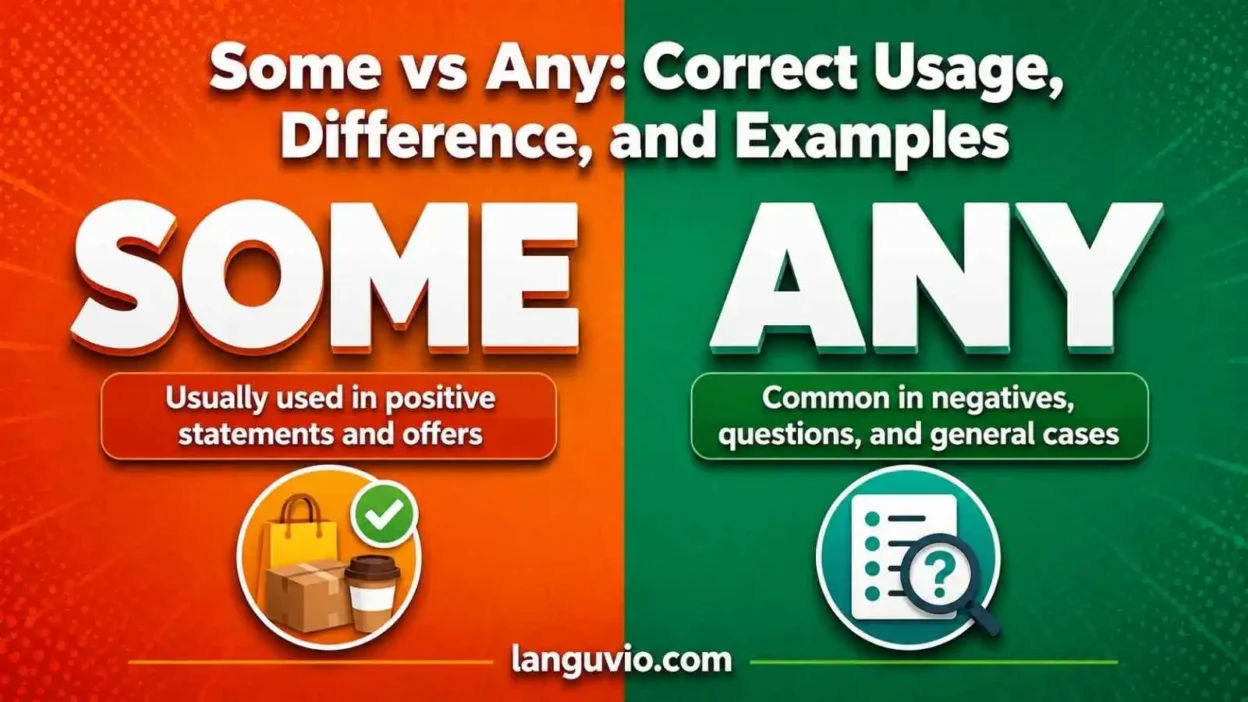
Some and any are both correct English words, but they do not fit the same sentence patterns. The basic choice is simple: use some when you mean an unspecified amount in a positive, expected, or offered way. Use any when the sentence is negative, open-ended, conditional, or asking whether something exists.
The tricky part is that both words can appear in questions. For example, “Do you have any questions?” sounds neutral. “Do you have some questions?” suggests the speaker expects the answer to be yes. That small shift changes the tone.
Quick Answer
Use some in positive statements, offers, requests, and questions where you expect a yes answer. Use any in negative statements, most neutral questions, conditionals, and sentences where the choice does not matter. “I need some help” is positive. “I don’t need any help” is negative. “Any option is fine” means no specific option matters.
Why People Confuse Them
People confuse some and any because both can refer to an unknown amount. They can also both work before plural nouns and uncountable nouns.
You can say:
I bought some snacks.
Did you buy any snacks?
Both sentences talk about snacks, but the structure changes. The first sentence says the snacks exist. The second asks whether they exist.
Questions create the most confusion. Many learners hear that any belongs in questions, but that is not always true. In offers and requests, some often sounds more natural.
Would you like some coffee?
Can I get some water?
These are questions, but they are not neutral information checks. They are polite offers or requests.
Key Differences At A Glance
| Context | Best Choice | Why |
| Positive statement | some | It points to an unspecified amount that exists. |
| Negative statement | any | It points to zero amount or no examples. |
| Neutral question | any | It asks whether something exists. |
| Offer | some | It sounds natural when offering something expected or available. |
| Request | some | It sounds polite when asking for an amount. |
| Conditional sentence | any | It keeps the idea open or uncertain. |
| Free-choice meaning | any | It means no specific one matters. |
Meaning and Usage Difference
Some means an unspecified amount, number, part, or member. It often suggests that the amount exists, even if the exact amount is not named.
I have some emails to answer.
She bought some fruit after work.
We need some time to review the file.
Any also refers to an unspecified amount, number, part, or member, but it often appears when the speaker is unsure, denying something, or leaving the choice open.
Do you have any emails to answer?
She didn’t buy any fruit.
We can meet any time after 3.
The main difference is not only positive versus negative. The deeper difference is how the speaker views the thing. Some often feels more definite or expected. Any often feels more open, uncertain, negative, or unrestricted.
A helpful pattern:
Some = an unspecified amount that exists, is expected, or is being offered.
Any = an unspecified amount in a negative, question, condition, or free-choice situation.
Both words commonly work with plural countable nouns and uncountable nouns.
Plural countable: some books, any books
Uncountable: some water, any water
They can also stand alone as pronouns.
I saved some for later.
I didn’t save any.
Pronunciation does not need much attention here. Both words are short and common. In normal speech, some often sounds lighter in unstressed use, while any keeps a clear short vowel sound. The choice is mainly about grammar and meaning, not pronunciation.
Tone, Context, and Formality
Some usually sounds warmer or more inviting in offers and requests.
Would you like some tea?
Can I have some help with this form?
Any sounds more neutral when you are checking whether something exists.
Do you have any tea?
Do you have any updates?
In negative sentences, any is the normal choice.
We don’t have any openings today.
I haven’t received any messages.
Some can appear in negative sentences, but the meaning changes. It usually means “some but not others.”
I don’t like some of these designs.
That means there are specific designs I do not like. It does not mean I dislike all of them.
I don’t like any of these designs.
That means I dislike all the designs in the set.
Any can also be positive when it means “whichever one” or “it does not matter which.”
Choose any seat.
Any employee can submit a request.
You can call me any day this week.
That use is not negative. It is free-choice.
Which One Should You Use?
Use some when you are making a positive statement.
Correct: I found some notes from the meeting.
Wrong: I found any notes from the meeting.
Use any when you are making a negative statement.
Correct: I didn’t find any notes from the meeting.
Wrong: I didn’t find some notes from the meeting.
Use any for a neutral question.
Correct: Do you have any notes from the meeting?
Less natural: Do you have some notes from the meeting?
Use some when the question is an offer, request, or expected yes.
Correct Examples With Some
Would you like some notes from the meeting?
Can I borrow some notes from the meeting?
You have some notes from the meeting, right?
Use any when the sentence has if, whether, hardly, never, without, or a similar negative or uncertain idea.
Let me know if you have any questions.
She asked whether we had any concerns.
He left without any explanation.
There is hardly any space left.
Use any when the choice is open.
Any folder is fine.
Pick any date that works for you.
When One Choice Sounds Wrong
Some sounds wrong when the sentence clearly denies the existence of something.
Wrong: I don’t have some cash.
Correct: I don’t have any cash.
Any sounds wrong in a simple positive statement when you mean a real amount that exists.
Wrong: I bought any groceries.
Correct: I bought some groceries.
Some can sound odd in neutral information questions.
Less natural: Are there some seats left?
Natural: Are there any seats left?
However, some sounds natural when the speaker expects the answer to be yes.
Natural: There are some seats left, right?
Any can sound cold or purely informational in offers.
Less natural: Would you like any coffee?
Natural: Would you like some coffee?
The first version is not always impossible, but it is not the usual friendly offer. The second sounds smoother in everyday US English.
Common Mistakes (and Quick Fixes)
Mistake: Using some after a negative verb
Wrong: I don’t need some help.
Correct: I don’t need any help.
Mistake: Using any in a normal positive statement
Wrong: She brought any cookies.
Correct: She brought some cookies.
Mistake: Treating all questions the same
Wrong: Would you like any chips?
Better: Would you like some chips?
Mistake: Missing free-choice any
Wrong: You can choose some color you like.
Correct: You can choose any color you like.
Mistake: Using some when you mean “not one”
Wrong: We didn’t get some replies.
Correct: We didn’t get any replies.
Mistake: Using any when you mean a known limited amount
Wrong: I saved any money this month.
Correct: I saved some money this month.
Everyday Examples
I have some time before lunch.
Do you have any time before lunch?
I don’t have any time before lunch.
She ordered some coffee for the team.
Did she order any coffee for the team?
She didn’t order any coffee for the team.
Can I ask some questions before we start?
Do you have any questions before we start?
Let me know if you have any questions later.
Would you like some help carrying that?
I can help with any task on the list.
I don’t need any help right now.
There are some good restaurants near the office.
Are there any good restaurants near the office?
Any restaurant with outdoor seating works for me.
We received some feedback from customers.
We haven’t received any feedback yet.
If you receive any feedback, forward it to me.
Small comparison block:
• Some: points to an amount, number, or part that exists, is expected, or is being offered.
• Any: points to an amount, number, or choice in a negative, question, condition, or free-choice situation.
• Some in a question: often sounds like an offer, request, or expected yes.
• Any in a positive sentence: often means “whichever one” or “no matter which.”
Dictionary-Style Word Details
Verb
Some: Not commonly used as a verb in standard US English. Use it mainly as a determiner, pronoun, or adverb.
Any: Not commonly used as a verb in standard US English. Use it mainly as a determiner, pronoun, or adverb.
Noun
Some: Not commonly used as a regular noun. It can stand alone as a pronoun, as in “I saved some.”
Any: Not commonly used as a regular noun. It can stand alone as a pronoun, as in “I didn’t save any.”
Synonyms
Some: Closest plain alternatives include a few, several, a little, a certain amount, part of, and an unspecified number. The best choice depends on the noun. “A few” works with plural countable nouns. “A little” works with uncountable nouns.
Any: Closest plain alternatives include one, one or more, whichever, whatever, at all, and no matter which. In negative sentences, any often helps express none or not one.
Clear antonyms do not always fit because both words are grammar words as much as meaning words. In many sentences, the opposite depends on the full idea, not only on some or any.
Example Sentences
Examples With Some
I bought some apples for the kids.
We need some time to finish the report.
Would you like some coffee?
Some of the files are missing.
Examples With Any
I didn’t buy any apples today.
Do you have any time this afternoon?
If you see any errors, mark them.
You can take any chair in the room.
Word History
Some: The word has been part of English for a long time and is connected with older forms meaning an unspecified one, part, or amount. For a practical usage guide, the exact history matters less than the modern sentence pattern.
Any: The word also comes from older English forms connected with “one” and indefinite choice. In modern use, it often signals an open, negative, conditional, or unrestricted idea.
Phrases Containing
Some: some of, some time, for some reason, to some extent, some kind of, some people, some day, some amount of.
Any: any of, any time, in any case, at any rate, any day now, any longer, any more, without any, if any, any number of.
FAQs
Is it correct to use some or any in questions?
Both can be correct in questions, but they do not always mean the same thing. Use any for neutral questions when you are simply checking whether something exists: “Do you have any questions?” Use some when making an offer, request, or expected-yes question: “Would you like some coffee?”
What is the main difference between some and any?
Some means an amount exists or is offered. Any is mostly used in negatives, questions, and open choices.
Example:
“I have some time.”
“I don’t have any time.”
Can any be used in a positive sentence?
Yes. Any can be positive when it means “whichever one.”
Example: Choose any seat.
This means every seat is okay.
But I bought any snacks sounds wrong. Use some:
I bought some snacks.
Why do we say “Would you like some coffee?”
Use some in offers because it sounds friendly.
Example: “Would you like some coffee?”
Use any only when checking availability or possibility.
Do some and any work with countable and uncountable nouns?
Yes. Both words can work with plural countable nouns and uncountable nouns. You can say “some books,” “any books,” “some water,” and “any water.” The noun type matters, but the sentence pattern matters more.
Is “I don’t have some money” correct?
It is usually not correct if you mean you have no money. Say, “I don’t have any money.” The phrase “not some” can work only in special contrast, such as “I don’t like some of these ideas,” meaning certain ideas are the problem.
Conclusion
Some and any are both standard, useful words, but they guide the sentence in different ways. Use some when the amount exists, is expected, or is part of an offer or request. Use any in negatives, neutral questions, conditionals, and open-choice sentences.
The safest rule is this: “I have some,” “I don’t have any,” and “Do you have any?” Then remember the important exception: offers and requests usually sound better with some. That is why “Would you like some coffee?” sounds natural, polite, and clear.
Both can be correct in questions, but they do not always mean the same thing. Use any for neutral questions when you are simply checking whether something exists: “Do you have any questions?” Use some when making an offer, request, or expected-yes question: “Would you like some coffee?”
Some means an amount exists or is offered. Any is mostly used in negatives, questions, and open choices.
Example:
“I have some time.”
“I don’t have any time.”
Yes. Any can be positive when it means “whichever one.”
Example: Choose any seat.
This means every seat is okay.
But I bought any snacks sounds wrong. Use some:
I bought some snacks.
Use some in offers because it sounds friendly.
Example: “Would you like some coffee?”
Use any only when checking availability or possibility.
Yes. Both words can work with plural countable nouns and uncountable nouns. You can say “some books,” “any books,” “some water,” and “any water.” The noun type matters, but the sentence pattern matters more.
It is usually not correct if you mean you have no money. Say, “I don’t have any money.” The phrase “not some” can work only in special contrast, such as “I don’t like some of these ideas,” meaning certain ideas are the problem.