
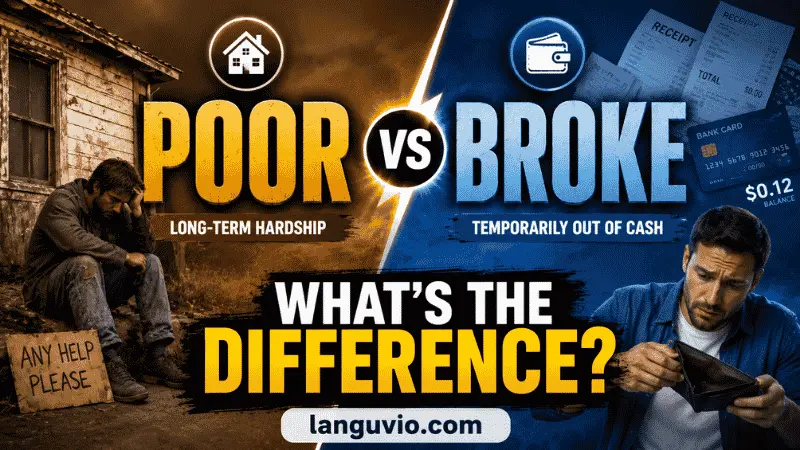
Poor and broke can both describe financial difficulty, but they do not always communicate the same idea.
In everyday American English, poor usually describes a broader lack of money or material resources. Broke is more informal and often describes having little or no money available at the moment.
That does not create an absolute temporary-versus-permanent rule. A person can remain broke for a long time, and someone who is poor can improve their financial position.
The main differences involve scope, tone, and context.
Quick Answer
Use poor when you mean that someone has very limited money or resources as a broader financial condition.
Use broke when you mean someone has little or no money available, especially in casual conversation.
For example:
- “His family was poor when he was growing up” describes wider financial hardship.
- “I’m broke until Friday” focuses on money available right now.
Broke often sounds temporary or situational, but that implication is not a strict rule.
Why People Confuse Them
The confusion is understandable because both words can describe someone who does not have enough money.
If a person says, “I’m poor,” and another says, “I’m broke,” both may be communicating financial difficulty.
The difference appears in what each word usually emphasizes.
Poor can describe an overall economic condition. It works naturally with people, families, households, neighborhoods, and countries.
Broke usually focuses more directly on the absence of available money.
Because these meanings overlap, either word can sometimes fit. The choice changes the tone and the picture the listener receives.
Key Differences At A Glance
- Poor: broader financial hardship; neutral in register; commonly describes people, families, communities, and economic conditions.
- Broke: little or no available money; informal; especially natural for a person’s immediate financial situation.
- Poor: can suggest a continuing condition, although it does not mean permanent.
- Broke: often suggests a current or temporary shortage, although it can last much longer.
- Poor: has several nonfinancial meanings, such as low quality.
- Broke: is also the past tense of break, but that meaning is separate from the financial adjective.
Meaning and Usage Difference
In the financial sense, poor means having little money, few possessions, or insufficient resources.
Someone might say:
“Maria grew up in a poor family.”
The sentence describes the family’s general economic circumstances rather than the amount of cash available on one particular day.
Broke means having little or no money available. In American conversation, it often relates to current spending ability.
For example:
“I paid rent this morning, so I’m broke until payday.”
The speaker may have a job and stable housing but little money available for additional spending.
This is why broke often feels more situational. Still, it does not automatically mean that the financial problem will end soon.
Tone, Context, and Formality
Poor is the more neutral choice. It appears comfortably in everyday conversation as well as serious discussions of financial hardship.
“Many poor families struggle with high housing costs” sounds natural in formal or neutral writing.
Broke is informal.
“I can’t come to dinner. I’m broke” sounds completely natural among friends.
The tone also differs emotionally. Saying someone is poor may sound more serious because it can describe their broader economic circumstances. Calling yourself broke can sound lighter when you simply mean you cannot afford something right now.
Context matters more than a rigid rule.
Which One Should You Use?
Choose the word that matches the financial situation you actually want to describe.
| Context | Best Choice | Why |
| No spending money until payday | Broke | Focuses on money available now |
| Long-term family financial hardship | Poor | Describes broader circumstances |
| Casual conversation with friends | Broke | Natural informal wording |
| Neutral discussion of economic hardship | Poor | Broader and less conversational |
| Someone currently has no ready money | Broke | Directly emphasizes available money |
| Describing a low-income community | Poor | Works naturally for wider conditions |
Neither word is automatically “better.” The more accurate choice depends on scope and tone.
When One Choice Sounds Wrong
Using broke for a broad social or economic condition can sound awkward.
“The government introduced assistance for broke communities” is much less natural than “poor communities.”
Likewise, poor may sound unnecessarily broad when the problem is simply a short-term lack of spending money.
After buying concert tickets, someone might jokingly say:
“I’m broke now.”
“I’m poor now” is possible, but it can sound as though the speaker is describing a more serious financial condition than intended.
Another mistake comes from the verb broke.
In “I broke my phone,” broke is the past tense of break. It has nothing to do with money.
Common Mistakes (and Quick Fixes)
A common mistake is treating the difference as an absolute formula.
Too rigid: Broke always means temporary, while poor always means permanent.
Better: Broke often describes a current shortage of money, while poor usually describes broader financial hardship.
Another mistake is assuming poor refers to attitude or personality. In this comparison, it describes financial circumstances, not a person’s mindset.
Writers should also avoid assuming broke means legal bankruptcy. A person can casually say “I’m broke” without being legally bankrupt.
Finally, remember the register difference. Broke may sound natural in conversation but too casual for some professional contexts.
Everyday Examples
“I can’t order takeout tonight because I’m broke.”
“She grew up poor but later became financially comfortable.”
“After paying tuition and rent, Jake was broke for the rest of the week.”
“The program provides meals to children from poor households.”
“I have a good salary, but after that unexpected repair, I’m completely broke this month.”
“They lived in a poor neighborhood when they first moved to the city.”
“I’d love to join the trip, but I’m broke right now.”
These examples show why context matters. Broke often focuses on immediate spending ability, while poor more naturally describes broader circumstances.
Dictionary-Style Word Details
Verb
- Poor: Not commonly used as a verb in standard US English.
- Broke: Broke is the standard past tense of break, as in “She broke the glass.” That verb use is separate from the financial adjective. In “They went broke,” broke describes the resulting financial state.
Noun
- Poor: It can appear collectively in the poor, meaning people who are poor. In modern writing, wording such as “poor people” or “poor households” may provide clearer context.
- Broke: Not commonly used as a noun for a person’s financial condition. The money meaning discussed here is an adjective.
Synonyms
- Poor: Closest financial alternatives include impoverished, needy, and financially disadvantaged, depending on context. A clear opposite is rich or wealthy.
- Broke: Closest alternatives include penniless, short of money, and strapped for cash. Flush can serve as an informal opposite in some contexts.
The alternatives are not perfect replacements in every sentence because their tone and strength vary.
Example Sentences
- Poor: “The family remained poor despite working several jobs.”
- Poor: “She spent much of her childhood in a poor neighborhood.”
- Broke: “I’m broke until my paycheck arrives.”
- Broke: “After paying the unexpected bill, he was nearly broke.”
Word History
- Poor: The word came into Middle English through Anglo-French and ultimately traces to Latin pauper, referring to someone with little wealth.
- Broke: The adjective developed from an older form related to broken. The financial sense became established as a way of describing someone without money.
The two words therefore did not begin as a specially designed pair. Their meanings simply overlap in modern financial language.
Phrases Containing
- Poor: poor family, poor household, poor neighborhood, the poor
- Broke: flat broke, go broke, stone broke, broke until payday
Flat broke strengthens the idea and means having no money at all.
FAQs
Both can be correct, but they frame the situation differently. Use broke when you mean you have little or no money available now, especially in casual speech. Use poor when you mean ongoing financial hardship or very limited money and possessions.
Yes. A person can be broke at the moment but still have a steady income, housing, savings they do not want to touch, or money arriving soon. In everyday speech, broke often describes current cash availability rather than a person’s overall economic position.
Sometimes, but not in every sentence. They overlap when describing lack of money, yet poor has a broader and often more serious meaning. Broke is informal and commonly situational, so replacing poor with broke can change the tone or scope.
Usually, yes, when the writing needs a neutral or formal tone. Broke works naturally in conversation, personal writing, and quoted speech. In reports or formal communication, poor or a more precise description of the financial situation will usually sound more appropriate.
“I’m broke” usually sounds like a statement about money available at the moment. “I’m poor” can sound broader, describing a continuing financial condition or social reality. Because poor carries more weight, speakers often choose broke for ordinary short-term money problems.
No. That is a useful tendency, not an absolute rule. Someone may remain broke for a long time, and poor does not mean a condition can never change. The safer distinction is current money shortage versus broader financial hardship.
Conclusion
The difference between poor vs broke is mainly one of scope, register, and usual context.
Poor generally describes wider financial hardship or limited money and resources. Broke is an informal way to say that someone currently has little or no money available.
The common shortcut that “broke is temporary and poor is permanent” goes too far. Broke often sounds temporary, but it does not have to be. Poor often describes a longer-term condition, but it does not imply that the situation can never change.
For everyday conversation about an empty wallet or no spending money, broke usually sounds natural. For broader financial circumstances, poor is usually the clearer choice.