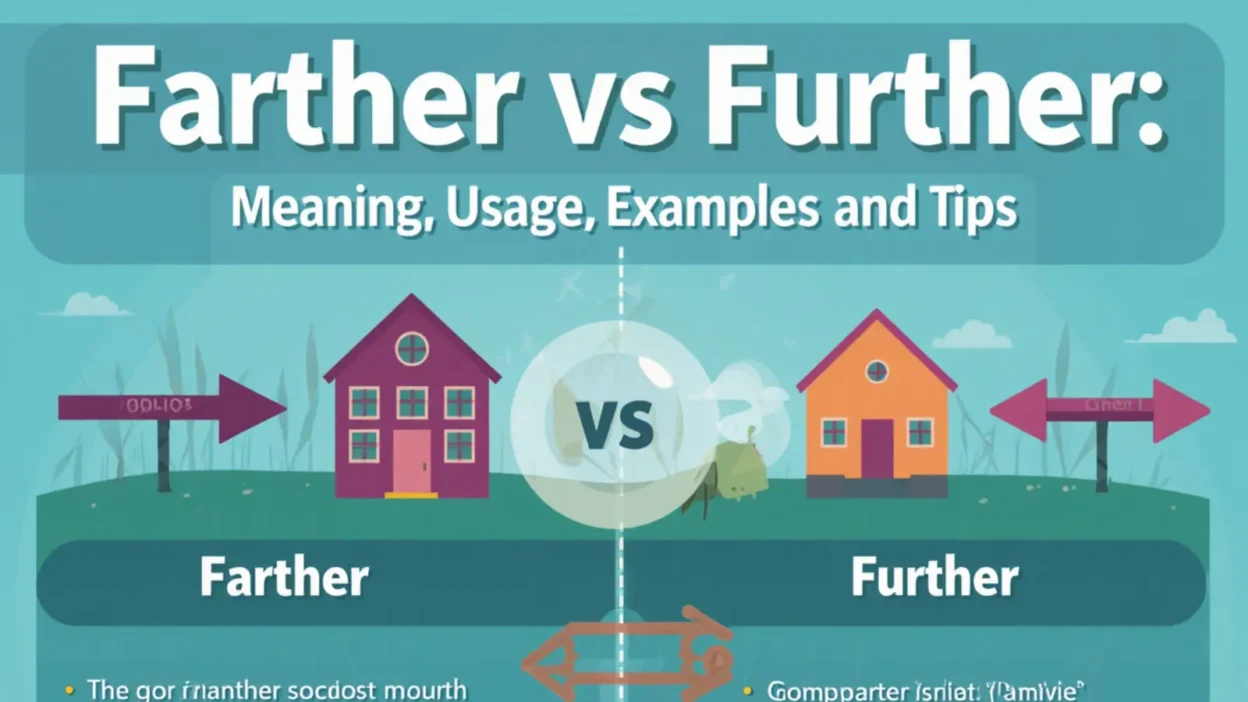
Farther and further are easy to mix up because they look similar, sound similar, and both connect to the idea of “more distance” in some way. You might see one person write, “The store is farther away,” while another writes, “Let’s discuss this further.” Both sentences can be correct, but the words are not always interchangeable.
The easiest way to understand the difference is this: farther usually points to physical distance, while further usually points to additional amount, degree, progress, or discussion.
Still, the difference is not as strict as many people think. In real English, further can also refer to distance, especially when the distance is not being measured exactly. That is why this guide explains both the simple rule and the real usage behind it.
2. Quick Answer
Use farther when you are talking about physical distance.
Examples:
- The gas station is farther down the road.
- She ran farther than I did.
- Their house is farther from school than ours.
Use further when you mean more, additional, extra, continued, or to a greater degree.
Examples:
- Please send further information.
- We need to discuss this further.
- The donation helped further the project.
A simple memory tip:
Farther often fits when you can ask, “How many miles?”
Further often fits when you mean “more” or “additional.”
3. Why People Confuse Them
People confuse farther and further because both words come from the same general idea: something going beyond a current point.
They also overlap in some distance-related sentences. For example, many speakers would accept both of these:
- The cabin is farther into the woods.
- The cabin is further into the woods.
In careful writing, farther is often preferred when the meaning is clearly physical distance. But further is also widely used for distance, especially when the distance feels general or figurative.
The bigger problem happens when someone uses farther where only further sounds natural.
For example:
- Incorrect: Please send farther details.
- Correct: Please send further details.
“Details” are not physically farther away. The meaning is “additional details,” so further is the right choice.
4. Key Differences At A Glance
| Use | Farther | Further |
|---|---|---|
| Physical distance | Yes | Sometimes |
| Measurable distance | Best choice | Often acceptable, but less precise |
| Additional information | No | Yes |
| More discussion | No | Yes |
| Abstract progress | Rare or awkward | Yes |
| Verb meaning “advance” | No | Yes |
Farther usually works best when the sentence is about actual distance:
- The second hotel is farther from the beach.
- Drive two miles farther and turn left.
Further works best when the sentence is about more action, more information, or greater progress:
- We need further proof.
- Let’s take this idea further.
- The program helped further her education.
5. Meaning and Usage Difference
Farther means “more far” in a physical sense. It usually describes distance you could measure, walk, drive, or compare.
Examples:
- The library is farther than the post office.
- He threw the ball farther this time.
- We walked farther than planned.
Further can also mean “more far,” but it has broader uses. It often means more, additional, continued, or to a greater extent.
Examples:
- We need further instructions.
- I have no further questions.
- The team will investigate further.
- This course will further your understanding.
The most important difference is that further has uses that farther does not. You can say further information, but not farther information. You can say further the cause, but not farther the cause.
For physical distance, the choice can sometimes overlap. But when the meaning is “additional” or “advance,” choose further.
6. Tone, Context, and Formality
Both words are standard in modern English, but they often feel different in context.
Farther can sound more exact when you are talking about physical distance. It fits naturally in travel, directions, sports, and location-based writing.
Examples:
- The airport is farther from downtown than the train station.
- She can swim farther than her brother.
- The trail continues farther up the mountain.
Further often sounds natural in professional, academic, and formal writing because it frequently appears with words like information, discussion, research, notice, and review.
Examples:
- Please contact us for further information.
- The matter needs further review.
- The study requires further research.
- No further action is needed.
In everyday speech, many people use further for both physical and abstract distance. That does not automatically make it wrong. However, if you want the cleanest choice in edited writing, use farther for clear physical distance and further for everything else.
7. Which One Should You Use?
Use this quick decision rule:
Choose farther when the sentence is mainly about physical distance.
- We drove farther than expected.
- The new office is farther away.
- The finish line is farther down the road.
Choose further when the sentence means additional, more, continued, or advance.
- Send me further details.
- Let’s discuss the issue further.
- The scholarship helped further his education.
When the sentence is about distance but not exact measurement, either word may sound acceptable.
Examples:
- We need to move farther from the fire.
- We need to move further from the fire.
Both can work, but farther is the safer choice if you want to emphasize actual physical space.
8. When One Choice Sounds Wrong
Some sentences clearly need further, not farther.
Use further with words like information, notice, discussion, research, details, and questions.
Correct:
- Please send further information.
- This requires further research.
- We will discuss it further tomorrow.
- I have no further questions.
Incorrect:
- Please send farther information.
- This requires farther research.
- We will discuss it farther tomorrow.
- I have no farther questions.
Farther also does not work as a verb in normal modern usage.
Correct:
- The program helped further her career.
Incorrect:
- The program helped farther her career.
The word further can mean “to help something progress.” Farther does not carry that meaning.
9. Common Mistakes
One common mistake is using farther whenever the sentence feels connected to “more.” That does not always work.
Mistake:
- We need farther proof.
Fix:
- We need further proof.
Another mistake is assuming further can never refer to physical distance. It can, especially in broad or figurative uses.
Acceptable:
- The village is further north.
- We walked further into the forest.
More precise in many style-conscious contexts:
- The village is farther north.
- We walked farther into the forest.
A third mistake is using farther in fixed phrases where further is expected.
Use these forms:
- until further notice
- further information
- further details
- further discussion
- further research
- no further questions
A helpful fix is to replace the word with additional. If additional makes sense, use further.
- Additional information → further information
- Additional research → further research
- Additional questions → further questions
10. Everyday Examples
Here are simple examples showing how farther and further work in real sentences.
Farther:
- The coffee shop is farther away than I thought.
- Can you throw the ball farther?
- We walked farther down the beach after lunch.
- Her apartment is farther from campus this year.
- The blue car traveled farther on one tank of gas.
- The trail gets steeper the farther you go.
Further:
- Please send further instructions.
- We need to talk further before deciding.
- The teacher gave us further reading for the weekend.
- I have no further comments.
- The new training helped further his career.
- This issue needs further attention.
Either may work in some distance contexts:
- The cabin is farther into the woods.
- The cabin is further into the woods.
For most beginners, the best habit is simple: use farther for distance you can measure and further for more information, more action, or more progress.
11. Dictionary-Style Word Details
Verb
Farther is not commonly used as a verb in modern standard English. You would not normally say, “This plan will farther our goals.”
Further can be a verb. As a verb, it means to help something move forward, develop, or succeed.
Examples:
- The grant helped further the research.
- She took extra classes to further her career.
- The meeting was designed to further cooperation between the teams.
Noun
Neither farther nor further is commonly used as a noun in everyday modern English.
They are usually used as adjectives or adverbs, and further can also be used as a verb.
Examples:
- Adjective: We need further details.
- Adverb: She walked farther than I did.
- Verb: The program will further our mission.
Synonyms
The best synonym depends on the sentence.
For farther, close plain alternatives include:
- more distant
- beyond
- more remote
- at a greater distance
Examples:
- The school is farther away.
- The school is more distant.
For further, close plain alternatives include:
- additional
- more
- extra
- continued
- advance
- promote
Examples:
- We need further details.
- We need additional details.
- The group worked to further the cause.
- The group worked to promote the cause.
Not every synonym works in every sentence. For example, additional works for “further information,” but it does not work well for “walk further.”
Example Sentences
Farther:
- The nearest hospital is farther than the clinic.
- We drove farther west before stopping for gas.
- He stood farther from the stage than we did.
- The second parking lot is farther from the entrance.
Further:
- Please call if you need further help.
- The company made no further comment.
- We should study the results further.
- Her internship helped further her career goals.
Word History
Farther and further have a long shared history, which is one reason their meanings overlap. Over time, many writers and editors began using farther more often for physical distance and further for additional, abstract, or extended meanings.
That modern distinction is useful, but it should not be treated as an absolute rule in every distance sentence. The most practical approach is to learn the common preference: farther for measurable distance and further for additional meaning or progress.
Phrases Containing
Common phrases with farther include:
- farther away
- farther down the road
- farther from home
- farther along the trail
- farther north
- farther from the truth
Common phrases with further include:
- further information
- further details
- further notice
- further research
- further discussion
- further review
- further action
- further your career
- further the cause
Notice that many further phrases are about more information, more action, or continued progress. That is the main clue that further is the better choice.
12. FAQ
Is it “farther away” or “further away”?
Both can be used, but farther away is often the better choice when you mean physical distance.
Example:
- The hotel is farther away than the restaurant.
Is it “further information” or “farther information”?
Use further information. The meaning is “additional information,” not physical distance.
Example:
- Please contact our office for further information.
Can “further” mean physical distance?
Yes. Further can refer to physical distance, especially in general speech or when the distance is not exact.
Example:
- We walked further into the park.
Still, farther is often preferred when the distance is clearly measurable.
Can “farther” be used figuratively?
Sometimes, yes. A phrase like farther from the truth is widely used. However, for most abstract meanings, further is usually the better choice.
Example:
- That claim could not be farther from the truth.
Is “further” more formal than “farther”?
Not exactly. Both words are standard, but further appears often in formal phrases such as further notice, further research, and further information.
Which word should I use in business writing?
Use further for information, details, discussion, review, and action.
Examples:
- Please send further details.
- We will take no further action.
- This needs further review.
Use farther only when the business context involves actual distance.
Is “further” a verb?
Yes. Further can mean to help something develop, grow, or move forward.
Example:
- The workshop helped further her career.
Is “farther” a verb?
No, not in common modern usage. Use further when you need a verb.
Correct:
- The policy may further the company’s goals.
13. Conclusion
The difference between farther and further is simple once you separate physical distance from additional meaning.