Buy and by are both correct words, but they do completely different jobs. The confusion happens because they sound the same in everyday speech.
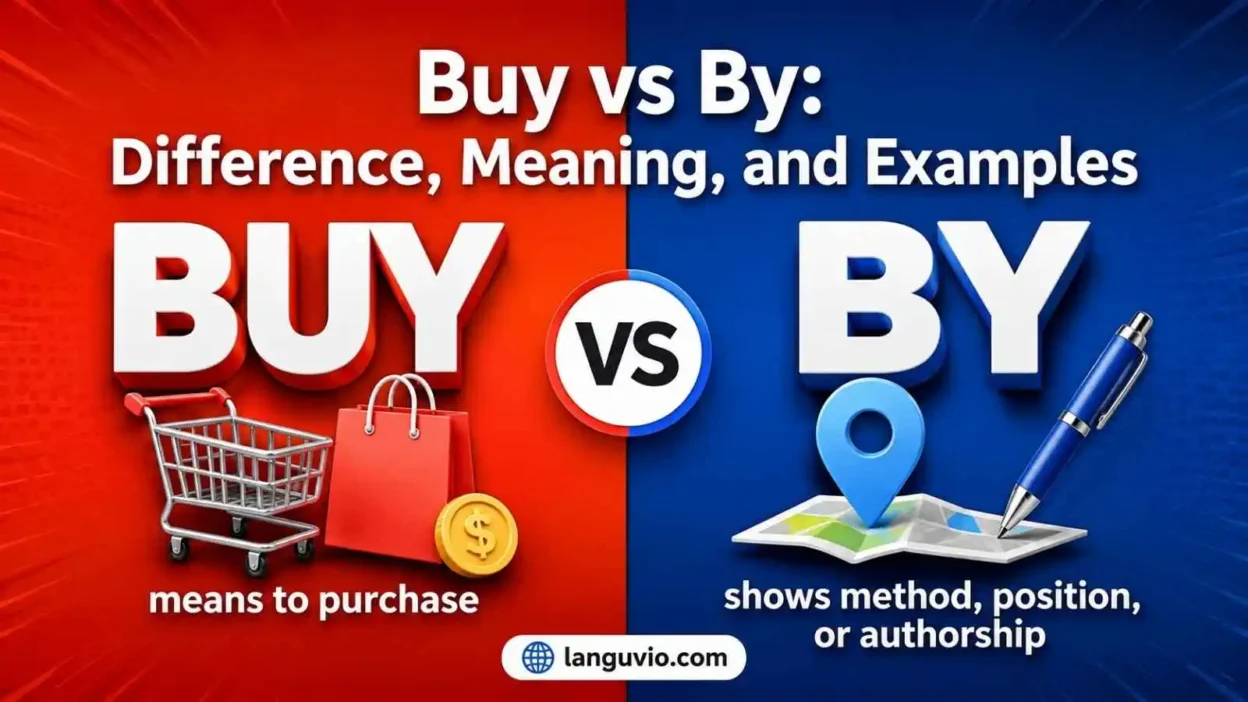
Use buy when you mean to purchase something. Use by when you mean near, beside, through, before a deadline, past something, or done through a method or person.
This is not a style choice. The wrong word can change the meaning of the sentence.
Quick Answer
Buy means to get something by paying for it.
Example:
I need to buy groceries after work.
By usually shows a relationship between words. It can mean near, through, using, past, not later than, or done by someone.
Example:
Please send the report by Friday.
So, the simple rule is this: if money or purchasing is involved, choose buy. In most other sentence connections, choose by.
Why People Confuse Them
People confuse buy and by because they are homophones. That means they sound alike but have different meanings and spellings.
Both words usually rhyme with sky. Because the sound is the same, the mistake often shows up in writing, not speech.
The spelling is also close. Buy has three letters, while by has two. However, that one extra letter makes a big difference.
Wrong: I need to by a new phone.
Correct: I need to buy a new phone.
Wrong: Finish this buy Monday.
Correct: Finish this by Monday.
Key Differences At A Glance
| Context | Best Choice | Why |
|---|---|---|
| Paying for something | buy | It means purchase. |
| Deadline | by | It means no later than. |
| Location | by | It can mean near or beside. |
| Method | by | It shows how something is done. |
| Person who did something | by | It shows the agent. |
| A good deal | buy | As a noun, it can mean a bargain or purchase. |
Meaning and Usage Difference
Buy is mainly a verb. It means to get something by paying money for it.
Examples:
I want to buy a laptop.
She bought coffee for the team.
They are buying tickets online.
Buy can also be a noun. In that use, it means a purchase or a good deal.
Example:
That used bike was a great buy.
By is mainly a preposition. A preposition connects words and shows a relationship. By can show location, method, time, movement, or who did an action.
Examples:
The chair is by the window.
We paid by card.
Please arrive by 8:00.
The song was written by her.
By can also work as an adverb when it means “past.”
Example:
A delivery truck drove by.
Here is the compact comparison:
| Feature | buy | by |
| Main job | Verb | Preposition |
| Main meaning | Purchase | Near, through, before, past, or done through someone/something |
| Common noun use | A purchase or bargain | Rare in everyday US writing |
| Sound | Rhymes with sky | Rhymes with sky |
| Example | I will buy lunch. | I will stop by later. |
Tone, Context, and Formality
Both buy and by are standard in American English. Neither word is more formal than the other by itself.
The difference depends on grammar and meaning, not tone.
In casual writing, you might say:
I’ll buy snacks.
Come by around 6.
In formal writing, you might say:
The company plans to buy new equipment.
Applications must be submitted by March 15.
The words still follow the same rule. Buy points to purchase. By connects ideas such as deadline, method, location, or agent.
Which One Should You Use?
Choose buy when the sentence involves paying, purchasing, or getting something in exchange for money.
Use buy in sentences like:
I need to buy gas.
Did you buy the book?
That couch was a smart buy.
Choose by when the sentence does not mean purchase. It often answers questions like:
Where?
How?
When is the deadline?
Who did it?
Did something move past?
Use by in sentences like:
The keys are by the door.
We traveled by train.
Pay the bill by Friday.
The article was written by Maya.
He walked by without stopping.
When One Choice Sounds Wrong
Buy sounds wrong when the sentence needs a connector.
Wrong: The package should arrive buy noon.
Correct: The package should arrive by noon.
Wrong: The photo was taken buy my sister.
Correct: The photo was taken by my sister.
Wrong: We went buy bus.
Correct: We went by bus.
By sounds wrong when the sentence means purchase.
Wrong: I’m going to by a new backpack.
Correct: I’m going to buy a new backpack.
Wrong: Can you by milk on your way home?
Correct: Can you buy milk on your way home?
Wrong: This was a good by for the price.
Correct: This was a good buy for the price.
Common Mistakes (and Quick Fixes)
A common mistake is using by after “to” when the sentence means purchase.
Wrong: I want to by a car.
Correct: I want to buy a car.
Quick fix: If you can replace the word with purchase, use buy.
Another mistake is using buy for deadlines.
Wrong: Submit the form buy Friday.
Correct: Submit the form by Friday.
Quick fix: If the meaning is “no later than,” use by.
Writers also mix them up in passive sentences.
Wrong: The meal was cooked buy Jordan.
Correct: The meal was cooked by Jordan.
Quick fix: If the word shows who did the action, use by.
Everyday Examples
I need to buy a birthday card before dinner.
The pharmacy is by the grocery store.
Can you buy more paper towels?
Please finish the slides by 3:00.
We paid by credit card.
That jacket was an expensive buy, but it should last.
The movie was directed by a local filmmaker.
I saw your car drive by this morning.
They plan to buy a house next year.
Leave the package by the front door.
Dictionary-Style Word Details
Verb
• buy: Commonly used as a verb. It means to purchase or get something by paying for it.
Example: We need to buy more printer ink.
• by: Not commonly used as a verb in standard US English. In everyday writing, by is usually a preposition or adverb.
Noun
• buy: Can be a noun meaning a purchase, especially a good deal.
Example: At that price, the tablet was a great buy.
• by: Rare as a noun in everyday US English. Most readers expect by to work as a preposition or adverb.
Synonyms
• buy: Closest plain alternatives include purchase, get, acquire, and pick up. The best direct synonym is purchase. A clear opposite is sell.
• by: No single synonym fits every use. Closest plain alternatives depend on context: near, beside, through, via, past, or no later than. A single clear antonym does not work for all uses of by.
Example Sentences
• buy: I’ll buy lunch if you pick up the drinks.
• buy: She does not buy that excuse.
• buy: This refurbished laptop was a solid buy.
• by: The coffee shop is by the bank.
• by: Please reply by tomorrow morning.
• by: The mural was painted by students.
Word History
• buy: The word has long been tied to the idea of getting something through payment or exchange. For modern writers, the important point is its current role as the word for purchasing.
• by: The word has long been tied to relation, nearness, direction, method, and connection. Today, it remains a flexible connector in English.
The history does not make these words interchangeable. They sound alike now, but they carry separate meanings.
Phrases Containing
• buy: buy time, buy into, buy out, buy up, best buy, good buy.
Example: We need to buy time until the repair crew arrives.
• by: by the way, by mistake, by hand, by car, by noon, stop by, stand by.
Example: I sent the note by mistake.
FAQs
No. Buy means to purchase, while by connects ideas showing location, time, method, or agent. Using one for the other changes the meaning.
Not in standard US English. By functions as a preposition or sometimes an adverb, but it’s not used for purchasing.
Yes. Buy as a noun refers to a purchase or a good deal. Example: “This laptop was a smart buy.”
Quick test:
If the sentence involves money or getting something: use buy.
If it shows location, method, time, movement, or agent: use by.
Yes. Both rhyme with “sky.” That’s why spelling errors happen, but context determines the correct choice.
Buy: buy time, buy into, good buy
By: by the way, by hand, by mistake, stop by
Absolutely. Example: “Submit your assignment by Friday” means no later than Friday.
Both buy and by are standard in formal and informal writing. The difference is grammatical, not stylistic.
Conclusion
Buy and by sound the same, but they are not the same word.
Use buy when you mean purchase, get for money, or a purchase itself.
Use by when you mean near, beside, through, using, past, not later than, or done by someone.
A quick test helps: if purchase fits, use buy. If the word connects time, place, method, movement, or a person doing an action, use by.