
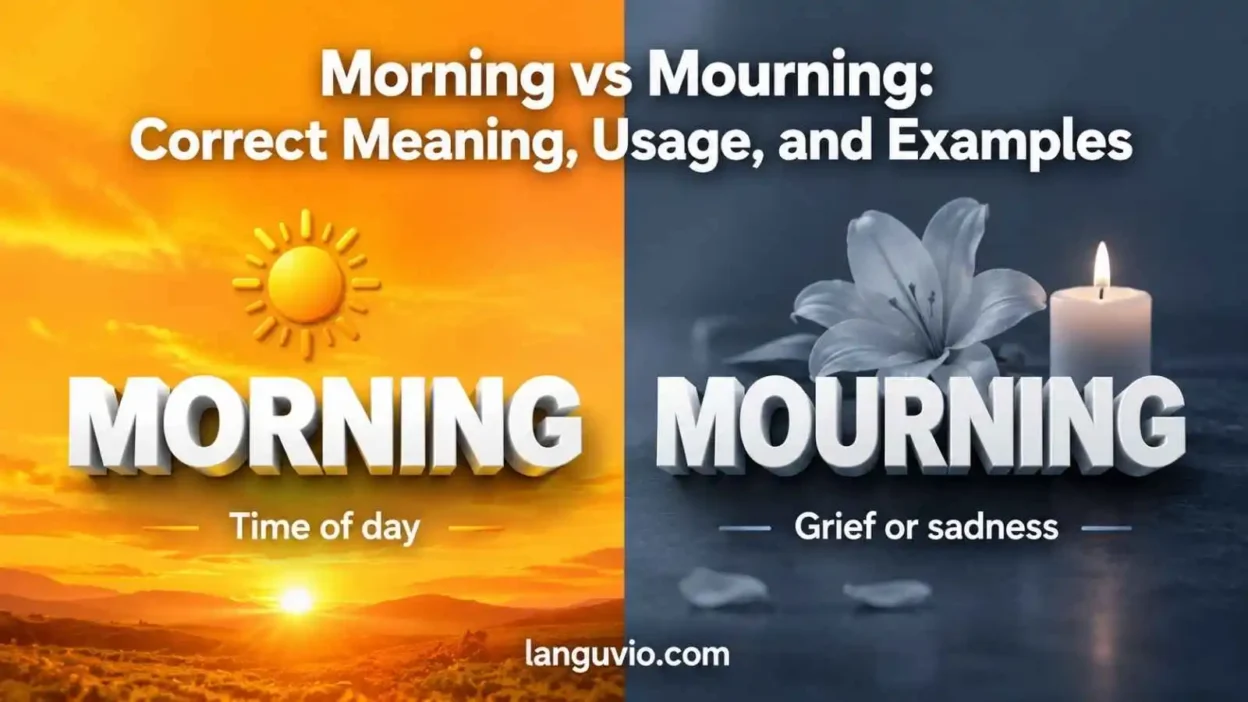
Morning and mourning sound exactly alike, but they mean very different things. One word talks about the early part of the day. The other word talks about grief, sorrow, or sadness after a loss.
This spelling mix-up is common because you cannot hear the difference in normal speech. Someone may say the word clearly, yet the correct spelling still depends on the meaning of the sentence.
The easiest rule is simple: choose morning when you mean time, sunrise, breakfast, school, work, or the start of the day. Choose mourning when you mean grief, loss, funerals, sadness, or the act of grieving.
Quick Answer
Morning means the early part of the day.
Mourning means grief, sorrow, or the act of grieving after a loss.
These words are homophones, so they sound the same in standard American English. However, they are not interchangeable. The spelling changes the meaning completely.
Correct: I have a class tomorrow morning.
Correct: The family is still in mourning.
Why People Confuse Them
The main reason people confuse these words is pronunciation. In everyday speech, morning and mourning sound the same.
Typing quickly can also lead to mistakes. A writer may know the right meaning but still choose the wrong spelling by habit.
Spell-check does not always help because both words are real English words. For example, “I woke up early in the mourning” may not look like a spelling error to some tools, but the sentence is still wrong because it uses a grief word instead of a time word.
Context solves the problem. When the sentence is about the early part of the day, use morning. When the sentence is about sadness or loss, use mourning.
Key Differences At A Glance
Here is the simple difference:
• Morning refers to the early part of the day.
• Mourning refers to grief, sorrow, or grieving.
• The word morning usually works as a noun.
• The word mourning can work as a noun or as the -ing form of the verb mourn.
• Both words sound the same.
• Their meanings are completely different.
• They should not replace each other.
Meaning and Usage Difference
Morning is the part of the day before noon. It often refers to the hours after waking up, sunrise, breakfast, school, work, errands, or early plans.
Examples:
I drink coffee every morning.
Our meeting is scheduled for Monday morning.
She likes walking in the morning before work.
By contrast, mourning refers to grief or the act of showing sadness after a loss. It is often used after someone dies, but it can also describe deep sorrow over another serious loss.
Examples:
The town was in mourning after the tragedy.
He is mourning the death of his grandfather.
Many people wore black as a sign of mourning.
The pronunciation is usually the same: MOR-ning. Because the sound does not help, readers must rely on meaning and spelling.
Tone, Context, and Formality
The word morning is neutral. It fits casual conversations, school essays, work emails, daily plans, news reports, and normal greetings.
Example: I will call you in the morning.
The word mourning has a serious and emotional tone. It belongs in contexts about grief, funerals, memorials, death, tragedy, or public sadness.
Example: The community entered a period of mourning.
These words are not formal and informal versions of each other. They simply mean different things. One points to time, while the other points to sorrow.
Which One Should You Use?
| Context | Best Choice | Why |
| Talking about sunrise, breakfast, or early plans | morning | The sentence is about time of day. |
| Describing sadness after death or loss | mourning | The sentence is about grief. |
| Writing about a class before noon | morning | A time word is needed. |
| Describing black clothes after a loss | mourning | The word refers to signs of grief. |
| Greeting someone early in the day | morning | The phrase is about the start of the day. |
| Describing a sad community after tragedy | mourning | The word shows shared sorrow. |
A quick test can help. Try replacing the word with “early part of the day.” If the sentence still makes sense, use morning.
Now try replacing it with “grieving.” If that meaning fits better, use mourning.
When One Choice Sounds Wrong
A sentence sounds wrong when the spelling does not match the meaning.
Wrong: The family was in morning after the funeral.
Correct: The family was in mourning after the funeral.
Wrong: I drink tea every mourning.
Correct: I drink tea every morning.
Wrong: She has a mourning meeting at 9 a.m.
Correct: She has a morning meeting at 9 a.m.
Wrong: The nation held a day of morning.
Correct: The nation held a day of mourning.
The greeting good morning uses morning because it refers to the early part of the day. The phrase good mourning may appear as a joke or wordplay, but it is not the standard greeting.
Common Mistakes and Quick Fixes
Mistake: See you tomorrow mourning.
Fix: See you tomorrow morning.
Mistake: He works the mourning shift.
Fix: He works the morning shift.
Mistake: The family began a long morning period.
Fix: The family began a long mourning period.
Mistake: I felt fresh this mourning.
Fix: I felt fresh this morning.
Mistake: People gathered for a day of morning.
Fix: People gathered for a day of mourning.
The noun after the word often gives you a clue. Say morning coffee, morning class, and morning traffic when talking about time. Say mourning period, mourning clothes, and mourning ceremony when talking about grief.
Everyday Examples
I woke up early this morning to finish my homework.
Tomorrow morning works better for our meeting.
The morning air felt cool and fresh.
She is not a morning person, so she avoids early calls.
Breakfast tastes better on a quiet morning.
After the accident, the whole neighborhood was in mourning.
He is mourning the loss of his close friend.
The family asked for privacy during their mourning period.
People wore black as a sign of mourning.
A candlelight event gave the community a way to express mourning.
Dictionary-Style Word Details
Verb
• Morning: This word is not commonly used as a verb in standard American English. It is mainly used as a noun or as part of phrases such as morning walk, morning class, or morning light.
• Mourning: This word can be the -ing form of the verb mourn, which means to grieve or feel sorrow.
Example: She is mourning the loss of her father.
In that sentence, mourning shows an ongoing action.
Noun
• Morning: As a noun, this word means the early part of the day.
Example: The morning went by quickly.
• Mourning: As a noun, this word means grief, sorrow, or the outward expression of sadness after a loss.
Example: The city entered a period of mourning.
Both words can be nouns, but they name completely different ideas.
Synonyms
• Morning: Closest plain alternatives include dawn, daybreak, sunrise, and early hours. These words may not fit every sentence because morning can last beyond sunrise.
• Mourning: Closest plain alternatives include grief, sorrow, bereavement, and grieving. These words are related, but they are not always exact replacements.
Opposites depend on context. For morning, possible opposites include evening or night. For mourning, possible opposites include joy or rejoicing, but only when the sentence clearly contrasts sadness with happiness.
Example Sentences
Morning: I have a dentist appointment in the morning.
• The morning light came through the window.
• We always take a short morning walk.
• Mourning: The family remained in mourning for months.
• The country observed a day of mourning.
• After the friendship ended badly, he spent weeks mourning the loss.
Word History
• Morning: In modern use, this word belongs to time-of-day language. It refers to the early part of the day.
• Mourning: This word is connected to mourn, which means to grieve or express sorrow.
The two words sound alike today, but their meanings are separate. Do not think of mourning as a sad version of morning. They are different words with different uses.
Phrases Containing
• Morning: good morning, this morning, tomorrow morning, in the morning, morning person, morning meeting, morning coffee, morning light.
• Mourning: in mourning, day of mourning, national mourning, mourning period, mourning clothes, mourning ceremony, go into mourning, mourning dove.
Note: Mourning dove is a bird name. The phrase contains mourning, but it does not mean the bird is grieving.
FAQs
Use morning when you mean the early part of the day. Use mourning when you mean grief, sorrow, or sadness after a loss. The two words sound the same, but their meanings are completely different.
Yes. In standard American English, morning and mourning are usually pronounced the same: MOR-ning. Because they sound alike, you must choose the correct spelling based on the meaning of the sentence.
Morning means the early part of the day, usually the time after night and before noon. For example, you can say, “I have a meeting tomorrow morning.”
Mourning means grief or the act of grieving after a loss. It is often used after someone dies, but it can also describe deep sadness after another serious loss. Example: “The family is still in mourning.”
No, good mourning is not the standard greeting. The correct phrase is good morning because you are greeting someone during the early part of the day. “Good mourning” may appear as a joke or wordplay, but it is not correct in normal use.
Spell-check may miss the mistake because both morning and mourning are real words. A tool may not flag the spelling, even when the meaning is wrong. You still need to check the sentence context.
Connect morning with time and mourning with grief. If the sentence is about sunrise, breakfast, school, work, or early plans, choose morning. If it is about sadness, death, loss, or grieving, choose mourning.
Here is a clear example: “In the morning, the family gathered in mourning.” The first word refers to time of day, while the second refers to grief.
Conclusion
Morning and mourning are easy to confuse because they sound the same, but their meanings are not close. Use morning for the early part of the day, daily routines, greetings, schedules, and time-based phrases. Use mourning for grief, sorrow, loss, funerals, memorials, and serious sadness. When you are unsure, read the full sentence and ask what it means. If the idea is time, choose morning. If the idea is grief, choose mourning.