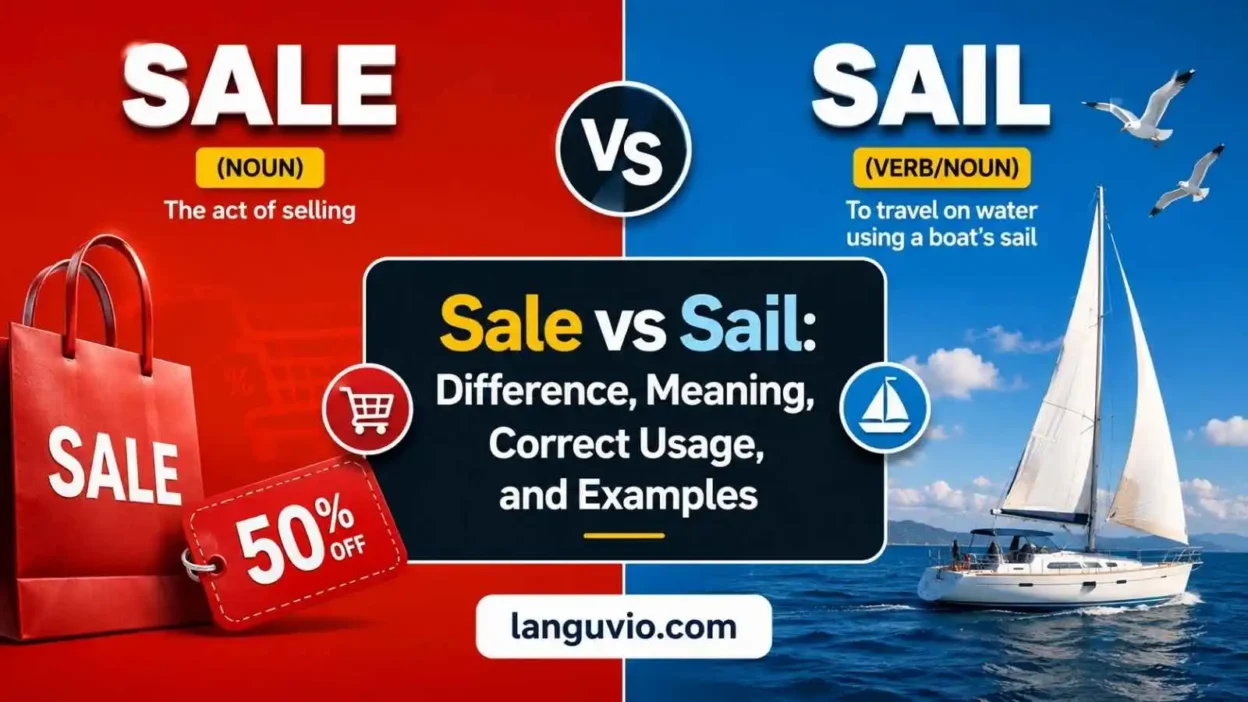
Sale vs sail is a common word-choice problem because the two words sound exactly the same. Their meanings, however, are completely different.
Use sale when you mean selling, buying, a discount, or a business transaction. Use sail when you mean a boat’s fabric part, traveling by boat, or moving smoothly through something.
That means a store can have a sale, but a boat has a sail. You can buy shoes at a sale, but you can sail across a lake.
The spelling matters because the wrong word changes the meaning right away. “The boat is for sale” means someone wants to sell the boat. “The boat is for sail” sounds wrong because sail does not mean “available to buy.”
Quick Answer
Sale is a noun. It means an act of selling, a selling event, a discount event, or something being available to buy.
Examples:
The store is having a weekend sale.
Their house is for sale.
I found this jacket on sale.
Sail can be a noun or a verb. As a noun, it means the cloth or material that catches wind on a boat. As a verb, it means to travel on water or move smoothly.
Examples:
The wind filled the sail.
We plan to sail across the bay.
The ball sailed over the fence.
Both words are pronounced like sayl, rhyming with mail and tail.
Why People Confuse Them
People confuse sale and sail because they are homophones. That means they have the same sound but different spellings and meanings.
When you hear the sentence “I saw a boat for sale,” your ear cannot tell which spelling is used. Only the context tells you the correct word.
They are also both short, common words. One small spelling change creates a very different meaning. In fast typing, a person may write sail when they mean a discount or write sale when they mean a boat trip.
The best way to choose is to ask a simple question: Is the sentence about selling, shopping, or money? Use sale. Is it about a boat, water travel, wind, or smooth movement? Use sail.
Key Differences At A Glance
| Context | Best Choice | Why |
| A store discount | sale | It refers to a reduced-price event. |
| Something available to buy | sale | The phrase is “for sale.” |
| A completed business deal | sale | It means an act or instance of selling. |
| Cloth on a boat | sail | It names the part that catches wind. |
| Traveling by boat | sail | It works as a verb for water travel. |
| Moving smoothly through air or a task | sail | It can describe easy or smooth movement. |
Meaning and Usage Difference
Sale belongs to the world of selling. It can describe a transaction, a discount event, or availability for purchase.
Use sale in sentences like these:
The bakery is having a sale.
The sale of the car took two days.
That bike is for sale.
In everyday US shopping, on sale usually means the price is lower than normal. For sale means something is available to buy.
Sail belongs to boats, water, wind, and smooth movement. It can name the boat part or describe the action of traveling.
Use sail in sentences like these:
The boat’s sail ripped in the storm.
They will sail to the island tomorrow.
The paper airplane sailed across the room.
Compact comparison:
• Sale = selling, buying, discount, transaction.
• Sail = boat cloth, boat travel, smooth movement.
• Sale is a noun.
• Sail can be a noun or a verb.
• They sound the same, so context decides the spelling.
Tone, Context, and Formality
Both sale and sail are normal words in US English. Neither word is slang, overly formal, or old-fashioned.
Sale appears often in shopping, real estate, business, advertising, and everyday conversation. It can sound casual in “big sale” or more formal in “the sale of the property.”
Examples:
The store announced a summer sale.
The sale of the building closed on Friday.
The phrase for sale is neutral and works in any setting. The phrase on sale is very common in stores and online shopping.
Sail appears in boating, travel, sports, and figurative writing. In “sail through a test,” it means someone did something easily. That use is natural, but it is a little more expressive than plain wording.
Examples:
We learned how to sail last summer.
She sailed through the interview.
Which One Should You Use?
Use sale when the sentence involves money, selling, buying, or discounts.
Correct:
The tickets are on sale now.
Our neighbor is having a garage sale.
The house is for sale.
Use sail when the sentence involves a boat, a sailboat, water travel, wind, or smooth movement.
Correct:
We watched the boats sail past the pier.
The captain raised the sail.
He sailed through the final round.
A quick memory trick can help: sale has a like available or advertised. Sail has i, which can remind you of a boat moving across water.
The safest rule is even simpler: money takes sale; boats take sail.
When One Choice Sounds Wrong
Some mistakes sound wrong because the word does not fit the situation.
Wrong:
The store is having a big sail.
Correct:
The store is having a big sale.
A store does not “have a sail” unless it is selling boat equipment and talking about an actual boat part.
Wrong:
We want to sale across the lake.
Correct:
We want to sail across the lake.
Sale is not the action word for traveling on water.
Wrong:
That car is for sail.
Correct:
That car is for sale.
The phrase is always for sale when something is available to buy.
Wrong:
The wind filled the sale.
Correct:
The wind filled the sail.
Wind fills a boat’s sail, not a sale.
Common Mistakes (and Quick Fixes)
A common mistake is using sale as a verb.
Wrong:
They will sale their old couch.
Correct:
They will sell their old couch.
Better for this comparison:
Their old couch is for sale.
Another common mistake is writing for sail when something is available to buy.
Wrong:
This laptop is for sail.
Correct:
This laptop is for sale.
Writers also mix up on sale and sail because they sound the same when spoken.
Wrong:
These headphones are on sail.
Correct:
These headphones are on sale.
With sail, the mistake usually happens in travel sentences.
Wrong:
We went for a sale on the lake.
Correct:
We went for a sail on the lake.
Quick fix: replace the word with shopping deal. If the sentence still makes sense, use sale. If not, use sail.
Everyday Examples
Here are natural examples of sale:
The furniture store has a Memorial Day sale.
I bought the sweater because it was on sale.
The family put their condo for sale last week.
The sale of the business surprised everyone.
Her first art sale made her feel proud.
Now compare those with sail:
The small boat had a bright white sail.
We plan to sail around the harbor on Saturday.
The kids watched the kite sail above the park.
He sailed through the driving test.
The ship will set sail at sunrise.
You can also use both words in one sentence:
The old sailboat is for sale.
That sentence works because sail helps describe the boat, while sale means it is available to buy.
Dictionary-Style Word Details
Verb
Sale: Not commonly used as a verb in standard US English. Use sell for the action.
Correct:
They want to sell the car.
Related noun use:
The car is for sale.
Sail: Used as a verb. It means to travel on water, control a boat, begin a water trip, or move smoothly.
Examples:
We will sail after lunch.
She learned to sail a small boat.
The ball sailed over the wall.
Noun
Sale: A noun meaning an act of selling, a selling event, a discount event, or availability for purchase.
Examples:
The sale ended Monday.
The sale of the home took months.
This desk is for sale.
Sail: A noun meaning the cloth or material that catches wind on a boat. It can also mean a short trip by boat.
Examples:
The sail was torn.
We went for a sail after breakfast.
Synonyms
Sale: Closest plain alternatives include transaction, deal, auction, discount event, and selling event. These are not always exact matches, so choose based on context.
Example:
A garage sale is a selling event.
A home sale is a transaction.
Sail: Closest plain alternatives for the verb include cruise, navigate, boat, and voyage. For the noun, canvas or sheet can fit only when you mean the fabric on a boat.
Clear antonyms do not fit every use of either word. For sale, purchase can be the buyer’s side of a transaction, but it is not always a direct opposite. For sail, a true opposite depends on the sentence.
Example Sentences
Sale:
The store posted a sign for its weekend sale.
We found a used bike for sale.
The company reported strong sales in June.
The sale of the land was final.
Sail:
The crew raised the sail before leaving the dock.
They will sail across the bay tomorrow.
A paper airplane sailed past my desk.
After the hard part, the project was smooth sailing.
Word History
Sale: The word is tied to the idea of selling and has long been used for an act of exchange or a selling event.
Sail: The word is tied to boats and the material that catches wind to move them.
The important point for modern writers is not word origin. The useful point is that sale and sail now sound alike but belong to different meaning families. One points to buying and selling. The other points to boats, wind, travel, or smooth movement.
Phrases Containing
Sale:
for sale — available to buy
on sale — usually discounted in everyday US shopping
garage sale — a home-based selling event
bake sale — a selling event for baked goods
clearance sale — a discount event to sell remaining items
Sail:
set sail — begin a boat trip
under sail — moving by sail power
go for a sail — take a trip on a boat
sail through — do something easily
smooth sailing — easy progress with few problems
take the wind out of someone’s sails — make someone lose confidence or energy
FAQs
What is the difference between sale and sail?
Sale means an act of selling, a discount event, or something available to buy. For example, “The store is having a sale.” Sail means the cloth on a boat or the action of traveling by boat. For example, “We will sail across the lake.” They sound the same, but their meanings are different.
Is it for sale or for sail?
The correct phrase is for sale when something is available to buy. For example, “This car is for sale.” For sail is incorrect unless you are talking about something related to an actual boat sail, which is rare in this phrase.
Is sail a noun or a verb?
Sail can be both a noun and a verb. As a noun, it means the material on a boat that catches wind. For example, “The sail was white.” As a verb, it means to travel by boat or move smoothly. For example, “They sail every summer.”
Why do people confuse sale and sail?
People confuse sale and sail because they are homophones. That means they sound exactly alike but have different spellings and meanings. Since pronunciation does not help, you must use context. If the sentence is about money, shopping, or selling, use sale. If it is about boats, wind, water, or smooth movement, use sail.
Conclusion
The difference between sale vs sail is simple once you connect each word to its meaning.
Use sale for selling, buying, discounts, transactions, and things available to purchase. It is a noun.
Use sail for boats, boat parts, water travel, and smooth movement. It can be a noun or a verb.
They sound the same, so pronunciation will not help you choose. Context will. If money or shopping is involved, write sale. If boats, wind, water, or smooth movement are involved, write sail.
Sale means an act of selling, a discount event, or something available to buy. For example, “The store is having a sale.” Sail means the cloth on a boat or the action of traveling by boat. For example, “We will sail across the lake.” They sound the same, but their meanings are different.
The correct phrase is for sale when something is available to buy. For example, “This car is for sale.” For sail is incorrect unless you are talking about something related to an actual boat sail, which is rare in this phrase.
Sail can be both a noun and a verb. As a noun, it means the material on a boat that catches wind. For example, “The sail was white.” As a verb, it means to travel by boat or move smoothly. For example, “They sail every summer.”
People confuse sale and sail because they are homophones. That means they sound exactly alike but have different spellings and meanings. Since pronunciation does not help, you must use context. If the sentence is about money, shopping, or selling, use sale. If it is about boats, wind, water, or smooth movement, use sail.