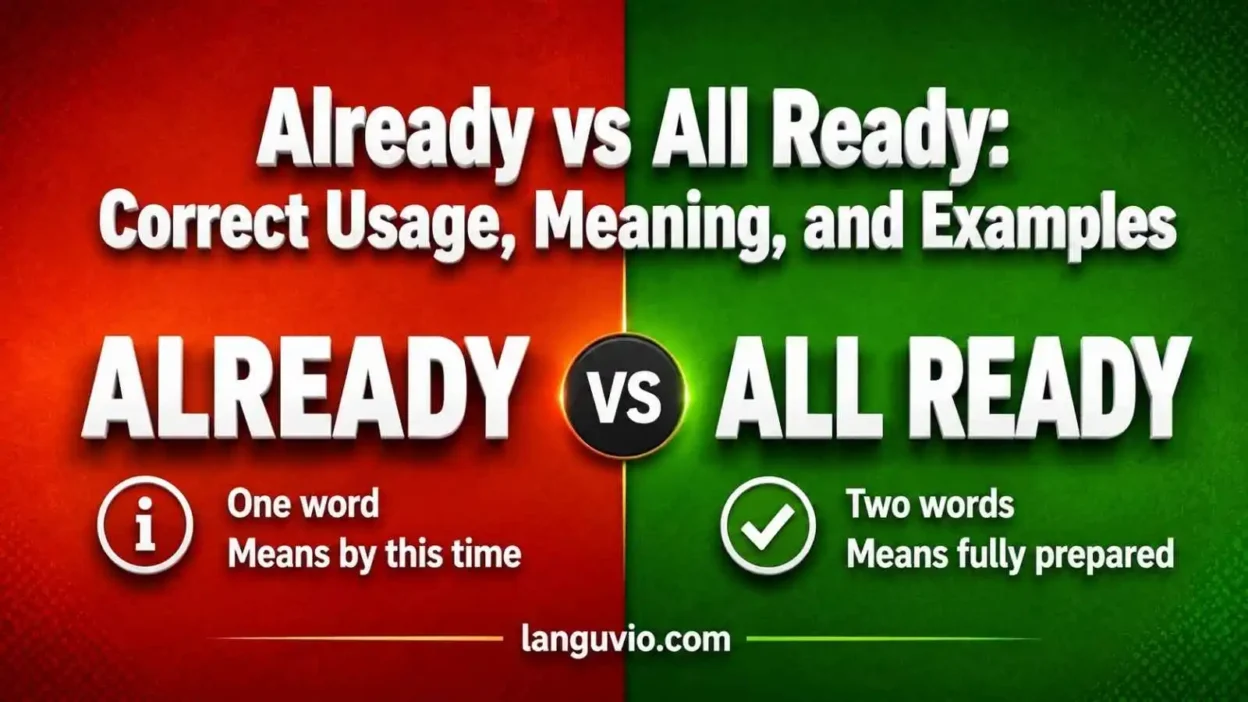
Already and all ready are both correct, but they do not mean the same thing. The choice depends on whether your sentence is about time or preparedness.
Use already when something has happened before now, by now, or sooner than expected. Use all ready when someone or something is fully prepared. They sound alike in normal speech, so the confusion is understandable. In writing, though, the one-word and two-word forms have different jobs.
Quick Answer
Use already when you mean “before now,” “by this time,” or “so soon.” Use all ready when you mean “completely ready” or “fully prepared.” For example, write “I already sent the email” but “I am all ready for the meeting.”
Why People Confuse Them
People confuse already and all ready because they sound almost the same in everyday speech. When spoken quickly, the space between all and ready disappears.
They also look similar because already contains the letters of all and ready closely packed together. However, the space changes the grammar.
Already points to timing.
All ready points to a state of preparation.
That one space decides whether the sentence means something happened before now or someone is prepared for what comes next.
Key Differences At A Glance
| Context | Best Choice | Why |
| Something happened before now | already | It refers to time. |
| Something happened sooner than expected | already | It can show surprise about timing. |
| Someone is prepared | all ready | It means fully ready. |
| A group is prepared | all ready | It can mean everyone is ready. |
| A thing or setup is prepared | all ready | It can describe a completed state. |
| You can replace it with “ready” | all ready | The sentence still keeps the same basic meaning. |
| You can replace it with “previously” | already | The sentence is about time, not preparation. |
Meaning and Usage Difference
Already is an adverb. It usually tells when something happened. It can mean “before now,” “by this time,” or “so soon.”
Examples:
• I already paid the bill.
• She had already left when I called.
• Is it lunch already?
In each sentence, already is about timing.
All ready is a two-word adjective phrase. It means “fully prepared” or “completely ready.”
Examples:
• We are all ready to leave.
• The room is all ready for the guests.
• Your order is all ready for pickup.
In each sentence, all ready describes someone or something as prepared.
Compact comparison:
• already = time: before now, by now, sooner than expected
• all ready = preparedness: fully ready, completely prepared, ready to go
• already modifies an action or situation
• all ready describes a person, group, object, plan, or setup
A helpful test is this: if ready alone still makes sense, use all ready.
Correct: The kids are all ready for school.
Test: The kids are ready for school.
Correct: I already packed lunch.
Test: I ready packed lunch.
That does not work, so already is correct.
Tone, Context, and Formality
Both forms are standard in US English. Neither is slang, and neither is too casual for normal writing.
Already appears often in everyday speech, emails, school writing, business writing, and formal writing because timing matters in all of those contexts.
Examples:
• We already reviewed the contract.
• The package has already shipped.
• The deadline is already on the calendar.
All ready is also normal, but it fits sentences about preparation.
Examples:
• The team is all ready for the presentation.
• The documents are all ready for review.
• I’m all ready when you are.
In tone, all ready can sound slightly more complete than plain ready. “I’m ready” means prepared. “I’m all ready” can suggest everything needed is finished.
Which One Should You Use?
Choose already when your sentence answers a time question.
Ask: Did it happen before now, by now, or earlier than expected?
Use already:
• I already ate.
• They already know the answer.
• She has already signed the form.
Choose all ready when your sentence answers a preparation question.
Ask: Is someone or something fully prepared?
Use all ready:
• I’m all ready to start.
• The car is all ready for the road trip.
• We are all ready for the interview.
When you are unsure, try replacing the phrase with ready.
If ready works, use all ready.
If ready does not work, use already.
When One Choice Sounds Wrong
Already sounds wrong when the sentence needs a prepared state.
Incorrect: Are you already for the call?
Correct: Are you all ready for the call?
The question is not asking whether something happened before now. It is asking whether the person is prepared.
All ready sounds wrong when the sentence needs a time adverb.
Incorrect: I all ready sent the file.
Correct: I already sent the file.
The sentence means the file was sent before now. It does not mean the speaker was fully prepared.
Another common issue appears with “available.”
Incorrect: The tickets are all ready available.
Correct: The tickets are already available.
Here, the sentence means the tickets are available by now. It is about time, so already is the right choice.
Common Mistakes (and Quick Fixes)
Mistake: I am already to go.
Fix: I am all ready to go.
Why: The person is prepared.
Mistake: We all ready finished dinner.
Fix: We already finished dinner.
Why: The action happened before now.
Mistake: Is the report already for review?
Fix: Is the report all ready for review?
Why: The report is prepared for review.
Mistake: She has all ready called me twice.
Fix: She has already called me twice.
Why: The calls happened before now.
Mistake: The setup is already for the event.
Fix: The setup is all ready for the event.
Why: The setup is fully prepared.
Everyday Examples
• I already bought the tickets, so we do not need to wait in line.
• We are all ready for the movie to start.
• The kids already brushed their teeth.
• The kids are all ready for bed.
• My phone has already updated.
• My phone is all ready to use.
• She already knows about the meeting.
• She is all ready for the meeting.
• The food is already on the table.
• The food is all ready for the party.
• I already submitted the form.
• The form is all ready for your signature.
• They already left for the airport.
• They were all ready before the driver arrived.
• Is it Friday already?
• Are you all ready for Friday’s test?
Dictionary-Style Word Details
Verb
• already: Not used as a verb in standard US English. It works as an adverb.
• all ready: Not used as a verb as a complete phrase. The word ready can be a verb in some sentences, as in “ready the room,” but all ready itself is not a verb.
Noun
• already: Not used as a noun in standard US English.
• all ready: Not used as a noun as a complete phrase. It describes a prepared state; it does not name a person, place, thing, or idea.
Synonyms
• already: Closest plain alternatives include before now, by now, previously, by that time, and so soon. Clear opposites can include later and afterward, depending on the sentence.
• all ready: Closest plain alternatives include fully prepared, completely ready, ready to go, and set to start. Clear opposites include unprepared and not ready.
Example Sentences
Already Examples
- I already checked the schedule.
- The store is already closed.
- Did you finish already?
- They had already made a decision.
All Ready Examples
- I’m all ready for the interview.
- The classroom is all ready for the students.
- We were all ready by 8 a.m.
- The files are all ready for upload.
Word History
• already: The one-word form is established in modern English as an adverb about time. For everyday writing, the important point is its current role, not a memorized origin story.
• all ready: The two-word phrase keeps the ordinary meanings of all and ready. Together, they express complete preparedness.
Phrases Containing
• already: already done, already know, already left, already finished, enough already, all right already.
• all ready: all ready to go, all ready for school, all ready for review, all ready by noon, all ready when you are.
FAQs
Is it already or all ready?
Use already when you mean something happened before now or by this time. Use all ready when you mean someone or something is fully prepared. For example, “I already ate” means the eating happened before now. “I am all ready to eat” means you are prepared to eat.
What is the main difference between already and all ready?
The main difference is meaning. Already is about time, while all ready is about preparation. If your sentence means “before now,” choose already. If your sentence means “fully ready,” choose all ready.
Is all ready one word or two words?
All ready is two words when it means “fully prepared.” For example, “The kids are all ready for school” means the kids are completely prepared. Do not write it as already in that sentence because the meaning is not about time.
Can already mean ready?
No. Already does not mean ready. It means something has happened before now, by now, or sooner than expected. For example, “She already left” means she left before this moment. It does not mean she is prepared.
How do I remember already vs all ready?
Use this simple test: if you can replace the phrase with ready, use all ready. For example, “We are all ready to go” still makes sense as “We are ready to go.” If ready does not fit, use already.
Which sentence is correct: I’m already or I’m all ready?
Both can be correct, but they mean different things. “I’m already here” means you arrived before now. “I’m all ready” means you are fully prepared. Choose the form that matches your meaning.
Conclusion
Already and all ready are both correct, but they belong in different sentences. Use already for time: something happened before now, by now, or sooner than expected. Use all ready for preparation: someone or something is fully ready.
The easiest test is simple. If you can replace the words with ready, choose all ready. If the sentence is about something happening before now, choose already.
Use already when you mean something happened before now or by this time. Use all ready when you mean someone or something is fully prepared. For example, “I already ate” means the eating happened before now. “I am all ready to eat” means you are prepared to eat.
The main difference is meaning. Already is about time, while all ready is about preparation. If your sentence means “before now,” choose already. If your sentence means “fully ready,” choose all ready.
All ready is two words when it means “fully prepared.” For example, “The kids are all ready for school” means the kids are completely prepared. Do not write it as already in that sentence because the meaning is not about time.
No. Already does not mean ready. It means something has happened before now, by now, or sooner than expected. For example, “She already left” means she left before this moment. It does not mean she is prepared.
Use this simple test: if you can replace the phrase with ready, use all ready. For example, “We are all ready to go” still makes sense as “We are ready to go.” If ready does not fit, use already.
Both can be correct, but they mean different things. “I’m already here” means you arrived before now. “I’m all ready” means you are fully prepared. Choose the form that matches your meaning.