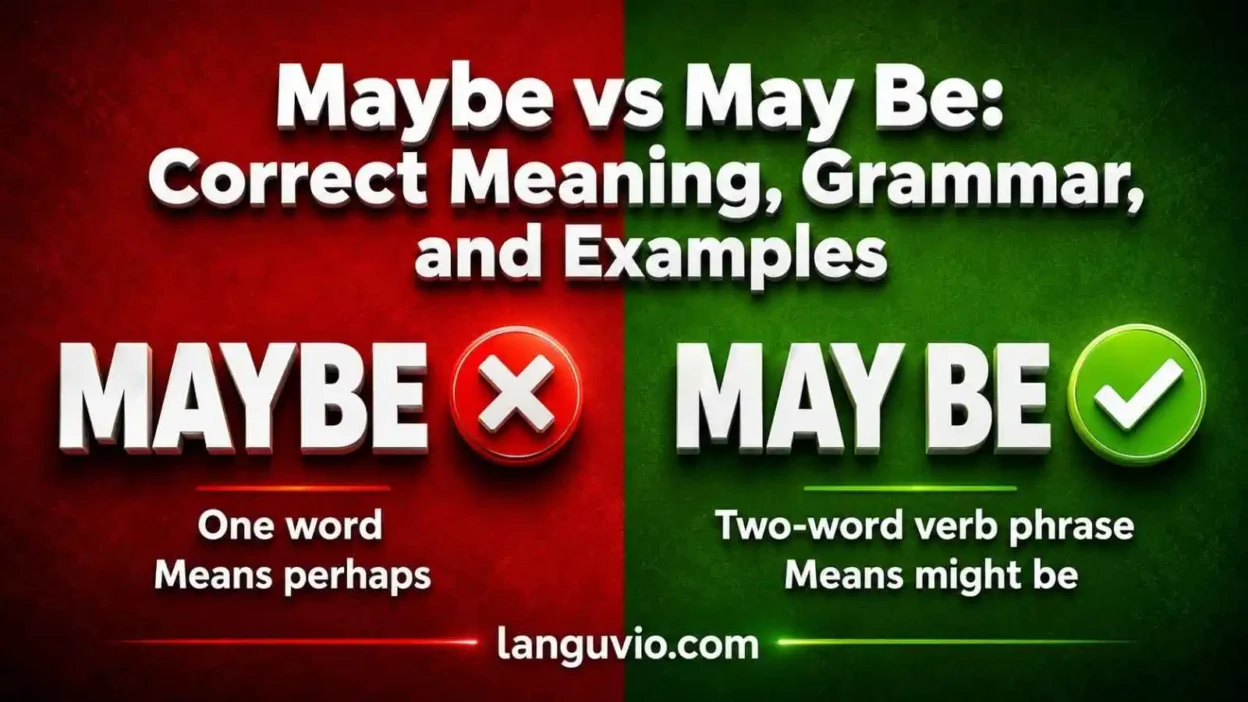
Maybe vs may be is a common word-choice problem because both forms talk about possibility. The difference is not meaning alone. It is mainly grammar.
Maybe is usually one word and works like perhaps. May be is two words and works like might be. Once you know that structure, the choice becomes much easier.
Quick Answer
Use maybe when you mean perhaps or possibly. Use may be when you need the verb phrase may + be, meaning might be. The two forms are related, but they are not interchangeable in standard US English.
Correct: Maybe we should leave early.
Correct: This may be our best option.
Why People Confuse Them
People confuse maybe and may be because they sound almost the same. They also express similar ideas. Both can show uncertainty, possibility, or a lack of a firm answer.
The problem is that they do different jobs in a sentence.
Maybe adds possibility to a full idea:
Maybe the meeting will end early.
May be is part of the verb structure:
The meeting may be over by noon.
In the first sentence, maybe sits outside the main verb. In the second sentence, may be is the verb phrase that belongs to the subject.
Key Differences At A Glance
| Context | Best Choice | Why |
| You mean “perhaps” | maybe | It works as an adverb. |
| You mean “might be” | may be | It is the verb phrase may + be. |
| The word comes before a full sentence | maybe | It can introduce a possible idea. |
| The words come after a subject | may be | The subject needs a verb phrase. |
| You are giving an uncertain answer | maybe | It can stand alone as a response. |
| You are describing a possible state | may be | It links the subject to a possible condition. |
Meaning and Usage Difference
Maybe means perhaps or possibly. It is usually an adverb. You can place it at the beginning of a sentence, in the middle, or at the end when the sentence structure allows it.
Maybe I left my keys in the car.
I maybe left my keys in the car.
We could try again tomorrow, maybe.
The first sentence sounds the most natural in everyday US English.
May be is not one word. It is the modal verb may plus the verb be. Use it when the subject might have a certain quality, identity, condition, or action in progress.
She may be right.
This may be the answer.
They may be waiting outside.
A helpful test is simple: replace maybe with perhaps. If the sentence still works, use maybe.
Maybe he forgot.
Perhaps he forgot.
For may be, try might be.
He may be tired.
He might be tired.
That test works because may be acts as a verb phrase, not as a single adverb.
Tone, Context, and Formality
Both maybe and may be are standard in US English, but they do not always feel the same.
Maybe often sounds conversational. It works well in everyday writing, messages, dialogue, advice, and casual suggestions.
Maybe we can talk after lunch.
Maybe you should call the office first.
May be sounds slightly more structured because it is part of the verb. It appears naturally in school writing, business writing, reports, emails, and everyday speech.
The file may be missing.
Your payment may be delayed.
The answer may be different in this case.
This does not mean maybe is wrong in formal writing. It simply has a softer, more conversational feel. In more careful writing, may be often sounds better when the sentence needs a clear subject and verb.
Which One Should You Use?
Use maybe when the word can stand for perhaps.
Maybe the store is still open.
Maybe we should ask for help.
I will stop by later, maybe.
Use may be when the phrase follows a subject and works as the verb.
The store may be open.
This may be harder than we thought.
Your name may be on the list.
Here is the compact comparison:
| Feature | maybe | may be |
| Form | One word | Two words |
| Main role | Adverb | Verb phrase |
| Easy replacement | perhaps | might be |
| Common position | Before a sentence or clause | After the subject |
| Example | Maybe she knows. | She may be right. |
When One Choice Sounds Wrong
Maybe sounds wrong when the sentence needs a verb after the subject.
Wrong: She maybe late.
Correct: She may be late.
In the wrong sentence, she needs a verb phrase. Maybe is an adverb, so it cannot do that job.
May be sounds wrong when you need an adverb before a full sentence.
Wrong: May be we should wait.
Correct: Maybe we should wait.
In the wrong sentence, may be has no subject before it. The sentence needs the one-word adverb maybe.
Also watch this pattern:
Wrong: This maybe the best time.
Correct: This may be the best time.
Here, this is the subject, so the sentence needs the verb phrase may be.
Common Mistakes (and Quick Fixes)
Mistake 1: Using maybe after a subject when the meaning is might be.
Wrong: The package maybe lost.
Correct: The package may be lost.
Quick fix: If you can replace it with might be, use may be.
Mistake 2: Using may be at the start of a sentence when you mean perhaps.
Wrong: May be I should try again.
Correct: Maybe I should try again.
Quick fix: If perhaps works, use maybe.
Mistake 3: Treating the two forms as interchangeable.
Wrong: Maybe the answer may be simple.
Better: Maybe the answer is simple.
Better: The answer may be simple.
Quick fix: Choose one structure. Use maybe to introduce the possibility, or use may be as the verb phrase.
Mistake 4: Adding extra words after may be without checking the structure.
Wrong: She may be can help us.
Correct: Maybe she can help us.
Correct: She may be able to help us.
Quick fix: After may be, use a noun, adjective, phrase, or an -ing verb form when the sentence calls for it.
Everyday Examples
Maybe I’ll make coffee before the meeting.
The coffee may be too hot.
Maybe we should leave before traffic gets worse.
The road may be closed near downtown.
Maybe your phone is in the car.
Your phone may be under the seat.
Maybe the teacher will extend the deadline.
The deadline may be moved to Friday.
Maybe I sent the email to the wrong address.
The email may be in your spam folder.
Maybe we can reschedule dinner.
Friday may be better for everyone.
Maybe the price will drop next week.
This may be the lowest price we see today.
Maybe she forgot about the appointment.
She may be stuck in traffic.
Maybe the game starts at seven.
The game may be delayed because of rain.
Maybe I should read the instructions again.
This may be easier than it looks.
Dictionary-Style Word Details
Verb
Maybe: Not commonly used as a verb in standard US English. It usually works as an adverb, and it can also work as a noun in limited contexts.
May be: A verb phrase, not a single verb. May is a modal verb, and be is the base form of the verb be.
Example: The answer may be correct.
Noun
Maybe: Can be used as a noun in informal or practical contexts when it means an uncertain answer or possibility.
Example: Put me down as a maybe for Saturday.
May be: Not used as a noun. It is two separate words that form a verb phrase.
Example: This may be important.
Synonyms
Maybe: Closest plain alternatives include perhaps, possibly, and it could be. These do not fit every sentence perfectly, but they match the idea of uncertainty.
May be: Closest plain alternatives include might be, could be, or is possibly, depending on the sentence.
Antonyms do not fit neatly because both forms express possibility, not a direct quality with a clean opposite. In some contexts, the opposite idea may be definitely, certainly, or is not, but those are sentence-level contrasts, not exact word opposites.
Example Sentences
Maybe
Maybe we can finish this before lunch.
I’ll join the call later, maybe.
Are you coming to the party? Maybe.
May be
The report may be ready by noon.
She may be the best person for the job.
They may be working from home today.
Word History
Maybe: The word developed from the idea expressed by may be, but in modern English it functions as its own word, mainly as an adverb. It now has a clear role separate from the two-word verb phrase.
May be: This is not a separate headword in the same way. It is the modal verb may followed by be. Its history belongs to the normal use of may for possibility and be as a linking or helping verb.
Phrases Containing
Maybe:
Maybe later
Maybe not
Maybe tomorrow
Maybe next time
Yes, no, or maybe
May be:
May be true
May be right
May be possible
May be ready
May be waiting
These phrases are useful because they show the structure clearly. Maybe can stand near a whole idea. May be normally follows a subject and works as part of the sentence’s verb.
FAQs
Is maybe one word or two words?
Maybe is one word when it means perhaps or possibly. For example, “Maybe we should leave early” means “Perhaps we should leave early.” Use the one-word form when it adds uncertainty to a full idea.
When should I use may be?
Use may be as two words when it means might be. It is a verb phrase made from may + be. For example, “She may be tired” means “She might be tired.” The subject usually comes before may be.
Are maybe and may be interchangeable?
No, maybe and may be are not interchangeable. They express a similar idea of possibility, but they do different grammar jobs. Maybe is usually an adverb. May be is a verb phrase.
What is the easiest way to remember the difference?
Use this simple test: if you can replace the word with perhaps, use maybe. If you can replace the phrase with might be, use may be.
Example: “Maybe he forgot” = “Perhaps he forgot.”
Example: “He may be busy” = “He might be busy.”
Is “maybe I will” correct?
Yes, “Maybe I will” is correct. Here, maybe means perhaps. It introduces an uncertain possibility: “Perhaps I will.”
Is “she maybe late” correct?
No, “she maybe late” is incorrect in standard English. The correct sentence is “She may be late.” Since she is the subject, the sentence needs the verb phrase may be.
Can maybe be used alone?
Yes. Maybe can stand alone as a short answer. For example:
“Are you coming tonight?”
“Maybe.”
Which is more formal: maybe or may be?
Both are standard, but may be often sounds more structured. Maybe feels more conversational, especially in casual speech and messages.
Conclusion
The difference between maybe vs may be comes down to grammar. Use maybe as one word when you mean perhaps. Use may be as two words when you mean might be.
The easiest test is this: perhaps = maybe and might be = may be. That simple check fixes most mistakes and keeps your writing clear, natural, and correct.
Maybe is one word when it means perhaps or possibly. For example, “Maybe we should leave early” means “Perhaps we should leave early.” Use the one-word form when it adds uncertainty to a full idea.
Use may be as two words when it means might be. It is a verb phrase made from may + be. For example, “She may be tired” means “She might be tired.” The subject usually comes before may be.
No, maybe and may be are not interchangeable. They express a similar idea of possibility, but they do different grammar jobs. Maybe is usually an adverb. May be is a verb phrase.
Use this simple test: if you can replace the word with perhaps, use maybe. If you can replace the phrase with might be, use may be.
Example: “Maybe he forgot” = “Perhaps he forgot.”
Example: “He may be busy” = “He might be busy.”
Yes, “Maybe I will” is correct. Here, maybe means perhaps. It introduces an uncertain possibility: “Perhaps I will.”
No, “she maybe late” is incorrect in standard English. The correct sentence is “She may be late.” Since she is the subject, the sentence needs the verb phrase may be.
Yes. Maybe can stand alone as a short answer. For example:
“Are you coming tonight?”
“Maybe.”
Both are standard, but may be often sounds more structured. Maybe feels more conversational, especially in casual speech and messages.