Should and would are both correct words, but they do different jobs. The right choice depends on what you mean.
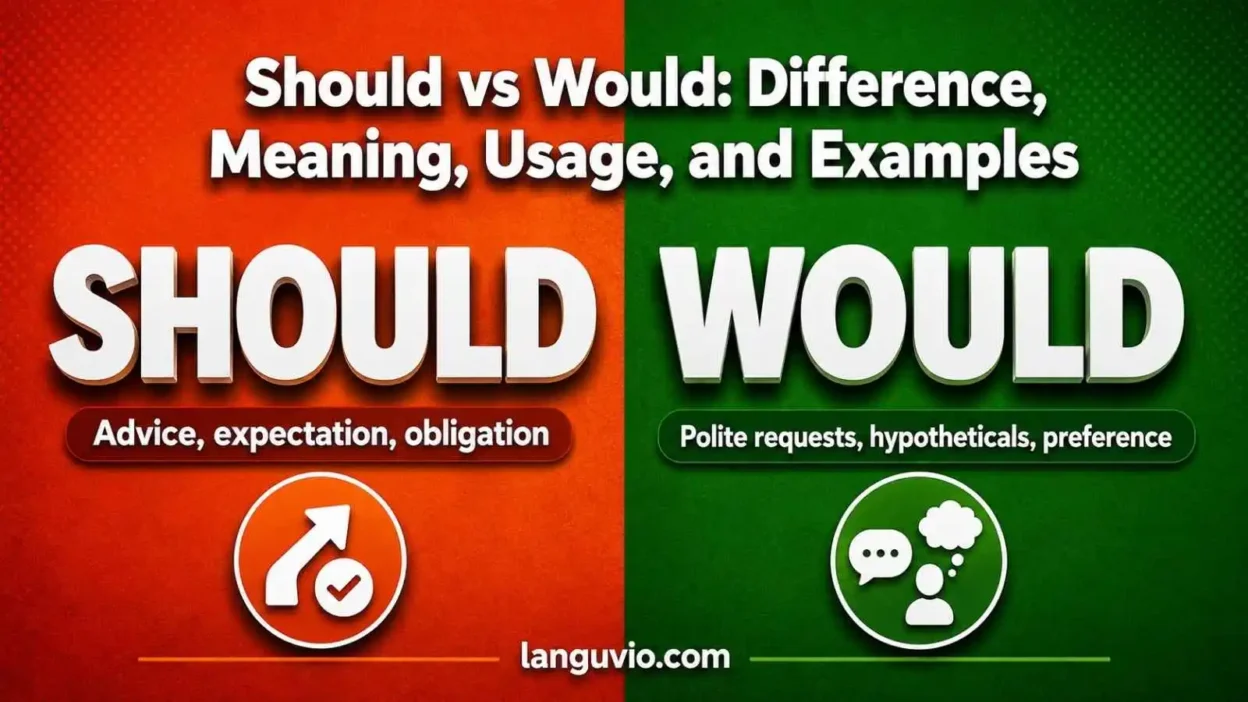
Use should when you mean advice, duty, the best action, or something expected. Use would when you mean an imagined result, a polite request, a preference, willingness, or a past habit.
For example, You should call your doctor gives advice. I would call your doctor if I were you imagines what the speaker might do in your situation. The meaning is close, but the grammar and tone are not the same.
Quick Answer
Use should for advice, obligation, what is right, or what is likely. Use would for imaginary situations, polite requests, preferences, willingness, or repeated actions in the past. Say You should leave early when giving advice. Say I would leave early if traffic were bad when imagining a condition.
Why People Confuse Them
People confuse should and would because both are modal auxiliary verbs. That means each one helps another verb.
They also follow the same basic pattern:
subject + should/would + base verb
Examples:
• You should bring a jacket.
• I would bring a jacket if it got cold.
The structure looks similar, but the meaning changes. Should tells what is smart, right, expected, or recommended. Would points to a possible or imagined action.
There is also some overlap in formal English. Phrases like I should think and I would think can both soften an opinion. In everyday US English, though, would sounds more natural in many of those cases.
Key Differences At A Glance
| Context | Best Choice | Why |
| Giving advice | should | It shows what is best or recommended. |
| Talking about duty | should | It points to responsibility or what is right. |
| Saying what is expected | should | It shows something is likely or supposed to happen. |
| Making a polite request | would | It sounds indirect and courteous. |
| Imagining a result | would | It depends on an unreal or possible condition. |
| Stating a preference | would | It shows what someone wants or chooses. |
| Talking about past habits | would | It describes repeated past actions when the past time is clear. |
| Regretting a past action | should have | It shows the better action did not happen. |
| Imagining a different past result | would have | It shows what might have happened under another condition. |
Meaning and Usage Difference
Should means that something is advisable, proper, expected, or likely. It often answers the question, “What is the right or better thing to do?”
Examples:
• You should back up your files.
• We should be at the airport by 6:00.
• The package should arrive tomorrow.
• I should have replied sooner.
In these sentences, should does not simply describe an action. It adds advice, expectation, or judgment.
Would often means that something is imagined, conditional, polite, preferred, or repeated in the past. It often answers the question, “What might happen, what did someone want, or what happened regularly before?”
Examples:
• I would help if I had more time.
• Would you send me the address?
• She would rather stay home tonight.
• When we were kids, we would ride bikes after dinner.
Here, would does not tell someone what is right. Instead, it makes the action conditional, polite, preferred, or connected to past habit.
Both words are verbs in grammar, but more precisely, they are modal auxiliary verbs. They come before a main verb and do not take -s, -ed, or -ing endings.
Correct:
• She should call.
• She would call.
Incorrect:
• She shoulds call.
• She woulded call.
Tone, Context, and Formality
Should can sound helpful, firm, or corrective. Its tone depends on the sentence and situation.
Soft advice:
• You should try the new coffee shop.
Stronger advice:
• You should stop ignoring those emails.
Expectation:
• The office should be open by now.
Because should can sound like advice or correction, use it carefully in sensitive messages. For example, You should calm down may sound rude. A softer choice is It may help to take a minute.
Would often sounds more polite, indirect, or hypothetical. It is common in requests, offers, and imagined situations.
Choose would when you want to sound polite, helpful, or less direct.
• Would you mind moving your car?
• Would you like a receipt?
• I would recommend saving a copy.
In these examples, would makes the sentence sound softer and more respectful.
In everyday US English, would is usually the natural choice for polite requests and imagined situations.
A formal overlap appears with I and we in phrases such as:
• I should like to speak with you.
• I would like to speak with you.
Both sentences can be understood, but I would like is much more natural in modern US conversation. By contrast, I should like sounds formal, old-fashioned, or British to many American readers.
Which One Should You Use?
Use should when your sentence means “the right thing,” “the smart thing,” “the expected thing,” or “the likely thing.”
Choose should for:
• advice: You should apply before Friday.
• duty: Drivers should stop for pedestrians.
• expectation: The meeting should end by noon.
• regret: I should have saved the receipt.
Use would when your sentence means “if something happened,” “I prefer,” “please do this,” or “this happened regularly in the past.”
Choose would for:
• imaginary results: I would move closer if rent were lower.
• polite requests: Would you check this file?
• preference: I would rather wait.
• past habits: Every summer, we would visit my grandparents.
A simple test helps:
• If you mean ought to, use should.
• If you mean if that happened, then this, use would.
• If you are making a polite request, use would.
• If you are giving advice, use should.
When One Choice Sounds Wrong
Some sentences become confusing when should and would are swapped.
Wrong: You would update your password today.
Better: You should update your password today.
The sentence gives advice, so should is the better word.
Wrong: If I had your schedule, I should work from home.
Better: If I had your schedule, I would work from home.
The sentence imagines a situation, so would fits better in everyday US English.
Wrong: Should you like a refill?
Better: Would you like a refill?
This is a polite offer, so would sounds natural.
Wrong: When I was in college, I should study at the library every night.
Better: When I was in college, I would study at the library every night.
This describes a repeated past action, so would is the right choice.
Common Mistakes (and Quick Fixes)
One common mistake is using would when giving advice.
Incorrect: You would talk to your manager.
Correct: You should talk to your manager.
Another common mistake is using should for an imagined result.
Incorrect: I should buy a house if prices dropped.
Correct: I would buy a house if prices dropped.
Many writers also confuse should have and would have.
Use should have when the better action did not happen:
• I should have left earlier.
• They should have checked the address.
Use would have when a result depended on a condition:
• I would have left earlier if I had known about traffic.
• They would have arrived on time if the flight had not been delayed.
Do not write should of or would of in standard English. The correct forms are should have and would have. In speech, should’ve and would’ve can sound like “should of” and “would of,” but the written form is have, not of.
Also avoid If I would have known in standard edited US English.
Awkward: If I would have known, I would have called.
Better: If I had known, I would have called.
Everyday Examples
Here are natural examples that show the difference.
| Feature | Should | Would |
| Main idea | Advice, duty, expectation | Imagined action, request, preference, past habit |
| Common question | What is best? | What might happen? |
| Tone | Helpful, corrective, expected | Polite, indirect, hypothetical |
| Past form | should have | would have |
More examples:
• You should bring your ID to the appointment.
• I would bring my ID if I were going with you.
• The train should arrive in ten minutes.
• The train would be faster if it ran express.
• You should proofread the email before sending it.
• Would you proofread this email for me?
• We should save money this month.
• We would save more money if we cooked at home.
• She should have asked before posting the photo.
• She would have asked if she had known it was private.
• When my dad worked nights, he would sleep late on Saturdays.
• The office should be quiet after 5:00.
Notice the pattern. Should gives advice or expectation. Would imagines, requests, prefers, or describes a repeated past action.
Dictionary-Style Word Details
Verb
• Should: Used as a modal auxiliary verb before a base verb. It shows advice, duty, correctness, expectation, likelihood, or regret with should have. Example: You should call today.
• Would: Used as a modal auxiliary verb before a base verb. It shows imagined results, polite requests, willingness, preference, future seen from the past, or repeated past action. Example: I would call if I had her number.
Noun
• Should: Not commonly used as a noun in normal sentences. It can be discussed as a word: Should is a modal verb.
• Would: Not commonly used as a noun in normal sentences. It can be discussed as a word: Would often appears in conditional sentences.
Synonyms
• Should: Closest plain alternatives include ought to, need to, had better, be supposed to, and be expected to. These are not always exact. Must is stronger than should.
• Would: Closest plain alternatives depend on context: would like can mean want; would rather can mean prefer; past-habit would can be close to used to. No single synonym fits every use.
Clear opposites are usually formed with negatives:
• should → should not / shouldn’t
• would → would not / wouldn’t
Example Sentences
• Should: You should drink more water before the hike.
• Should: The repair should take about an hour.
• Should: I should have saved a copy of the contract.
• Would: Would you send me the meeting link?
• Would: I would travel more if I had a flexible schedule.
• Would: When we lived in Chicago, we would walk to the lake after dinner.
Word History
• Should: Historically connected to shall, but modern should is not limited to a simple past-tense role. Today it is mainly used for advice, duty, expectation, and related meanings.
• Would: Historically connected to will, but modern would also has several established uses beyond simple past time. It commonly appears in polite requests, imagined conditions, preferences, and past habits.
The useful point for today’s writer is not the older history. The useful point is the modern function: should usually judges or recommends; would usually imagines, softens, requests, or describes a repeated past action.
Phrases Containing
• Should: should have, should not, should I, you should, as it should be, if you should, should be able to
• Would: would like, would rather, would have, would you mind, would be, would not, I would think, would be able to
FAQs
Is should or would correct?
Both should and would are correct, but they are not interchangeable. Use should for advice, duty, what is best, or what is expected. Use would for imagined situations, polite requests, preferences, willingness, or repeated past actions.
What is the main difference between should and would?
The main difference is meaning. Should points to the right, smart, expected, or recommended action. Would points to a possible, imagined, polite, preferred, or conditional action. For example, “You should leave now” gives advice. “I would leave now if I were you” imagines a choice.
Can I use would for advice?
Sometimes would can sound like advice when you say what you personally would do. For example, “I would call the office first” is indirect advice. However, direct advice usually uses should: “You should call the office first.”
What is the difference between should have and would have?
Use should have when the better action did not happen. Example: “I should have studied earlier.” Use would have when a result depended on another condition. Example: “I would have studied earlier if I had known about the test.”
Is “should of” or “would of” correct?
No. In standard English, write should have and would have. The contractions should’ve and would’ve may sound like “should of” and “would of,” but of is not correct in this structure.
Which sounds more polite, should or would?
Would usually sounds more polite in requests and offers. “Would you send me the file?” sounds softer than “Should you send me the file?” Use should when giving advice, but use would when making polite requests.
Conclusion
The difference between should and would comes down to meaning. Use should when you are giving advice, showing duty, naming the best action, or saying what is expected. Use would when you are imagining a result, making a polite request, stating a preference, showing willingness, or describing a past habit.
A quick rule works most of the time: should points to what is best or expected; would points to what is imagined, polite, preferred, or repeated in the past.
Both should and would are correct, but they are not interchangeable. Use should for advice, duty, what is best, or what is expected. Use would for imagined situations, polite requests, preferences, willingness, or repeated past actions.
The main difference is meaning. Should points to the right, smart, expected, or recommended action. Would points to a possible, imagined, polite, preferred, or conditional action. For example, “You should leave now” gives advice. “I would leave now if I were you” imagines a choice.
Sometimes would can sound like advice when you say what you personally would do. For example, “I would call the office first” is indirect advice. However, direct advice usually uses should: “You should call the office first.”
Use should have when the better action did not happen. Example: “I should have studied earlier.” Use would have when a result depended on another condition. Example: “I would have studied earlier if I had known about the test.”
No. In standard English, write should have and would have. The contractions should’ve and would’ve may sound like “should of” and “would of,” but of is not correct in this structure.
Would usually sounds more polite in requests and offers. “Would you send me the file?” sounds softer than “Should you send me the file?” Use should when giving advice, but use would when making polite requests.