Little vs a little looks like a tiny grammar difference, but it can change the message of a sentence. Both forms can refer to a small amount, yet they do not create the same feeling.
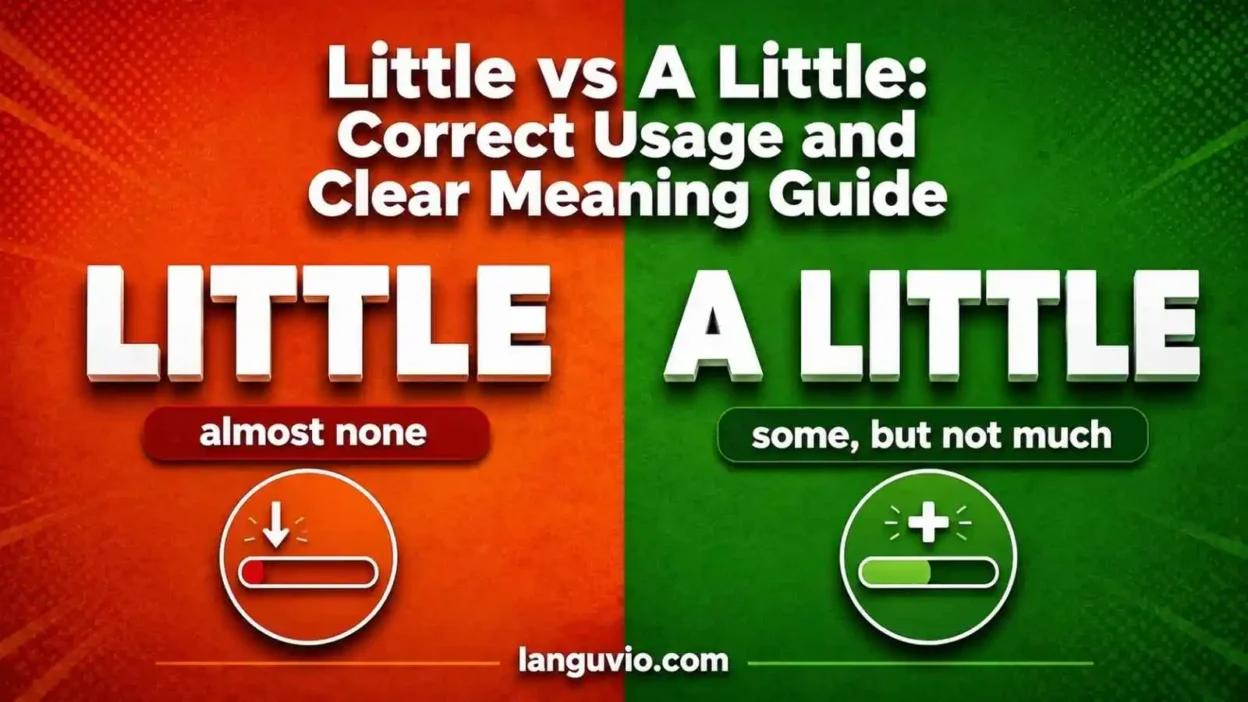
In modern US English, little often points to a lack, shortage, or amount that is not enough. By contrast, a little usually means some, a small amount, or enough to matter. That is why “I have little time” sounds more urgent than “I have a little time.”
Quick Answer
Use little when you mean not much, especially when the amount feels too small, weak, or disappointing. Choose a little when you mean some or a small amount that still exists. For example, “We have little time” means time is almost gone, while “We have a little time” means some time is still available.
Why People Confuse Them
Readers often confuse little and a little because the words look almost the same. The only visible difference is the article a, so the meaning change can seem too small to matter.
That small article does real work. Little often focuses on what is missing. A little focuses on what is present.
Compare these two sentences:
There is little coffee left.
This suggests the amount may not be enough.
There is a little coffee left.
Here, the sentence suggests some coffee is still available.
The same pattern appears with time, money, energy, hope, patience, progress, and other uncountable ideas.
Key Differences At A Glance
| Context | Best Choice | Why |
| You mean not much or almost none | little | It stresses lack or shortage. |
| You mean some amount remains | a little | It stresses that something is available. |
| The tone should sound limited or negative | little | It often makes the sentence feel less hopeful. |
| The tone should sound mild or positive | a little | It often makes the sentence feel more reassuring. |
| You use an uncountable noun like time, money, water, or patience | little / a little | Both can work, but the meaning changes. |
| You modify an adjective like tired, cold, or nervous | a little | It means somewhat or slightly. |
Meaning and Usage Difference
Little usually means not much when it describes quantity. It often comes before uncountable nouns such as time, money, water, hope, energy, interest, and patience.
Examples:
We have little time before the meeting.
The speaker feels rushed.
She showed little interest in the offer.
Her interest was low.
There is little hope of finishing today.
The sentence sounds doubtful.
A little means some or a small amount. It can also soften adjectives and verbs by meaning somewhat or slightly.
Examples:
We have a little time before the meeting.
Some usable time remains.
She showed a little interest in the offer.
Her interest was small, but it existed.
I am a little tired.
The speaker is somewhat tired.
A simple way to remember the difference is this: little often points to shortage, while a little points to availability.
Compact comparison:
• little = not much, not enough, or less than expected
• a little = some, a small amount, or somewhat
• little money = not much money
• a little money = some money
• little progress = progress was weak
• a little progress = some progress happened
Tone, Context, and Formality
Little can sound more serious, formal, or negative when it means “not much.” Reports, reviews, business updates, and careful statements often use it to show limited results.
Examples:
The new rule had little effect.
The report offered little evidence.
Our team made little progress this week.
In casual speech, many people would say not much instead.
Example:
We didn’t make much progress this week.
A little sounds natural in everyday conversation, school writing, workplace emails, and polite requests. It is often softer and more hopeful.
Examples:
Could I get a little help with this form?
Please give me a little more time.
The update made the app a little faster.
Pronunciation usually does not cause confusion here. The word little sounds the same in both forms; the meaning changes because a appears before it.
Which One Should You Use?
Choose little when the amount is too small, disappointing, or nearly absent.
Good uses of little:
I have little patience for repeated delays.
There is little chance of rain today.
The instructions gave little guidance.
Pick a little when the amount is small but real, useful, or enough to mention.
Natural uses of a little:
I have a little patience left.
There is a little chance of rain today.
The instructions gave a little guidance.
One quick test can help. Replace the phrase with not much if the sentence needs little. Try some if the sentence needs a little.
When One Choice Sounds Wrong
Some sentences need a little because little alone sounds incomplete or unnatural.
Correct: I’m a little nervous about the interview.
Incorrect: I’m little nervous about the interview.
Correct: The room is a little cold.
Incorrect: The room is little cold.
Correct: Can you move a little closer?
Incorrect: Can you move little closer?
Before adjectives, a little commonly means somewhat.
With nouns, little can be correct when the meaning is “not much.”
Correct: We had little warning before the storm.
Natural: The speaker gave little explanation.
Also correct: They made little effort to fix the issue.
Common Mistakes (and Quick Fixes)
Mistake: I have a little money, so I can’t buy lunch.
Better: I have little money, so I can’t buy lunch.
Why: The sentence means the amount is not enough.
Mistake: I have little money, so I can buy lunch.
Better: I have a little money, so I can buy lunch.
Why: The sentence means some money is available.
Mistake: She is little upset.
Better: She is a little upset.
Why: Before an adjective, a little means somewhat.
Mistake: There is a little evidence to support the claim when you mean almost none.
Better: There is little evidence to support the claim.
Why: Little evidence sounds weaker and more doubtful.
Mistake: We need little more time.
Better: We need a little more time.
Why: The phrase before more is usually a little.
Everyday Examples
Little examples:
I got little sleep last night.
There is little room in the trunk.
The new policy made little difference.
He had little interest in joining the group.
Customers gave little feedback after the update.
A little examples:
I got a little sleep on the flight.
There is a little room in the trunk.
The new policy made a little difference.
He had a little interest in joining the group.
Customers gave a little feedback after the update.
Side-by-side meanings:
I have little time.
The speaker is busy or almost out of time.
I have a little time.
Some time is available.
There is little water left.
More water may be needed.
There is a little water left.
Some water is still there.
The class made little progress.
This result was disappointing.
A little progress happened in the class.
Some improvement took place.
Dictionary-Style Word Details
Verb
little: Not commonly used as a verb in standard US English.
a little: Not used as a verb. It is a phrase, not a verb form.
Noun
little: Can work as a noun meaning a small amount, especially in sentences such as We know little about the issue or They did little to help.
a little: Can work as a noun phrase meaning a small amount, as in I saved a little for later or A little goes a long way.
Synonyms
little: Closest plain alternatives include not much, hardly any, minimal, slight, and limited, depending on the sentence. Clear opposites include much, a lot of, and plenty of.
a little: Closest plain alternatives include some, a small amount, a bit, slightly, and somewhat. Clear opposites include none, not at all, or a lot, depending on the sentence.
Example Sentences
little:
The project made little progress after the budget cuts.
There was little food left after the party.
The manager gave little explanation for the change.
a little:
The project made a little progress this week.
There was a little food left after the party.
The manager gave a little explanation before the meeting ended.
Word History
little: The word comes from Old English and has long been used for small size, small amount, or low degree. Its exact role depends on how it works in the sentence.
a little: The phrase combines a with little. In current English, it often means a small amount or, before adjectives and adverbs, somewhat.
Phrases Containing
little: Common phrases include little by little, too little, too late, little or no, little more than, make little difference, and leave little room.
a little: Common phrases include a little bit, a little more, a little less, a little goes a long way, a little while, and a little something.
FAQs
What is the main difference between little and a little?
Little usually means not much or not enough. A little means some or a small amount. For example, little time sounds urgent, but a little time sounds more hopeful.
Is “little” negative?
In many quantity sentences, little has a negative feeling because it points to a shortage. Little hope, little money, and little progress all suggest that the amount is low or disappointing.
Is “a little” positive?
A little is often more positive because it shows that some amount exists. A little hope, a little money, and a little progress all suggest that the amount is small but still useful.
Can I use little and a little with countable nouns?
Use little and a little mainly with uncountable nouns, such as water, time, money, energy, and patience. For countable plural nouns, use few or a few instead.
Is “I am little tired” correct?
No. The natural phrase is I am a little tired. Before adjectives such as tired, cold, hungry, nervous, or busy, use a little to mean somewhat.
Which is correct: little time or a little time?
Both are correct, but they mean different things. Little time means there is not much time and possibly not enough. A little time means some time is available.
Conclusion
The difference between little vs a little is mainly about amount and tone. Little usually means not much, not enough, or less than expected. A little means some, a small amount, or somewhat.
Use little when you want to stress shortage. Choose a little when you want to show that a small amount exists and may help. One small article changes the sentence from lack to presence.
Little usually means not much or not enough. A little means some or a small amount. For example, little time sounds urgent, but a little time sounds more hopeful.
In many quantity sentences, little has a negative feeling because it points to a shortage. Little hope, little money, and little progress all suggest that the amount is low or disappointing.
A little is often more positive because it shows that some amount exists. A little hope, a little money, and a little progress all suggest that the amount is small but still useful.
Use little and a little mainly with uncountable nouns, such as water, time, money, energy, and patience. For countable plural nouns, use few or a few instead.
No. The natural phrase is I am a little tired. Before adjectives such as tired, cold, hungry, nervous, or busy, use a little to mean somewhat.
Both are correct, but they mean different things. Little time means there is not much time and possibly not enough. A little time means some time is available.