
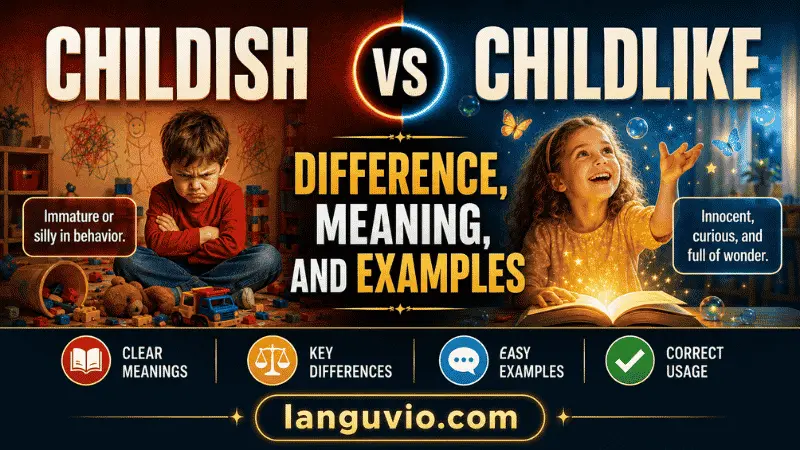
The difference between childish vs childlike is mainly a difference in meaning and tone. Both adjectives connect a person, action, or quality with children, but they usually create opposite impressions. Childish often criticizes behavior as immature, petty, or unsuitable for someone’s age. Childlike usually describes positive or neutral qualities such as innocence, trust, curiosity, honesty, or wonder.
Childish can also carry a literal, neutral meaning when something relates to or suits a child. Still, when describing an adult, the choice strongly affects whether the sentence sounds critical or appreciative.
Quick Answer
Use childish when you mean immature, silly, petty, or lacking self-control: “His refusal to apologize seemed childish.”
Use childlike for appealing qualities associated with children, such as wonder, openness, trust, or enthusiasm: “She greeted the snowfall with childlike excitement.”
Both words are correct, but they are rarely interchangeable in descriptions of adults.
Why People Confuse Them
Both words begin with child and broadly suggest a connection to children. That shared idea makes them look interchangeable. Modern speakers, however, usually hear childish as criticism and childlike as praise or neutral description.
Key Differences At A Glance
| Feature | Childish | Childlike |
| Part of speech | Adjective | Adjective |
| Usual tone | Negative or disapproving | Positive or neutral |
| Main idea | Immaturity, pettiness, poor self-control | Innocence, trust, curiosity, wonder |
| Common subjects | Behavior, arguments, reactions, pranks | Delight, openness, smile, faith, enthusiasm |
| Typical effect | Criticizes | Appreciates or gently describes |
Meaning and Usage Difference
Childish has two supported uses. Its common evaluative meaning describes behavior that seems immature or inappropriate: “They had a childish argument over who should sit in front.” It can also mean related to, typical of, or suitable for a child, as in “childish handwriting” or “childish games.” That literal use may be neutral, although context can still make it sound dismissive.
Childlike means resembling a child, especially in qualities people view favorably or without criticism. Common combinations include childlike curiosity, childlike trust, and childlike delight.
Both words function as adjectives. They can appear before a noun or after a linking verb: “The response was childish.” “Her excitement was childlike.”
Tone, Context, and Formality
Both words appear in casual and formal settings. Tone matters more than formality. Calling someone childish can sound sharp because it questions maturity or judgment. Childlike usually sounds warm, though it may seem patronizing when the context emphasizes helplessness, naivety, or dependence.
Which One Should You Use?
| Context | Best Choice | Why |
| An adult throws a tantrum after losing | Childish | The behavior shows poor emotional control |
| A traveler feels wonder at a new place | Childlike | The feeling is open and enthusiastic |
| Coworkers argue over a trivial issue | Childish | The word criticizes their pettiness |
| A grandfather laughs with pure delight | Childlike | The description is affectionate |
| A drawing looks as though a young child made it | Childish or childlike | The choice depends on whether the tone is critical, neutral, or admiring |
Choose childish when you want to criticize immaturity. Choose childlike when you want to highlight innocence, wonder, trust, openness, or natural enthusiasm.
When One Choice Sounds Wrong
“Her childish sense of wonder impressed the museum guide” sounds unintentionally critical. Childlike sense of wonder fits the positive meaning.
“His childlike refusal to share credit frustrated the team” sounds too gentle for the criticism. Childish refusal expresses the intended disapproval.
Literal uses require care. “The room had childish decorations” may imply that the decorations were silly. A more direct description prevents that negative reading.
Common Mistakes (and Quick Fixes)
Mistake: Treating the words as exact synonyms.
Fix: Decide whether you mean an unpleasant lack of maturity or an appealing quality associated with childhood.
Mistake: Using childish as praise.
Fix: Use childlike for innocence, wonder, openness, or sincere enthusiasm.
Mistake: Assuming childlike can never sound negative.
Fix: Check the full sentence. In some contexts, trust or naivety may suggest vulnerability rather than praise.
Mistake: Calling harmless hobbies childish.
Fix: Enjoying cartoons or collecting toys does not by itself show immature behavior.
Everyday Examples
- Maya showed childlike excitement when the concert lights came on.
- Refusing to read the instructions because he was annoyed felt childish.
- The coach admired the rookie’s childlike eagerness to learn.
- Their childish bickering slowed the group project.
- Luis still has a childlike curiosity about how machines work.
- Posting an angry reply without checking the facts was childish.
- Her childlike smile made the family photo feel natural.
Dictionary-Style Word Details
Verb
- Childish: Not commonly used as a verb in standard US English.
- Childlike: Not commonly used as a verb in standard US English.
Noun
- Childish: Not normally used as a noun. The related noun is childishness, meaning immature or silly behavior.
- Childlike: Not normally used as a noun. The related noun is childlikeness, meaning the quality of resembling a child.
Synonyms
- Childish: Close alternatives include immature, petty, babyish, juvenile, and silly. Opposites include mature and responsible.
- Childlike: Closest plain alternatives include innocent, trusting, open, and wide-eyed. No single antonym fits every use.
Example Sentences
- Childish: “The manager ended the childish dispute before it affected the customers.”
- Childlike: “Nora listened to the story with childlike attention and delight.”
Word History
- Childish: Formed from child and the adjective ending -ish. Older uses could simply mean related to or resembling a child, but the critical sense became firmly established.
- Childlike: Formed from child and -like. Its meaning has remained closer to resemblance, with modern usage often emphasizing admired qualities of childhood.
The two words once overlapped more than they usually do today.
Phrases Containing
- Childish: childish behavior, childish prank, childish argument, childish outburst, childish fear
- Childlike: childlike wonder, childlike innocence, childlike curiosity, childlike trust, childlike enthusiasm
FAQs
Yes, both are standard adjectives, but they usually express different judgments. Childish commonly criticizes behavior as immature, petty, or poorly controlled. Childlike commonly describes innocence, trust, curiosity, honesty, or wonder in a positive or neutral way.
Yes, childish can neutrally mean related to, typical of, or suitable for a child. Phrases such as “childish handwriting” may simply describe a child’s style. However, many readers may still hear criticism, so context should make the literal meaning clear.
No, childlike is usually positive or neutral, but context can make it less flattering. A phrase such as “childlike dependence” may suggest helplessness, while “childlike trust” may imply vulnerability. The word itself is gentle, yet the surrounding noun shapes the final tone.
Yes, but it may sound unnecessary because a child naturally has a child’s qualities. It works when the comparison has a clear purpose, such as contrasting one child’s unusually open manner with another person’s guarded behavior. Often, a more specific adjective sounds clearer.
Neither word automatically fits based only on hobbies. An adult can enjoy cartoons, games, toys, or costumes without behaving immaturely. Use childlike when emphasizing delight or imagination. Use childish only when the person’s conduct shows irresponsibility, pettiness, or poor self-control.
It can be rude because childish usually expresses disapproval. The word suggests that someone has failed to act with expected maturity. In constructive feedback, describe the exact behavior instead, such as interrupting, refusing to compromise, or reacting angrily to a minor problem.
Conclusion
The choice between childish vs childlike depends on the quality you mean. Childish usually points to immaturity, pettiness, or poor self-control. Childlike usually highlights innocence, trust, curiosity, or wonder.
Use childish to criticize immature conduct and childlike to appreciate appealing qualities of childhood. Then check the surrounding context, because literal or less flattering uses can soften that general rule.